

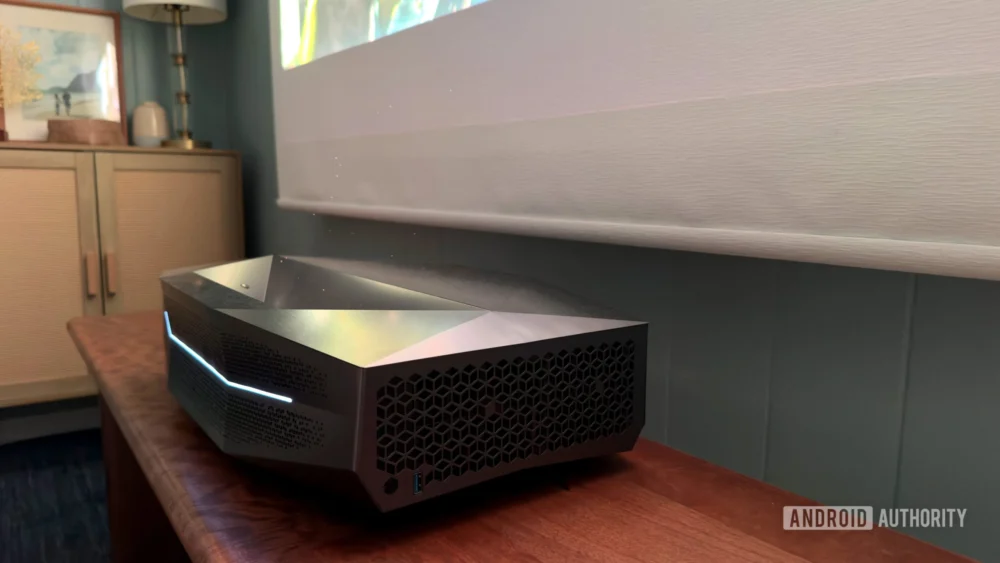
The landscape of high-fidelity home entertainment is undergoing a profound transformation, driven not by ceiling-mounted behemoths, but by the technological marvel of ultra-short-throw (UST) projection. These devices, which sit mere inches from the wall, promise the visceral impact of a cinema screen without the intrusive installation requirements of traditional projectors. However, as UST technology matures, the industry faces a fascinating paradox: the most capable projectors demand not just technological adaptation, but architectural commitment. The AWOL Vision Aetherion Max stands squarely at the apex of this trend, a premium 4K laser projector whose sheer optical prowess compels users to confront the limitations of their existing living spaces.
The Aetherion Max is engineered with an uncompromising focus on achieving cinematic perfection across immense canvases—up to 200 inches. It is a device where stability, blinding brightness from its triple-laser engine, and meticulous color fidelity are not selling points, but foundational necessities. Crucially, it integrates the fluid, familiar ecosystem of Google TV directly into its chassis. This positioning immediately signals that the Aetherion Max is not intended as a casual room accessory; it is the centerpiece for a dedicated, purpose-built media environment.
The Context of Scale: Why UST Matters
For years, the aspiration for a truly massive screen in a residential setting was either prohibitively expensive (requiring vast, dedicated infrastructure for a projector-and-screen setup) or physically cumbersome (requiring a ceiling-mounted unit with complex cabling). UST projectors emerged as the elegant solution, eliminating the need for ladders and long cable runs by employing sophisticated, near-vertical optics. The user places the unit on a low console, and the screen materializes inches away. This democratization of scale was revolutionary, bringing 100-inch diagonals into the realm of standard furniture placement.
Yet, as manufacturers push the limits of brightness and resolution in UST technology, the requirement for physical space reasserts itself. While a 100-inch image is achievable in most average rooms, maximizing the Aetherion Max’s potential—pushing toward that 150-inch or 200-inch boundary—requires significant uninterrupted wall real estate. During extensive testing, it became starkly apparent that my standard living room layout, optimized for a large flat-panel television, was fundamentally inadequate to showcase the projector’s full capabilities. The realization that a piece of AV hardware could inspire a total spatial re-evaluation—a contemplation of furniture rearrangement or even room repurposing—is the strongest endorsement of its technical excellence. For those with the requisite square footage, the Aetherion Max delivers one of the most technically refined projected images available today.
Design Language: Projecting Ambition
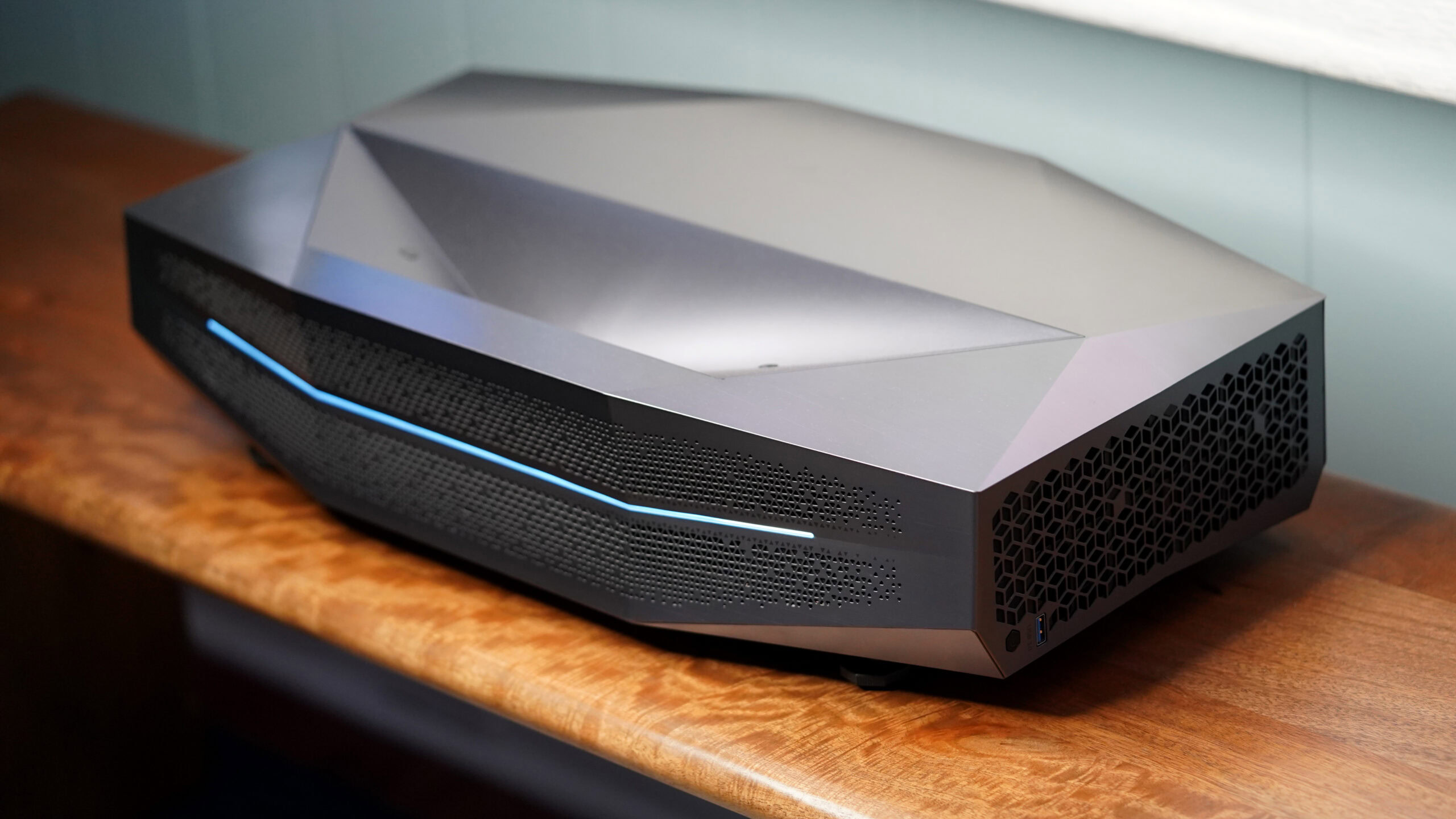
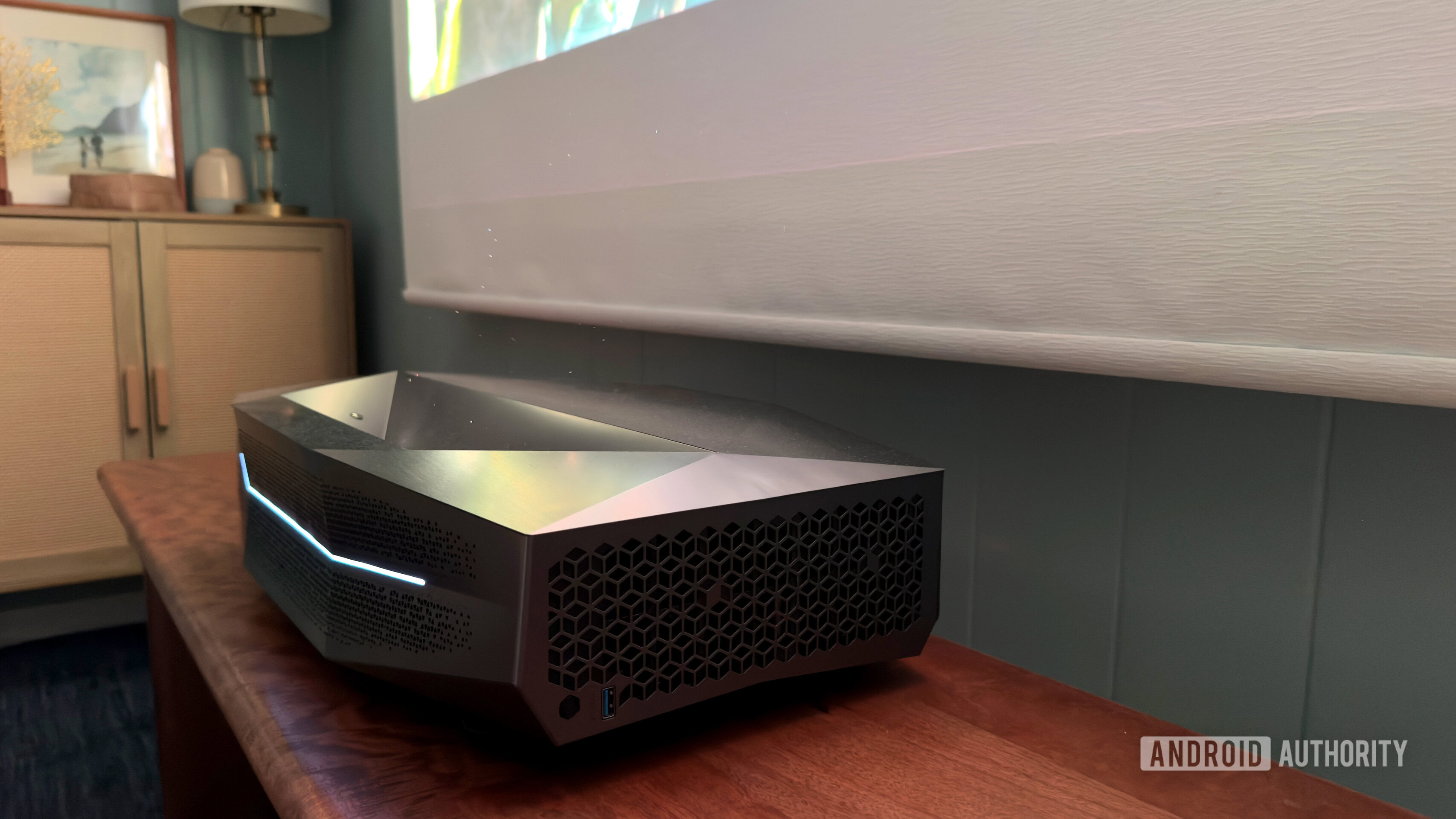
The physical manifestation of the Aetherion Max is as assertive as its performance specifications. It eschews the minimalist, easily concealed aesthetic common to many consumer electronics. Instead, its design is overtly architectural, featuring aggressive angles, layered surfaces, and a substantial footprint that evokes contemporary science fiction design—a "small spacecraft" resting near the viewing plane. This is not a device meant to blend into the background; it demands attention, aligning perfectly with its role as the focal point of an entertainment zone.

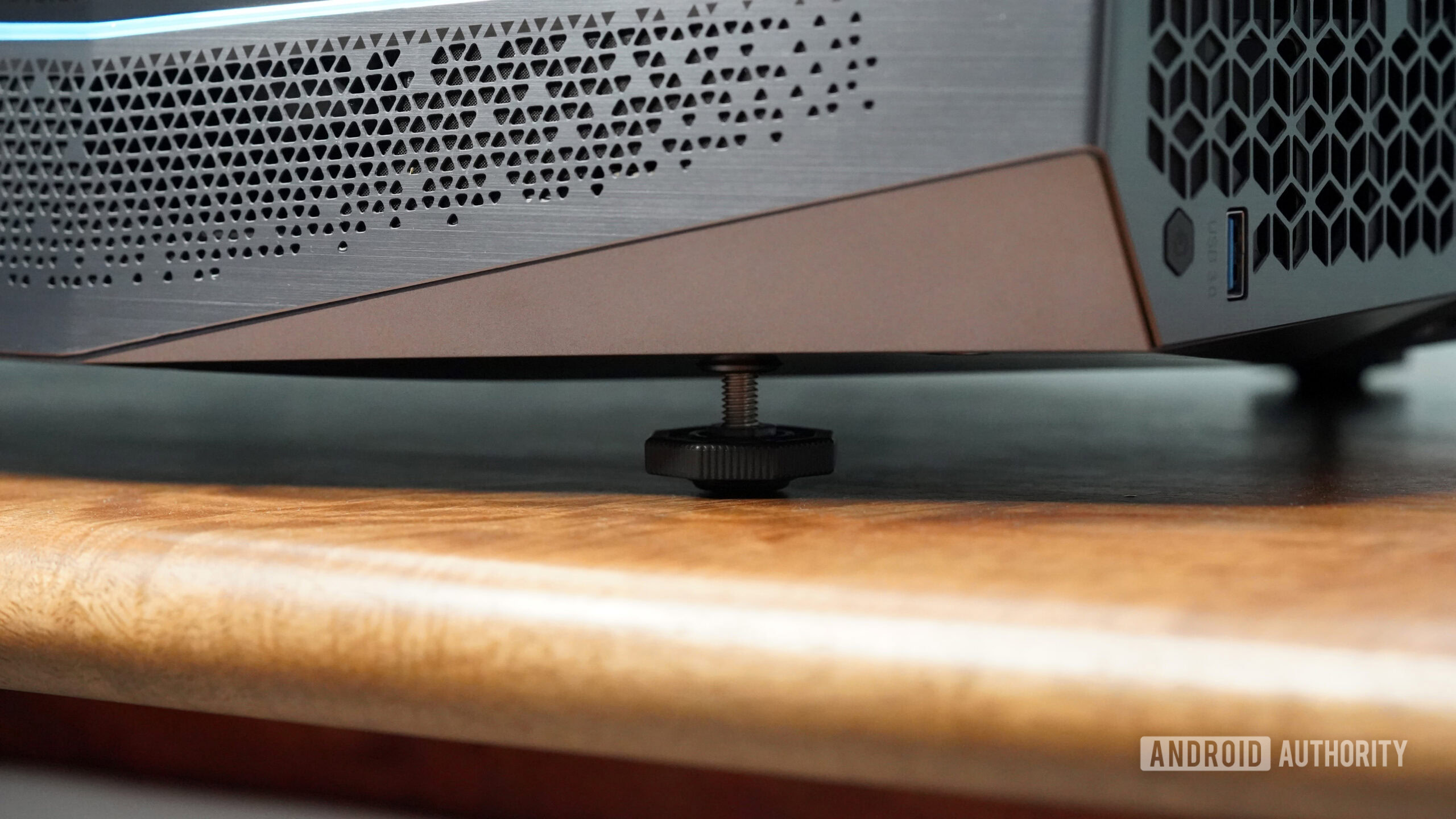
Measuring 22.13 x 12.72 x 5.49 inches and weighing a considerable 19.3 pounds, the Aetherion Max is built with the permanence of a flagship component. This weight and scale immediately disqualify it from casual portability, reinforcing its status as a permanent fixture. This robust construction is complemented by thoughtful operational features, such as the motorized lens cover that seals the optics against dust intrusion, a necessity for a device intended for daily use rather than sporadic deployment. While initial setup requires the meticulous precision inherent to UST projection—finding the exact right distance from the wall—the inclusion of finely adjustable feet aids in the critical fine-tuning process once the general location is established.
Technical Superiority: The Clarity of PixelLock
The core differentiator for the Aetherion Max lies in its ability to maintain image integrity at extreme sizes. The industry term for this challenge is "edge uniformity and pixel alignment." Standard UST projectors, while delivering sharp images at 100 or 120 inches, often suffer a visible degradation—softening edges, noticeable light fall-off, or minor geometric warping—as the image size increases past this threshold.
AWOL Vision addresses this head-on with their proprietary PixelLock technology. This system is designed to ensure that pixel-level alignment remains perfectly coherent across the entire projected surface, even when scaling up to the unit’s maximum 200-inch capacity. This is not merely a software correction; it speaks to the precision of the optical block itself. Testing this feature with fast-moving content, such as high-speed motorsport sequences (like Formula 1 broadcasts), revealed exceptional motion handling and retained sharpness across the periphery of the massive image. Equally telling were expansive, highly detailed atmospheric shots; the fine textural information remained present and distinct, rather than dissolving into a generalized glow, confirming that the projector scales gracefully rather than straining under the load.
Illumination and Color Science: Beyond Brightness
The Aetherion Max utilizes a sophisticated RGB Triple-Laser Light Engine, a critical component in achieving both high brightness and exceptional color volume. Rated at approximately 3,300 ISO lumens, the brightness is substantial enough to combat moderate ambient light conditions—a common hurdle for UST systems that often rely on near-perfect darkness. The unit performed admirably under typical living room lighting, preserving detail without washout.
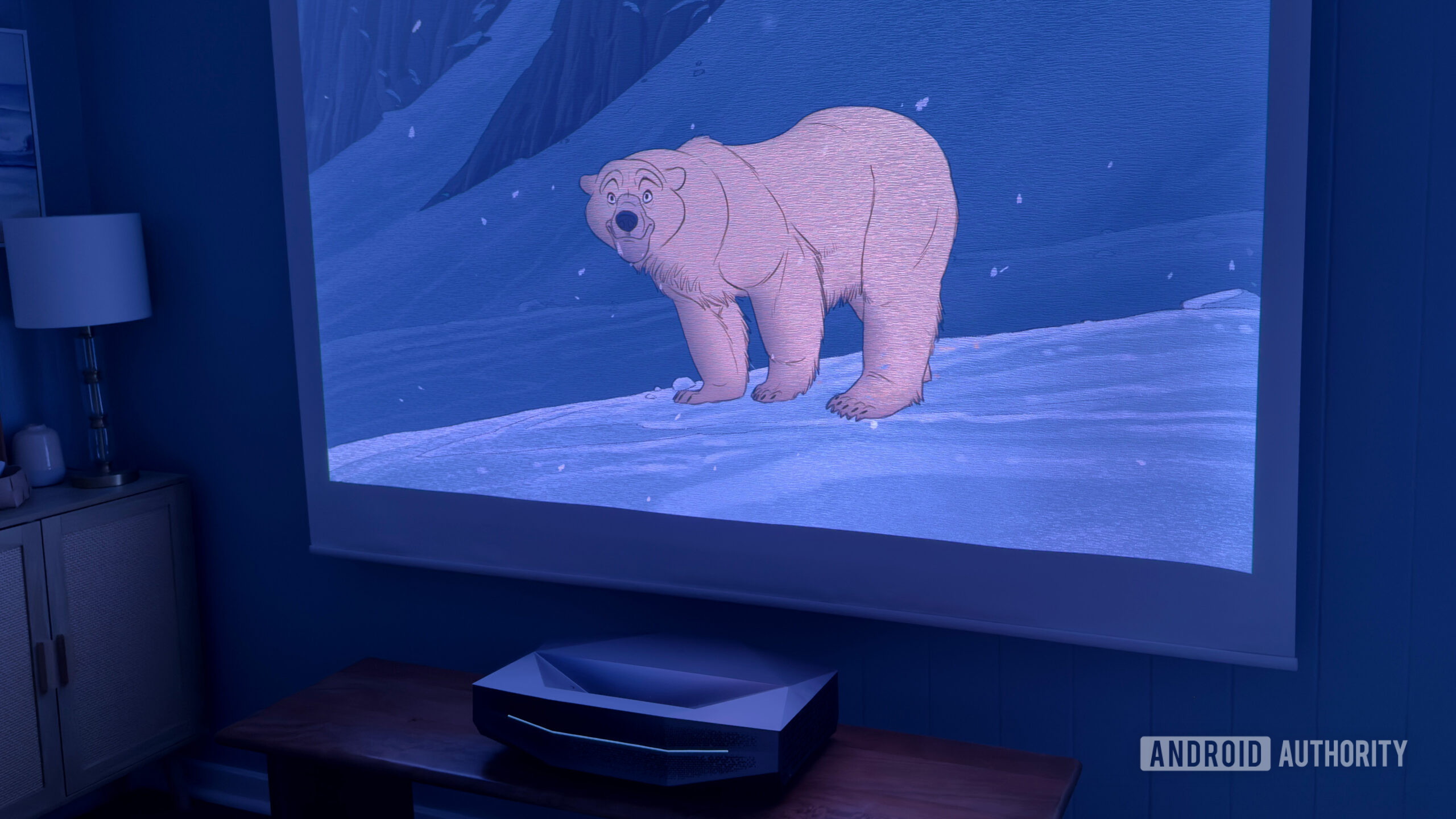
More significant than the raw lumen count is the color performance, particularly its expansive coverage of the Rec.2020 color space, reportedly reaching 110%. In premium projection, the goal is not merely saturation, but accurate saturation. The Aetherion Max demonstrates masterful control over its color palette. While many high-brightness laser projectors lean towards an aggressive over-saturation, particularly in the blues and greens, the Aetherion maintains cinematic control. Testing with visually rich, highly stylized productions (such as contemporary musicals or fantasy cinematography) confirmed this balance: saturated elements, like vibrant costumes or artificial stage lighting, retained depth and nuance without exhibiting the digital harshness or bleeding associated with lesser color management. This careful calibration ensures that HDR content—supported across Dolby Vision, HDR10+, and HLG standards—delivers impactful highlights alongside deep, well-delineated blacks, crucial for maintaining shadow detail in darker sequences.
The Smart Component: A Seamless Google TV Experience
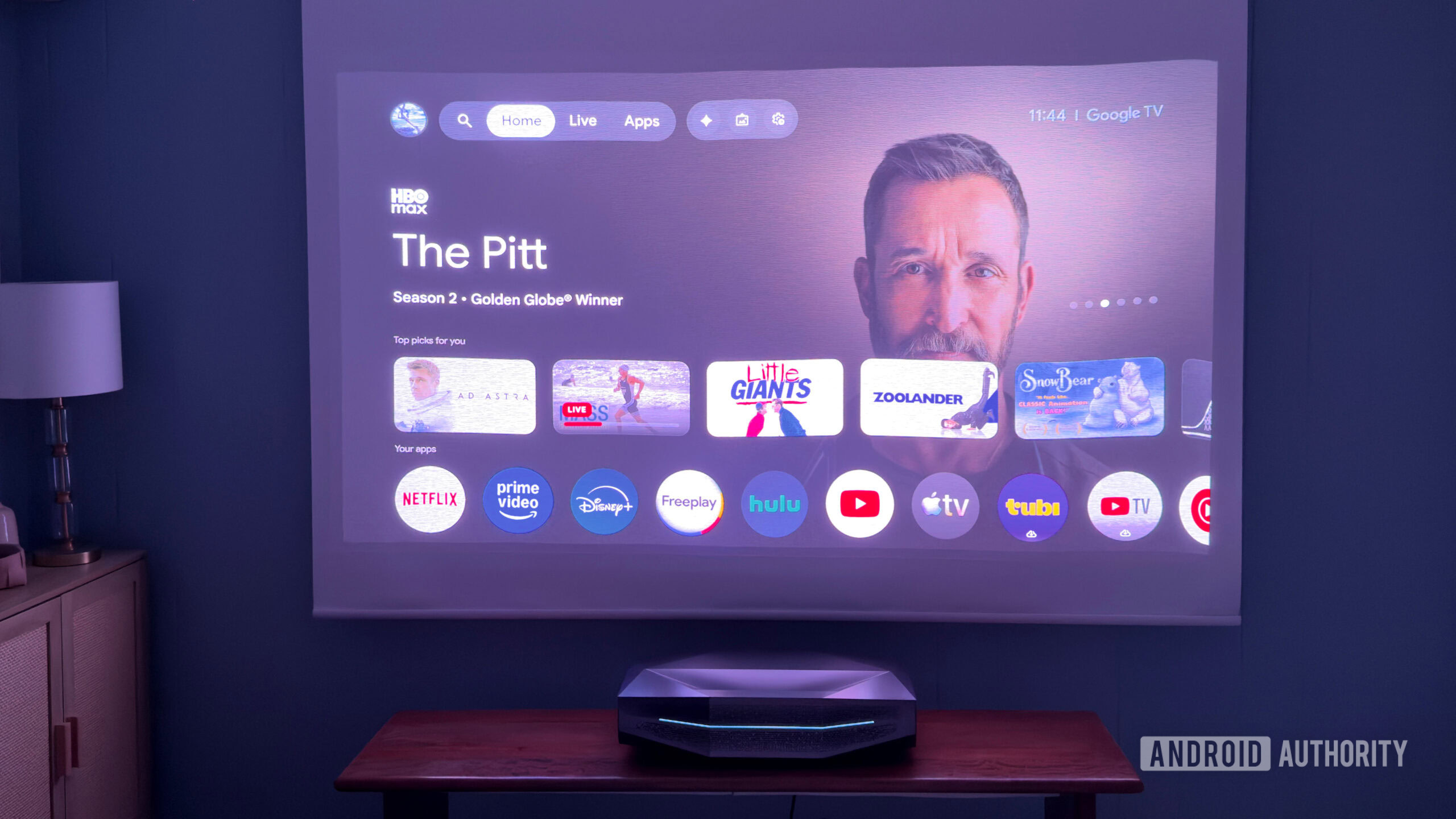
In the premium projector market, integrated operating systems are often an afterthought—a necessary evil bolted onto powerful optics. The Aetherion Max successfully sidesteps this pitfall. Its implementation of Google TV is remarkably responsive and polished. The user interface navigates with the speed and stability expected of a modern smart television, loading applications swiftly and responding instantaneously to remote inputs.
This integrated intelligence is a significant factor in justifying the unit’s physical presence. By providing a high-quality, lag-free native platform, the need for auxiliary streaming devices—which would only clutter the console beneath the projector—is eliminated. The remote control is functional, offering standard navigation and voice control, although a minor ergonomic flaw was noted in the placement of the volume rocker, which occasionally triggered unintended application launches (like Netflix) when a user intended only to adjust audio levels.
Furthermore, the connectivity suite is engineered for the modern media hub. Featuring bleeding-edge standards such as Wi-Fi 7 and Bluetooth 5.4, alongside three full-bandwidth HDMI 2.1 ports and DisplayPort support, the Aetherion Max is future-proofed for high-bandwidth sources.
Gaming Performance: Challenging the Flat-Panel Dominance
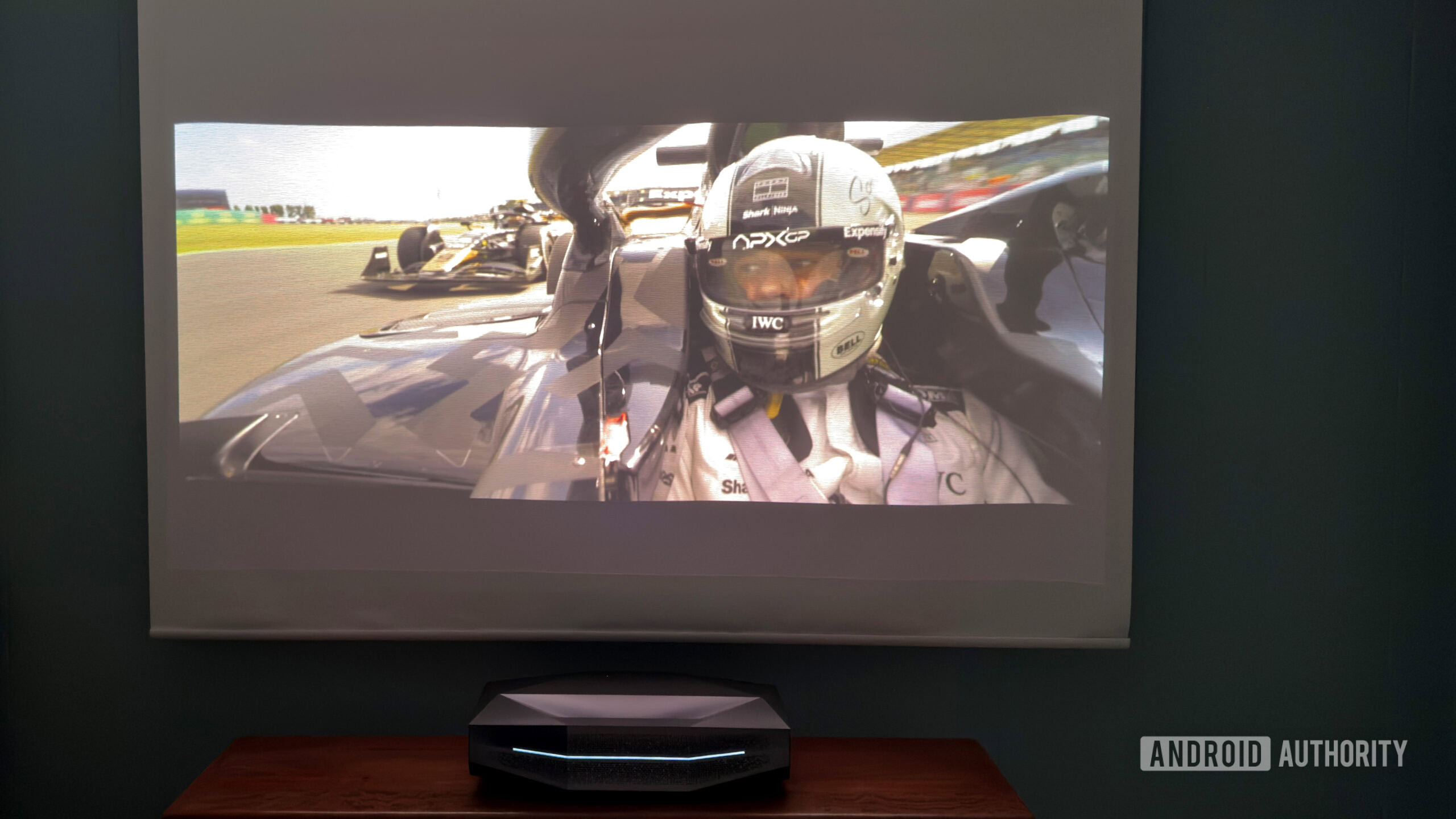
The perception that high-end projection is inherently unsuitable for competitive gaming due to latency has long been a barrier to adoption. The Aetherion Max directly confronts this bias. Its specifications include critical gaming features: Variable Refresh Rate (VRR) support, Auto Low Latency Mode (ALLM), and direct Dolby Vision Gaming compatibility. Paired with an impressive, measured low input lag, the projector offers a genuinely responsive experience. During high-frame-rate gaming sessions, the system exhibited minimal perceptible delay between controller input and on-screen action. Camera tracking remained smooth, and the large format viewing experience, usually associated with motion blur artifacts in projectors, remained sharp and immediate. This integration positions the Aetherion Max not just as a home cinema machine, but as a viable, large-format gaming display for enthusiasts who value immersion over sheer pixel response time advantage.
Industry Implications and Market Positioning
The existence and performance profile of the Aetherion Max signal several key industry shifts within the visual display sector.
Firstly, it solidifies the "TV Killer" narrative for the UST segment. As UST technology reduces the throw distance even further while increasing brightness and color accuracy (especially with native RGB lasers), the practical gap between projection and OLED/QLED televisions shrinks considerably, especially when considering diagonal size limitations for flat panels (which become exponentially more expensive beyond 98 inches). The Aetherion Max is not competing with 75-inch TVs; it’s aiming squarely at the 120-to-200-inch space that was once reserved for custom home theaters costing five to ten times as much.
Secondly, the integration of high-end smart OS platforms like Google TV suggests a trend toward "appliance-ification" of projectors. Consumers increasingly expect all-in-one solutions, reducing reliance on external dongles or media players. For a premium product, the operating system must match the optical engine in terms of speed and stability, a benchmark the Aetherion Max appears to meet effectively.
Thirdly, the pricing structure—with the Max variant commanding $4,499—places it firmly in the upper echelon of consumer AV gear. This reinforces the idea that massive-scale, high-color-volume projection is moving away from niche enthusiast territory toward a viable, albeit high-end, mainstream luxury product. The availability of a slightly de-featured ‘Pro’ model at $3,499, offering slightly lower luminance (2,600 ISO lumens), demonstrates a strategy to capture a broader segment of the affluent home cinema builder who prioritizes color fidelity and features over absolute peak brightness. The early launch via a crowdfunding platform (Kickstarter, as noted in its initial rollout) often serves as a way for companies to gauge demand and secure initial capital for high-spec, low-volume production runs, a common strategy in this emerging high-end projector space.
The Future Impact: Architectural Aspiration
The most enduring impact of a product like the Aetherion Max is its capacity to influence interior design and real estate expectations. The reviewer’s admission—that the projector made them consider redesigning their living space—is the ultimate testament to its immersive quality. As the performance gap between UST and flat panels narrows, the decision shifts from "Can I fit a projector?" to "How large a wall can I dedicate to the experience?"
We anticipate a future where dedicated media rooms become more common, even in standard residential builds, specifically designed around the projection surface and the optimal placement for a UST unit. This requires rethinking ambient light control, wall finishes (to maximize light reflectance, even with high-lumen units), and furniture placement relative to the projection plane. The Aetherion Max acts as a catalyst, proving that the visual payoff justifies the spatial investment. Its technical stability at 200 inches suggests that the next frontier for home displays may not be measured in pixel density, but in sheer, uninterrupted surface area.
Final Assessment: A Focused Masterpiece
The AWOL Vision Aetherion Max is not a compromise product; it is an uncompromising statement. It is built for the enthusiast who has already mentally committed to a large-scale display solution or is actively planning the architecture to support it. While its sheer physical size and premium price tag make it unsuitable for small apartments or casual use, for those operating in the realm of dedicated home theater design, the Aetherion Max delivers on its core promise: unparalleled image sharpness that defies the scaling limitations of its competitors, vibrant yet controlled color reproduction thanks to the triple-laser system, and a fully modern smart ecosystem. The technical execution is superb, offering a viewing experience that genuinely competes with dedicated cinema installations, provided the user can meet its substantial spatial demands. It stands as a benchmark for what ultra-short-throw technology can achieve when engineered without reservation.