

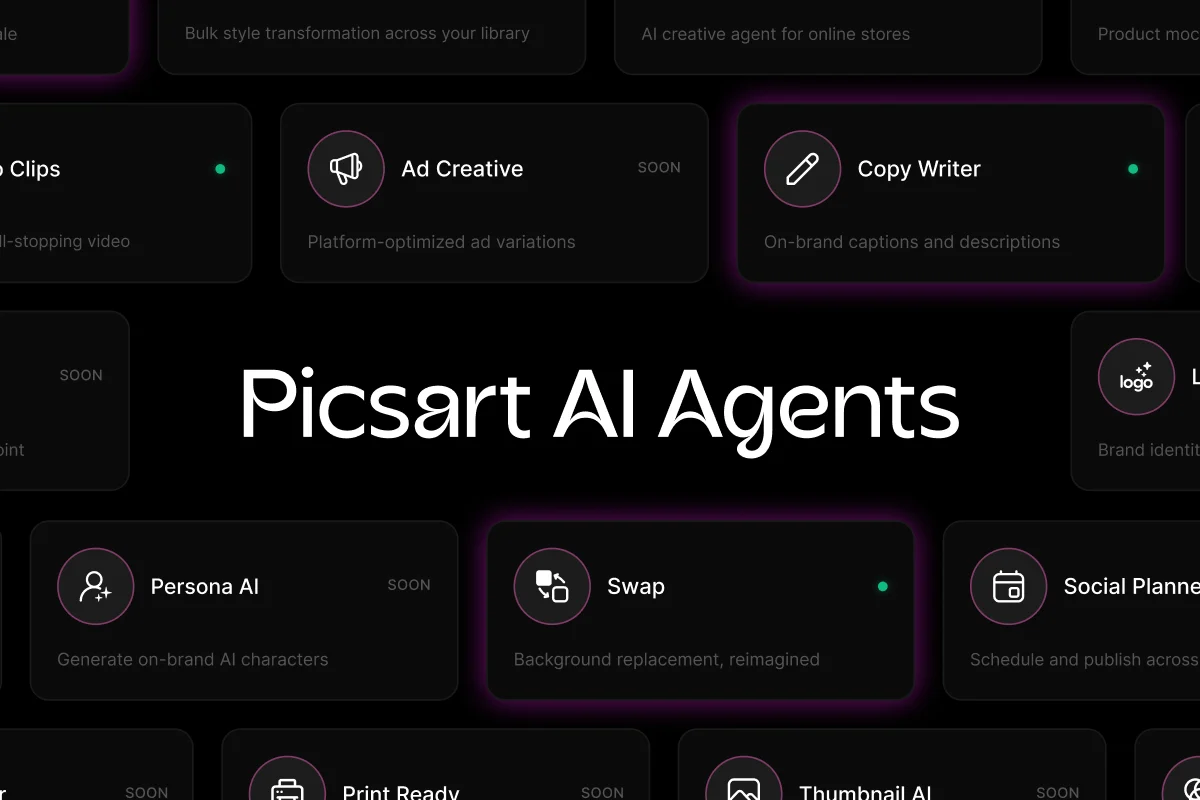
The landscape of digital creation is undergoing a seismic shift, moving away from tools that require manual precision toward autonomous systems that prioritize strategic intent. At the forefront of this transition is Picsart, the AI-driven design powerhouse, which has officially unveiled a dedicated AI agent marketplace. This move allows its massive global user base to effectively "hire" specialized digital assistants designed to handle the granular, often tedious tasks that have traditionally bogged down the creative process. By introducing these agents, Picsart is not merely adding new features to an existing toolkit; it is fundamentally reimagining the role of the creator from a manual operator to a high-level creative director.
For years, the creative economy has been defined by the "operator" model. Whether it was a social media manager meticulously resizing assets for five different platforms or a Shopify merchant struggling to ensure product photos looked cohesive across a digital storefront, the creator was the primary engine of execution. Hovhannes Avoyan, the founder and CEO of Picsart, notes that creators have historically been trapped in the "doing" rather than the "deciding." The launch of the Agent Marketplace aims to invert this relationship. In this new paradigm, the human provides the vision and direction, while the AI agent constructs a plan, processes real-time data, and executes the heavy lifting upon approval.
The Evolution of the Picsart Ecosystem
To understand the significance of this launch, one must look at Picsart’s trajectory within the broader tech ecosystem. With over 130 million monthly active users—a demographic that skews heavily toward Gen Z—Picsart has carved out a niche as a more agile, mobile-first alternative to legacy software like Adobe Creative Cloud or even the more structured Canva. Having reached unicorn status during the 2021 creator economy surge, the company has managed to maintain its relevance by aggressively pivoting toward generative AI.
The timing of this marketplace launch is particularly strategic. The tech industry is currently obsessed with "agentic AI"—chatbots and systems that don’t just answer questions but perform multi-step tasks. While early generative AI was focused on "prompt-to-image" or "prompt-to-text" outputs, the current wave, exemplified by projects like OpenClaw, focuses on "prompt-to-action." Picsart is capitalizing on this trend by productizing agency, allowing users to delegate specific workflows to specialized AI models.
A Closer Look at the Specialized Workforce
At launch, the marketplace features four distinct agents, each tailored to a specific pain point in the modern content lifecycle. While the company promises a weekly rollout of new specialized agents, the inaugural quartet—Flair, Resize Pro, Remix, and Swap—provides a clear blueprint for how Picsart envisions the future of work.

Flair: The E-commerce Strategist
Perhaps the most sophisticated agent in the initial lineup is Flair. Designed specifically for the e-commerce sector, Flair integrates directly with Shopify. It functions less like a photo editor and more like a brand consultant. By analyzing market trends and the specific visual language of a merchant’s store, Flair can suggest improvements to product imagery to drive better conversion rates. Future iterations of Flair are expected to handle A/B testing autonomously, identifying which product photos are underperforming and proactively offering edited alternatives to boost sales. This represents a significant leap from passive software to proactive business intelligence.
Resize Pro: Beyond Simple Cropping
The problem of platform-specific dimensions is as old as social media itself. However, Resize Pro approaches this challenge through the lens of generative expansion. Rather than simply cropping an image and losing valuable visual data, Resize Pro uses AI to "outpaint" or extend the frame. This ensures that a photo originally shot in landscape for a website can be transformed into a vertical 9:16 format for TikTok or Instagram Reels without looking distorted or poorly framed. The agent ensures the composition feels intentional, maintaining the integrity of the original creative vision.
Remix and Swap: Bulk Creative Direction
The Remix agent allows creators to apply complex stylistic themes—such as "vintage film," "cyberpunk," or "watercolor"—across entire libraries of content. This ensures brand consistency across a high volume of posts. Similarly, the Swap agent automates the background removal and replacement process in bulk. For a creator managing hundreds of assets, these agents turn hours of manual clicking into a few minutes of oversight.
The Rise of Asynchronous Creativity
One of the most innovative aspects of Picsart’s approach is the integration with external messaging platforms like WhatsApp and Telegram. By utilizing the APIs of these ubiquitous apps, Picsart allows creators to interact with their AI agents in the same way they would a human assistant.
This move acknowledges the reality of the modern "hustle economy," where work doesn’t just happen at a desk. A creator can send a batch of photos to the Flair agent via a WhatsApp message while on the subway, review the agent’s suggested edits on their phone, and approve the plan for immediate execution. This asynchronous workflow breaks the tether between the creator and the creative software, allowing the AI to work in the background while the human focuses on other high-value tasks.
Navigating the Risks of Autonomy
The transition to agentic AI is not without its hurdles. The tech industry is currently grappling with the "hallucination" problem—the tendency for Large Language Models (LLMs) to generate confident but incorrect or nonsensical information. In a creative context, an agent might "hallucinate" an unwanted element into a product photo or misinterpret a stylistic prompt, potentially damaging a brand’s reputation.

To mitigate these risks, Picsart has introduced "autonomy levels." This feature gives users granular control over how much independence an agent has. A creator can set an agent to "Manual Approval," where no action is taken without a final sign-off, or "High Autonomy," where the agent handles routine tasks with minimal intervention. Furthermore, by keeping these agents within a controlled ecosystem, Picsart aims to shield them from "prompt injection attacks," a security vulnerability where malicious users attempt to hijack an AI’s logic through clever phrasing.
The Broader Industry Implication: The End of "SaaS" as We Know It?
Picsart’s move reflects a broader trend in the software-as-a-service (SaaS) industry: the shift from "Software as a Tool" to "Software as a Service-Provider." In the old model, you paid for access to the hammer; in the new model, you pay for the house to be built.
Competitors like Canva and Adobe are also racing to integrate agentic features, but Picsart’s focus on a marketplace of specialized agents suggests a move toward a "gig economy" for AI. Just as a business might hire a freelancer on Upwork for a specific task, Picsart users can now "hire" an agent for a specific workflow. This democratization of agency is particularly impactful for small-to-medium enterprises (SMEs) that lack the budget for a full-time design team but require professional-grade output to compete in a visually-driven digital economy.
Economic Accessibility and the Subscription Model
Picsart is positioning these agents as a premium value-add. While the platform maintains a freemium model with a limited number of AI credits, the full utility of the Agent Marketplace is designed to drive users toward its paid tiers, which typically start around $10 per month when billed annually. For a solo entrepreneur, the cost-benefit analysis is compelling: for the price of two cups of coffee, they gain access to a suite of digital assistants that can perform the work of a junior designer or social media coordinator.
Conclusion: The Future of the Creative Director
As Picsart continues to roll out more specialized agents, the definition of "creativity" will likely continue to evolve. The value of a creator will no longer be measured by their technical proficiency with a brush tool or a timeline, but by their ability to orchestrate a team of AI agents to achieve a cohesive vision.
The launch of the Agent Marketplace is a clear signal that the era of manual content production is waning. In its place, we are seeing the rise of a more strategic, high-level form of creation where the human provides the soul and the strategy, and the AI provides the scale and the speed. For the 130 million users on Picsart, the message is clear: don’t just be the artist; be the agency.