

The catalyst for Selina Tobaccowala’s pivot into climate technology was not a complex government mandate or a detailed scientific report, but rather a series of handwritten missives left by her daughter. These simple, yet insistent, post-it notes urging family members to conserve energy—to "turn off the lights" and reduce waste—sparked a critical realization for the veteran Silicon Valley executive. Having recently completed the sale of her previous venture, Gixo, to OpenFit, Tobaccowala was seeking a formidable new challenge. She recognized the profound urgency of the climate crisis but understood that mere behavioral changes, such as manually switching off lamps, were insufficient. There had to be a systemic, scalable solution to address residential energy waste, a sector notoriously resistant to change due to complexity and expense.
“I saw the kids and thought, ‘Let me see if there’s something there on the sustainability and climate side,’” Tobaccowala recounted. “There had to be something more than like turning our lights off.”
Lacking a deep background in climate science or specialized hardware engineering, Tobaccowala leveraged her core expertise: understanding user friction through data. As the former president and CTO of SurveyMonkey, she possessed an innate ability to design and execute large-scale consumer research. She embarked on a deep surveying effort, interviewing extensive cohorts of homeowners to diagnose the precise pain points related to energy consumption.
What emerged clearly from this rigorous market investigation was a profound gap between awareness and action. Consumers were keenly aware that their utility bills were too high, often receiving frustrating, generalized reports comparing their usage unfavorably to that of their neighbors. This standard utility communication effectively raised an alarm but failed completely in providing actionable, localized solutions. Homeowners were left in a state of analytical paralysis, receiving warnings without the diagnostic tools necessary to understand why they were overspending and how to effectively remedy the situation.
This systemic friction led Tobaccowala to co-found HomeBoost, a company designed to democratize the home energy assessment process. HomeBoost aims to place the power of professional-grade auditing tools directly into the hands of the consumer, transforming a traditionally expensive, opaque, and often intrusive service into a streamlined, cost-effective, self-guided experience. The company’s innovative approach and potential for industry disruption earned it a coveted spot among the Startup Battlefield 200 cohort at TechCrunch Disrupt 2025.
The HomeBoost Mechanism: DIY Thermography
The core of the HomeBoost solution is the "BoostBox," a compact, user-friendly kit mailed directly to the customer. This kit contains the essential diagnostic hardware: a specialized infrared (IR) thermal camera and a blacklight (UV) flashlight, paired with a sophisticated mobile application. The application guides the homeowner through a structured, room-by-room audit, transforming the process into an accessible, interactive survey.
The use of thermography is central to the platform’s efficacy. As the homeowner scans the interior walls, windows, and structural components of their residence, the IR camera reveals immediate, visual evidence of the building’s envelope integrity. Cold air intrusion (or hot air leakage) is rendered visible as distinct color gradients on the screen, instantly identifying critical thermal bridges, insulation deficiencies, and structural gaps—issues that represent the vast majority of energy waste in older homes. Simultaneously, the blacklight aids in identifying which existing light fixtures utilize inefficient bulb technology, prompting upgrades to modern LEDs.
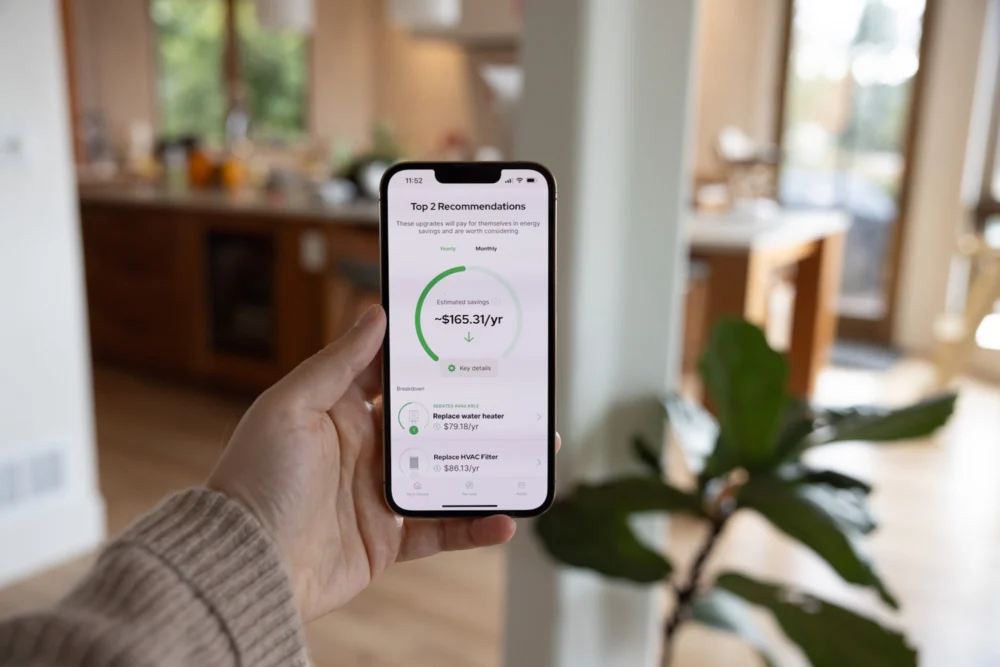
Upon completion of the guided scans, the application aggregates the raw data captured by the peripherals, cross-references it with local climate data, the home’s specific utility profile, and known construction standards. Utilizing advanced algorithms, the app automatically generates a prioritized, bespoke report. Crucially, this report transcends simple diagnostics. It outlines the most cost-effective and highest-impact upgrade recommendations, ranging from simple weather-stripping to comprehensive insulation projects. Furthermore, the application integrates a dynamic database of localized incentives and rebates, ensuring that recommended actions are immediately linked to available financial assistance based on the homeowner’s geographical location and specific utility provider.
Background Context: The Flaws of the Traditional Audit
To fully appreciate HomeBoost’s disruptive potential, one must examine the entrenched inefficiencies of the incumbent energy audit market. For decades, utilities across the United States have been mandated or incentivized (through mechanisms like demand-side management programs) to encourage energy reduction among end-users. Their primary mechanism for achieving this has been the traditional, in-person professional energy audit.
While theoretically sound, the execution of these traditional audits is often characterized by high cost, variability in quality, and significant consumer skepticism. A comprehensive, professional blower-door test and thermal scan typically costs between $400 and $800, often requiring several hours of on-site time. Even when subsidized by utilities, the process remains cumbersome and often yields inconsistent results.
A major finding from Tobaccowala’s initial consumer surveys highlighted a deeper systemic issue: trust. “We talked to a bunch of consumers who’d gotten home energy assessments done, and there this feeling that was like, ‘all they did was try to sell me up an upgraded HVAC,’” she explained. This perception of audits being thinly veiled sales consultations for high-ticket items (like new heating, ventilation, and air conditioning systems) significantly reduces consumer engagement and follow-through on minor, yet highly impactful, remediation steps.
HomeBoost addresses this friction by prioritizing independence and empowerment. By charging only $99—approximately one-quarter the cost of a basic in-person assessment—and placing the diagnostic control directly with the resident, the platform accelerates the time-to-diagnosis and cultivates a sense of ownership over the resulting actions.
Industry Implications and Strategic Utility Partnerships
HomeBoost’s business model is strategically positioned at the nexus of consumer technology and regulated energy infrastructure. Its affordability and speed—being faster and significantly cheaper than a human auditor—make it highly appealing not just to individual homeowners, but to the utility sector itself.

Utilities, which are regulated entities incentivized to decrease peak energy demand and overall consumption, view HomeBoost as a scalable, high-volume tool for achieving regulatory compliance and minimizing infrastructure strain. Instead of dispatching expensive, time-consuming auditors, they can leverage HomeBoost’s platform to engage thousands of customers simultaneously.
This alignment of incentives has resulted in crucial partnership agreements. HomeBoost has secured deals with major providers, including Central Hudson, Omaha Public Power District (OPPD), and Avista. These utilities are often willing to subsidize the assessment kit heavily or entirely. For example, OPPD covers all but $19 of the cost for its customers, while Central Hudson has pioneered an innovative partnership allowing homeowners to check out the BoostBox kit entirely free of charge from local public libraries—a move that effectively integrates energy efficiency tools into the public infrastructure, much like books or media.
This library model is a compelling example of behavioral economics applied to energy conservation. It removes the monetary barrier entirely and positions the energy assessment as a civic resource, minimizing the psychological cost of adoption and maximizing accessibility, particularly for low-to-moderate-income households where utility savings are most critical.
Expert Analysis: Scaling Auditing and Data Aggregation
While the self-service model offers unprecedented scale, it is crucial to recognize the limitations of consumer-driven data capture compared to a highly trained professional auditor who might spend two to ten hours meticulously analyzing a structure. The complexity of air flow dynamics, duct leakage, and combustion safety often requires specialized expertise and equipment that a DIY kit cannot fully replicate.
HomeBoost recognizes this duality. For the segment of the market that demands professional depth, or for auditors facing increasingly high demands, the company has developed a dedicated version of its application tailored for energy professionals. This professional platform enhances the auditor’s efficiency by automating data collation and report generation, allowing them to serve a larger volume of clients without sacrificing the rigor of their inspection. This strategy ensures that HomeBoost acts not merely as a replacement for auditors, but as an essential technological augment, increasing the velocity and standardization of professional assessments.
More significant than the individual assessment is the potential for large-scale data aggregation. Every BoostBox scan contributes to a growing, granular database of residential thermal performance across diverse climates and building types. This crowdsourced thermographic data, combined with machine learning models, offers unprecedented insight into localized energy inefficiency patterns.
This level of data granularity allows HomeBoost, and its utility partners, to transition from reactive auditing to predictive modeling. For instance, if the platform identifies that 80% of homes built in a specific ZIP code between 1980 and 1995 suffer from chronic attic bypass leakage, utilities can preemptively target those areas with specific, highly relevant rebate programs for air sealing, maximizing the return on investment for efficiency incentives. This moves the industry beyond generic efficiency advice to highly targeted, data-driven retrofitting strategies.
Future Impact and Trends: Building the Energy Ecosystem
HomeBoost is not content merely to diagnose problems; its long-term strategy involves closing the loop between identification and remediation. The company is actively testing a critical feature: linking homeowners directly with vetted, qualified contractors capable of executing the upgrades outlined in the assessment report.
This linkage feature transforms HomeBoost into a comprehensive three-sided marketplace: connecting Consumers seeking savings, Utilities needing verifiable efficiency gains, and Contractors requiring a consistent stream of qualified leads. For contractors, this provides a powerful business advantage: they receive detailed, pre-assessed project information (including thermographic data and a prioritized list of interventions) before ever setting foot on the property. This eliminates costly initial consultation time and allows contractors to bid more accurately and efficiently.
This integrated ecosystem approach promises to accelerate the rate of residential retrofitting—a critical necessity in mitigating climate change. The residential sector accounts for a significant portion of global energy consumption, and improving the energy efficiency of existing housing stock is arguably one of the fastest and most cost-effective methods of reducing carbon emissions.
By creating an environment where consumers are empowered, utilities are subsidized, and contractors are streamlined, HomeBoost aligns traditionally disparate economic forces toward a common, measurable goal.
“It’s a very unique situation where everybody’s aligned to actually lower the utility bill, which in the net result is improvement on the climate,” Tobaccowala concluded.
The transition from a simple parental concern about wasted electricity to a sophisticated, subsidized technology platform exemplifies the future of climate tech: leveraging high-tech tools and behavioral design to make climate action financially compelling and logistically simple for the average homeowner. As energy costs continue to climb and the imperative for climate action intensifies, decentralized, data-driven solutions like HomeBoost are poised to become indispensable tools in the global effort to redefine the energy efficiency of the built environment. This democratization of professional diagnostics represents a fundamental shift in how residential energy waste is managed, promising not just lower utility bills, but a genuine, scalable impact on global carbon footprints.