

Ethereal Exploration Guild, operating under the simplified moniker EtherealX, has dramatically escalated its presence in the global launch sector, confirming an oversubscribed Series A funding round that catapults its valuation by 550% to $80.5 million. This substantial capital infusion arrives as the Bengaluru-based space technology innovator prepares to initiate critical hot-fire tests for the proprietary engines driving its ambitious, fully reusable launch architecture. The rapid financial growth, coming less than two years after a $5 million seed round in August 2024 which pegged the company’s value at $14.6 million, signals strong investor confidence in EtherealX’s ability to master the complex engineering challenges associated with deep space vehicle reusability.
The $20.5 million Series A was anchored by significant commitments from TDK Ventures and BIG Capital, demonstrating a cross-sector investment thesis focused on disruptive industrial technology. The round saw broad participation from major venture capital entities, including Accel, Prosus, YourNest, BlueHill, Campus Fund, and Riceberg Ventures. This confluence of investors underscores the increasing maturity and strategic importance of India’s private space ecosystem, which is rapidly evolving from a nascent market into a global competitor capable of attracting high-profile international funding.
The Strategic Imperative: India’s Space Liberalization
EtherealX’s momentum is inseparable from the broader strategic goals of the Indian state. Historically dominated by the Indian Space Research Organisation (ISRO), the nation’s space sector has undergone profound liberalization since 2020, aiming to leverage private innovation to meet aggressive economic targets. The government’s vision is to grow India’s space economy from approximately $8 billion currently to a commanding $45 billion within the next decade. Achieving this scale requires moving beyond traditional government-led missions and component contracts to establishing robust, cost-effective commercial launch capabilities that can serve the burgeoning global satellite market.
In this context, EtherealX represents a vanguard of the new Indian aerospace industry, directly addressing the launch bottleneck that has intensified worldwide. Satellite operators, particularly those deploying large low-Earth orbit (LEO) constellations, demand high cadence, predictable scheduling, and, most critically, lower per-kilogram pricing—a benchmark firmly established by SpaceX’s partially reusable Falcon 9. EtherealX is not merely seeking parity with the Falcon 9 model but aiming to surpass it by designing a vehicle capable of recovering both the booster (first stage) and the upper stage.
Technical Prowess: Mastering Deep Reusability
The company’s flagship vehicle, the medium-lift Razor Crest Mk-1, is designed around this principle of complete vehicle reuse. This engineering approach is exponentially more complex than recovering only the first stage, as it necessitates precision atmospheric re-entry and landing systems for the upper stage, which typically carries less mass margin for propellant and complex maneuvering hardware.
To achieve this, EtherealX has focused its resources on developing two highly specialized liquid-propellant engines in-house:
- The Stallion Booster Engine: Rated at 1.2 meganewtons (MN) of thrust, the Stallion engine provides the immense lifting force required for the first stage. This class of thrust places the vehicle firmly in the medium-lift category. The Stallion utilizes a gas-generator cycle, a mature and reliable engine architecture where a small amount of propellant is combusted in a preburner to drive the turbopumps before being exhausted. It delivers 306 seconds of sea-level specific impulse (Isp), a crucial measure of propellant efficiency.
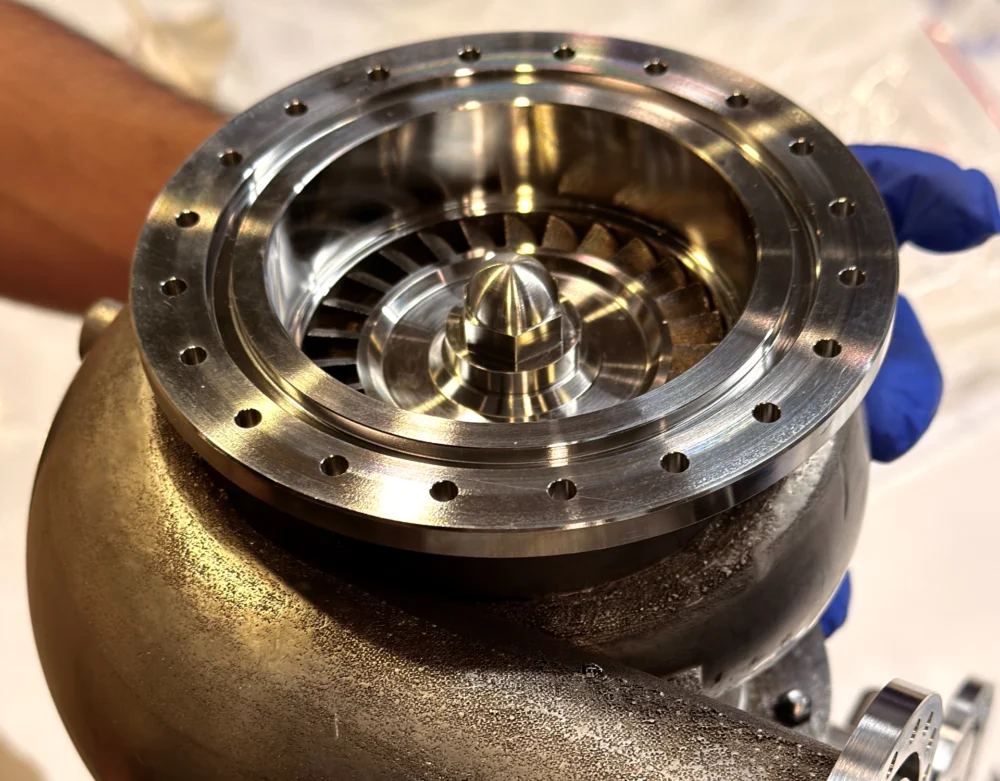
- The Pegasus Upper-Stage Engine: This engine is designed for high-performance operation in the vacuum of space, generating 80 kilonewtons (kN) of thrust. Its technical specifications are particularly advanced, featuring a vacuum-specific impulse of 323 seconds. Crucially, EtherealX has incorporated what it terms a proprietary “full-flow segregated cooling cycle.” This advanced thermal management system—a design characteristic typically reserved for state-of-the-art propulsion systems—aims to maximize performance and longevity, critical factors for a reusable upper stage. Furthermore, the Pegasus engine integrates an in-house additively manufactured (AM) turbopump, showcasing the startup’s commitment to leveraging modern manufacturing techniques for rapid prototyping, reduced weight, and improved component reliability.
The immediate goal for the newly secured funding is to execute the critical hot-fire tests for both engine types, targeted for the June-July timeframe. This testing phase will focus on completing the flight qualification of the Stallion booster engine and, more challengingly, conducting clustered-firing tests of the Pegasus engines. The Razor Crest Mk-1 is designed to maximize lift capabilities through engine clustering: the booster stage will employ nine Stallion engines, while the upper stage will be powered by a formidable cluster of 15 Pegasus engines.
Engine clustering introduces significant complexity in terms of throttling, structural load management, and synchronization, but it is necessary to achieve the desired payload capacity while maintaining reusability margins.
Payload and Pricing Disruption
The efficiency of a launch vehicle is often measured by its payload capacity in different recovery configurations. EtherealX has provided clear performance targets for the Razor Crest Mk-1:
- Expendable Configuration: Up to 24.8 metric tonnes (tonnes) to LEO.
- Partially Reusable Configuration (Booster recovery only): 22.8 tonnes.
- Fully Reusable Configuration (Booster and Upper Stage recovery): Approximately 8 tonnes.
While the fully reusable payload capacity of 8 tonnes is significantly lower than the expendable mode, the economic advantage derived from avoiding the manufacturing cost of a new upper stage for every mission is transformative. This deeper level of reusability, if successfully operationalized, allows EtherealX to target aggressive pricing tiers that could fundamentally reshape the global launch market. Co-founder and CEO Manu J. Nair indicated that the company aims for pricing between $350 and $2,000 per kilogram over time, depending on the mission configuration and launch cadence.
A pricing floor of $350/kg is highly disruptive, placing EtherealX’s future pricing targets well below current industry averages for medium-lift vehicles. For context, even the highly optimized Falcon 9, which recovers only its first stage, operates at prices generally above $2,000/kg (though ride-share options can lower this). Successfully meeting the $350/kg target would not only undercut most current competitors but would also unlock entirely new classes of commercial and research missions previously deemed too expensive.

Industry Implications: The Reusability Arms Race
The global space industry is currently locked in a fierce "reusability arms race," spurred by the paradigm shift initiated by private ventures. While many companies are developing small- and medium-lift launchers, only a handful are tackling the engineering behemoth of full reusability. By aiming to recover the upper stage—the component that achieves orbital velocity and is traditionally the most difficult to bring back—EtherealX is positioning itself alongside a small, elite group of innovators, most notably Starship developers.
Expert-level analysis suggests that the true cost savings in orbital launch are unlocked by reusing the upper stage, as this component is subject to the most extreme thermal and velocity stresses, making it structurally complex and costly to manufacture. If EtherealX can prove the reliability and turnaround time necessary for this deep reusability, the implications for launch cadence are profound.
The ability to reuse both stages significantly reduces the reliance on internal manufacturing throughput, allowing the company to sustain a high launch frequency without the prerequisite of a massive, captive satellite constellation (like Starlink) to guarantee manifest volume. This flexibility is immensely attractive to third-party satellite operators who are currently reliant on shared manifests and often face delays due to the operational rigidities of single-use or partially reusable systems.
Moreover, the success of EtherealX will validate India’s capability to generate world-class, proprietary propulsion technology. The decision to use a custom, additively manufactured turbopump and the sophisticated full-flow segregated cooling cycle on the Pegasus engine suggests a design philosophy prioritizing high performance and future scalability over immediate cost minimization using off-the-shelf components. This strategic technological depth is what attracts sophisticated investors like TDK Ventures, who focus on the foundational hardware underlying global tech trends.
Operational Roadmap and Market Validation
EtherealX is meticulously laying the physical and commercial groundwork necessary for its aggressive timeline. The company currently operates Base 001 in the southern state of Tamil Nadu, a rocket engine test site dedicated primarily to the qualification of the Pegasus upper-stage engine.
To scale operations, the startup has secured a sprawling 150-acre manufacturing and testing campus within Andhra Pradesh’s designated "space city." This larger facility is scheduled to become operational by mid-2026 and will be the hub for integrated engine and stage testing, crucial steps before assembling the final flight hardware. The expansion of the workforce, planned to grow from 67 personnel to approximately 90 over the next two months, directly supports this ramp-up in manufacturing capacity and testing cadence.
The company is targeting a late 2027 launch window (November–December) for its maiden technology demonstration flight. This demonstration will be critical for validating the complex atmospheric re-entry and landing systems required for stage recovery. Following successful demonstration, commercial missions are anticipated to commence toward the end of 2028.
Crucially, EtherealX has already secured substantial commercial validation in the form of launch memoranda of understanding (MOUs) totaling around $130 million. These agreements include commitments from international partners such as Japan’s launch broker SpaceBD and Taiwan’s national space agency, TASA. These early non-binding commitments are vital, demonstrating that global customers are willing to bet on EtherealX’s long-term technical promises, offering a degree of market security ahead of the first orbital flight.
Future Impact and Trends
The trajectory of EtherealX is indicative of two major trends shaping the future of space access: the rise of sovereign private space capabilities outside traditional Western nations, and the irreversible shift toward maximizing reusability.
If EtherealX succeeds in its goal of fielding a reliably and deeply reusable medium-lift vehicle by the close of the decade, it will cement India’s position as a major competitive force in the global launch services market. This success will not only drive down costs for Indian government and private missions but will also provide a robust alternative for international customers seeking launch flexibility away from the dominant providers. The subsequent investment surge into India’s space tech sector would be transformative, accelerating the nation’s journey toward the $45 billion space economy goal.
However, the path to orbit remains fraught with technical and financial risk. Propulsion development, especially involving highly efficient cycles like the Pegasus engine’s proprietary cooling system, is capital-intensive and subject to high rates of failure during initial qualification. The ability of EtherealX to successfully transition from ground testing to flight qualification for the high-thrust Stallion engine and the complex clustered Pegasus array will be the ultimate determinant of its success.
The $80.5 million valuation reflects a belief that EtherealX has navigated the initial "valley of death" in startup aerospace—the transition from design concept to hardware fabrication and initial testing. The coming 18 months, dominated by the engine qualification campaign and the build-out of the Andhra Pradesh campus, will determine whether the company can transform its aggressive technical roadmap and impressive financial backing into operational reality, setting a new global standard for cost-effective access to space.