

The firefighting industry, a critical pillar of public safety infrastructure, has historically been characterized by remarkable bravery and deeply entrenched technological stagnation. For decades, the core tools used to suppress structural and wildland fires—hoses, valves, and nozzles—have operated on principles established largely in the 1960s. This inertia has been decisively broken by HEN Technologies, a Hayward-based firm founded by Sunny Sethi, whose background spans nanotechnology and solar energy rather than emergency response. While HEN’s initial claim to fame is a high-efficiency nozzle that reportedly increases fire suppression rates by up to 300% while achieving a 67% reduction in water consumption, this hardware revolution is merely the visible foundation for a much larger ambition: creating the essential data infrastructure required for the next generation of predictive artificial intelligence in emergency management.
Sethi, who holds a PhD in surface and adhesion research from the University of Akron, is an unlikely disruptor in the public safety sector. His professional trajectory is a testament to multidisciplinary problem-solving. Before tackling conflagrations, he founded ADAP Nanotech, securing Air Force Research Lab grants for carbon nanotube applications. He subsequently developed shingled photovoltaic modules at SunPower and engineered new adhesive formulations for rapid automotive manufacturing at TE Connectivity. This varied experience—spanning material science, energy, and precision engineering—provided him with a "bias-free and flexible" mindset, enabling him to view the seemingly intractable problem of firefighting efficiency through an entirely new engineering lens.
The impetus for this radical career pivot was deeply personal, rooted in the escalating reality of California’s megafires. Having relocated to the East Bay outside San Francisco in 2013, Sethi and his family witnessed the devastating sequence of the Thomas Fire, the Camp Fire, and the Napa-Sonoma complexes. The breaking point arrived in 2019, during a period of intense evacuation warnings. Sethi’s wife, facing the existential threat of wildfire alone with their young daughter and without nearby family support, issued a challenge that catalyzed the formation of HEN: "You need to fix this, otherwise you’re not a real scientist."
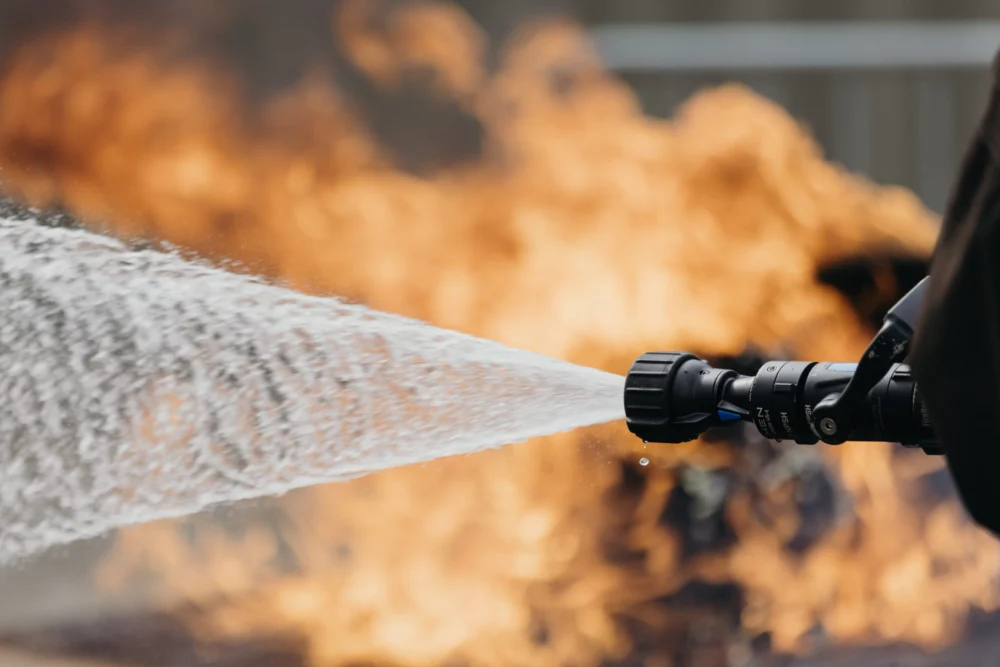
In June 2020, HEN (High-Efficiency Nozzles) Technologies was formally established. Utilizing National Science Foundation grants, Sethi and his team applied sophisticated computational fluid dynamics (CFD) research to analyze the complex physics of water droplet formation, fire suppression mechanics, and the critical effect of wind dynamics. The resulting hardware innovation is a nozzle engineered to precisely control droplet size and manage water velocity, ensuring the stream remains coherent and effective even in high winds, contrasting sharply with traditional nozzles that suffer significant stream dispersion and resultant waste. A visible comparison confirms the radical efficiency gain: the HEN stream maintains its integrity and kinetic energy at the same flow rate where legacy systems fragment.
However, the high-efficiency nozzle, which Sethi describes as "the muscle on the ground," quickly evolved into the core component of a much broader, interconnected system. HEN has rapidly expanded its product line to include intelligent monitors, valves, overhead sprinklers, and pressure devices. This year marks the launch of "Stream IQ," a highly advanced flow-control device, alongside comprehensive discharge control systems.
The true technological leap lies not in the metal or composites, but in the pervasive intelligence embedded within the ecosystem. Each piece of HEN hardware—from the smallest valve to the largest monitor—is integrated with custom-designed circuit boards, sensors, and localized computing power, often leveraging high-performance chips like the Nvidia Orion Nano processors. This dense sensor network, comprising 23 distinct design variations, transforms conventional, inert firefighting gear into smart, connected Industrial IoT (IIoT) equipment. HEN has already filed 20 patent applications, half a dozen of which have been granted, protecting this integrated approach.
The Operating System for Emergency Response
The collective data generated by these smart devices flows into HEN’s cloud platform, which Sethi conceptually aligns with the transition Adobe facilitated for creative professionals by moving software infrastructure to the cloud. This platform is designed to act as a comprehensive operational system for fire defense, providing granular, real-time situational awareness that has historically been unattainable.
The system utilizes sensors at the pump, combined with advanced modeling, to function as a virtual sensor inside the nozzle itself. It meticulously tracks when equipment is active, the exact volume of water flowing, the required pressure dynamics, the specific hydrant utilized, and correlating weather conditions.
The industry implications of this real-time data integration are profound. Fire suppression efforts frequently fail due to critical logistical breakdowns, most notably the unforeseen depletion of water resources. Historical tragedies, such as the Palisades Fire and the devastating Oakland Fire decades earlier, highlighted the danger inherent in the communication gap between firefighters and water utility providers. Furthermore, when multiple engines tap a single hydrant, sudden pressure variations can lead to one engine losing flow entirely, escalating the hazard exponentially. For rural fire departments reliant on water tenders—large tankers that shuttle water from distant sources—optimizing usage calculations and integrating utility monitoring systems becomes a mission-critical function for resource allocation.
HEN’s application layers provide customized intelligence for every level of command—from fire captains on the front line to battalion chiefs and incident commanders. The system incorporates real-time weather data and GPS tracking for all deployed devices. This capability allows the platform to deliver immediate, actionable warnings—for example, alerting crews that a wind shift is imminent, necessitating the immediate relocation of engines, or notifying a specific truck that its onboard water reservoir is reaching critically low levels.
This centralized, data-driven approach directly addresses the requirements outlined by federal agencies. The Department of Homeland Security, through its National Emergency Response Information System (NERIS), has been actively seeking predictive analytics solutions for emergency operations. Sethi points out the fundamental challenge that has stalled these initiatives: "You can’t have predictive analytics unless you have good quality data. You can’t have good quality data unless you have the right hardware." HEN is solving the foundational data problem.

Cracking the B2B/B2C Procurement Maze
While the technical complexity of building an advanced, predictive analytics platform for emergency response is substantial, Sethi asserts that the biggest hurdle has been navigating the unique sales cycle of public safety. He describes the market as a challenging hybrid: "It’s a B2C play when you think of convincing the customers to buy, but the procurement cycle is B2B." Success requires developing a product that resonates instantly with the end-users—the firefighters—while simultaneously maneuvering through the bureaucratic, multi-year government purchasing cycles. HEN claims to have cracked this dual challenge, and the growth metrics strongly support this assertion.
Launching its initial products in the second quarter of 2023, HEN secured 10 fire department customers and generated $200,000 in initial revenue. The momentum accelerated rapidly: revenue surged to $1.6 million in 2024, followed by $5.2 million last year. Currently serving 1,500 fire department customers, HEN projects a substantial revenue jump to $20 million this year.
The company’s market reach extends far beyond municipal fire departments, encompassing the Marine Corps, US Army bases, Naval atomic labs, NASA, and international clients such as Abu Dhabi Civil Defense, shipping to 22 countries through a network of 120 distributors. This broad penetration was recently fortified by achieving General Services Administration (GSA) qualification after a rigorous year-long vetting process, a federal seal of approval that streamlines sales to government and military agencies.
In the United States, fire departments replace roughly 20,000 engines annually within a national fleet of 200,000. HEN’s strategy is built on embedding its smart hardware during these replacement cycles, establishing recurring revenue streams. Crucially, the continuous data generation inherent in the hardware ensures revenue persists even between major capital expenditure cycles.
Although competitors exist—including public companies like IDEX Corp. that supply traditional hardware, and sophisticated software providers like Central Square and First Due (which recently raised a massive $355 million round)—Sethi maintains that no other entity offers HEN’s integrated, end-to-end hardware-to-cloud data generation capability. For HEN, the primary operational constraint is no longer market demand, but the speed of scaling production and deployment to meet global interest.
The Data Physics Engine: Fueling AI World Models
The most intriguing element of HEN’s strategy is the long-term value inherent in the data it collects. While the company is currently focused on maximizing hardware adoption and building out the data pipeline—creating a massive data lake of operational inputs—the real economic and scientific opportunity lies in monetizing the resulting intelligence layer. This is scheduled for commercialization next year.
The data being amassed is not merely logistical (water used, time elapsed); it is highly specific, real-world physics data collected under extreme, high-stress conditions. This includes precise information on how water behaves at different pressures, how flow rates interact with various materials, the exact suppression techniques employed, and the nuanced response of fire environments to specific applications of kinetic energy and cooling agents.
This dataset is extraordinarily valuable to the cutting edge of artificial intelligence research, particularly for organizations developing "world models." World models are sophisticated AI systems designed to construct simulated representations of physical environments—the "physics of reality"—to predict future states and outcomes. While AI can be taught general physics principles through simulation, simulating complex, chaotic, and destructive environments—like a structure fire or a wind-driven wildfire—with high fidelity remains exceptionally difficult.
To overcome the "simulation gap," AI and robotics developers require multimodal, real-world data from physical systems operating under highly variable and extreme conditions. HEN collects exactly this type of data with every deployment, essentially creating a proprietary, validated physics engine sourced directly from the global front lines of emergency response. Companies dedicated to training autonomous robotics, optimizing fluid dynamics for industrial applications, or developing advanced climate modeling systems would pay a significant premium for access to this unique, validated dataset.
The company’s ability to execute this complex dual strategy—hardware manufacturing and sophisticated software/AI development—is reflected in its team composition. HEN’s 50-person staff includes a software lead who previously helped architect Adobe’s cloud infrastructure, a former NASA engineer, and veterans from leading technology firms such as Tesla, Apple, and Microsoft.
Investors have recognized the immense potential of this converged approach. Last month, HEN successfully closed a $20 million Series A funding round, supplemented by $2 million in venture debt from Silicon Valley Bank, bringing the total capital raised to over $30 million. The financing, led by O’Neil Strategic Capital with participation from NSFO, Tanas Capital, and z21 Ventures, underscores confidence in HEN’s capacity to transition from a physical hardware innovator to a crucial data utility for global public safety. With aggressive scaling underway, Sethi has indicated the company will return to fundraising in the second quarter of this year, cementing its path toward becoming the definitive operating system for modern fire defense and, perhaps more significantly, a key enabler for the next frontier of predictive AI.