

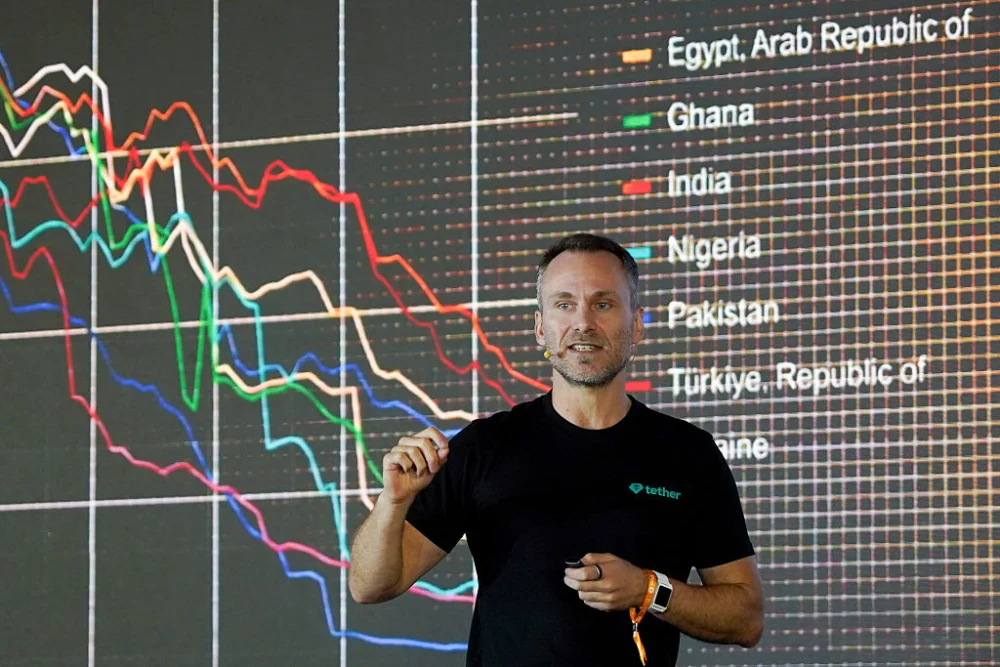
The ubiquitous presence of Paolo Ardoino, CEO of Tether, across major financial and technology news outlets signals far more than a routine public relations cycle; it marks a calculated, aggressive strategy to dismantle the long-held narrative of Tether as a secretive, offshore entity operating in the regulatory shadows. After years of avoiding the U.S. jurisdiction—a period characterized by intense scrutiny from global regulators and allegations of opacity—Ardoino is now engaging in a full-scale media and governmental blitz, positioning the stablecoin behemoth not merely as legitimate, but as an indispensable pillar of the future global financial architecture.
This strategic shift is timed meticulously to coincide with two seismic events: the launch of USAT, Tether’s first U.S.-regulated stablecoin, and the escalating competitive environment driven by traditional finance giants.
The introduction of USAT, issued through Anchorage Digital Bank, represents a watershed moment for the company. Unlike its flagship product, the $187 billion market cap USDT—which operates globally but does not meet stringent new federal requirements—USAT is explicitly designed for U.S. regulatory compliance. This move immediately thrusts Tether into direct competition with Circle’s USDC, long considered the preferred, regulated stablecoin choice for institutional investors and centralized crypto exchanges operating within American borders. The stablecoin race has recently become congested with high-profile entrants: Fidelity Investments, JPMorgan Chase, and PayPal have all launched their own dollar-pegged tokens, signaling that Wall Street now views tokenized dollars as an essential component of the digital economy. Tether’s move with USAT is a clear declaration that it will not concede the lucrative and increasingly standardized U.S. institutional market to rivals.
Crucially, Tether’s pivot is bolstered by its deepening relationship with the U.S. financial establishment. The firm’s reserves are managed by Cantor Fitzgerald, the prominent Wall Street institution formerly led by Howard Lutnick. Lutnick’s subsequent appointment as Commerce Secretary creates a significant, albeit ethically scrutinized, confluence of interests. While Lutnick has publicly endorsed Tether’s legitimacy, Cantor Fitzgerald benefits financially from managing the massive reserve portfolio, which largely consists of U.S. Treasury holdings. This alignment provides Tether with a critical layer of institutional validation and political proximity that was unimaginable just a few years ago when the company was frequently the subject of state attorneys general investigations and federal inquiries. Ardoino, now meeting with White House officials and collaborating openly with agencies like the FBI and Secret Service, is effectively weaponizing this new regulatory posture to shed the company’s "Wild West" reputation.
The Defense of Dominance and the Inclusion Argument
Tether’s market dominance remains unparalleled. With $187 billion in circulation, USDT’s market capitalization exceeds that of all its stablecoin competitors combined. This scale is fueled by explosive user growth, currently adding approximately 30 million new users per quarter, a pace Ardoino likens more closely to the early adoption curve of a social media giant like Facebook than a typical fintech application.
The CEO frames this exponential growth not as a financial victory alone, but as the "biggest financial inclusion success story in the history of humanity." This narrative is central to Tether’s defense against criticism. For users outside the stable, developed economies, USDT functions as a vital, accessible escape hatch from catastrophic currency devaluation. Ardoino cites staggering figures: the Argentine peso losing 94.5% of its value against the USD over five years, or the daily reality of those in Haiti living on $1.34 per day who are excluded from traditional banking. In these markets, USDT is not a speculative tool; it is a fundamental savings vehicle, offering crucial stability pegged to the U.S. dollar, delivered without the barriers of opening an international bank account.
This inclusion argument directly counteracts persistent accusations regarding the token’s use in illicit activities. Historically, critics, including publications like The Economist, have highlighted instances of money laundering and sanction evasion facilitated by USDT. Ardoino dismisses these amounts as a "drop in the ocean" compared to the vast, legitimate usage. More proactively, he argues that the transparency inherent in blockchain technology actually makes USDT superior to physical cash for law enforcement purposes.
“If there are cash pallets of hundreds of billions of dollars roaming around the world, U.S. law enforcement can hardly do anything about it,” Ardoino states. Conversely, Tether claims to have demonstrated the ability to quickly freeze funds in collaboration with the DOJ, FBI, and Secret Service, having already frozen $3.5 billion in tokens, primarily linked to scams and hacks. He points to the proactive identification of a $225 million “pig-butchering scam” in 2023, caught by Tether when traditional financial institutions failed to flag the activity. This proactive engagement with OFAC and U.S. agencies is essential to establishing the operational bona fides necessary for mainstream acceptance.
Resilience and the Excess Reserve Model
Tether’s ability to withstand systemic shock has become a cornerstone of its defense against stability concerns. These concerns were most recently amplified by S&P Global Ratings, which assessed USDT’s stability as “weak.” Ardoino, however, sharply rebuts such institutional criticism, equating S&P’s judgment with their failure to foresee the subprime mortgage crisis, suggesting he is proud to be deemed "weak" by such a system.
The true test of Tether’s resilience came during the catastrophic collapse of the TerraLuna ecosystem in spring 2022, which wiped out $40 billion overnight and triggered a widespread panic across the stablecoin sector. Hedge funds aggressively shorted Tether, expecting a similar failure. The result was an unprecedented bank run: Tether successfully redeemed $7 billion in 48 hours and $20 billion (25% of its total reserves) within 20 days. Ardoino rightly emphasizes that virtually no traditional bank could survive redemptions of that magnitude.
Furthermore, he subtly references the de-pegging event of Circle’s USDC during the 2023 collapse of Silicon Valley Bank (SVB), where Circle disclosed $3 billion in exposure, causing the token to temporarily lose its dollar parity. Ardoino implies that Circle, often championed as the compliant, cleaner alternative, stumbled when Tether did not. This narrative positions Tether as the battle-tested, anti-establishment victor.
Key to this stability argument is the company’s financial structure. Tether now maintains over $30 billion in excess reserves—capital beyond the 100% backing required for all outstanding tokens. Ardoino argues that this structure renders Tether safer than the highly leveraged fractional reserve banking system, where banks typically lend out 90% of deposits. He asserts that even in an extreme scenario where underlying crypto assets like Bitcoin were to collapse, Tether would still possess sufficient fiat assets to fully redeem every outstanding USDT token.
The Profit Engine and the Yield Debate
The vast reserves managed by Tether generate staggering profits, primarily through interest earned on U.S. Treasury securities. In 2025 alone, Tether reported over $15 billion in profit. A critical financial implication of Tether’s model is its decision not to share this yield with USDT holders, distinguishing it significantly from traditional savings vehicles.
Ardoino defends this strategy by drawing a sharp distinction between U.S. and international users. For the average American, a stablecoin might be viewed as a checking or savings account where yield is expected. However, for the core global user base, where currencies like the Turkish Lira and Argentine peso are suffering massive double-digit annual devaluations, the priority is absolute capital preservation, not a 4% annual interest rate. For these users, USDT is the savings account, and its primary value proposition is stability, not yield generation.
This conservative approach to yield may soon become a regulatory mandate. The CLARITY Act, currently moving through Congress, seeks to prohibit stablecoin issuers from paying interest to holders. This legislation is championed by traditional banking groups aiming to prevent massive outflows of deposits. If passed, the Act would effectively codify Tether’s current business model, while simultaneously eliminating a potential competitive advantage for rivals like Circle, which have occasionally experimented with reward programs.
The Sovereign Wealth Fund of the Digital Age
Ardoino’s vision extends far beyond dollar-pegged tokens. Tether is rapidly transforming into a diversified holding company, akin to a technology-focused sovereign wealth fund, utilizing its massive profits to secure its long-term stability and independence.
The company’s diversification into commodities is notable. Tether Gold, launched in 2020, now accounts for $2.6 billion in circulation. More impressively, Tether’s total gold holdings, according to recent disclosures, stand at approximately 140 tons, valued at around $24 billion, positioning the company as one of the largest private gold holders globally. Ardoino emphasizes that blockchain technology is finally enabling gold to function as a medium of exchange, not just a store of value. The steady acquisition of one to two tons of gold per week underscores this strategic push to be a major player—or as Ardoino calls it, "one of the biggest gold central banks in the world."
The most ambitious strategic prong, however, is the commitment to artificial intelligence and digital infrastructure. Nine months ago, Tether launched Qvac, a decentralized AI platform named after Isaac Asimov’s short story, “The Last Question.” mirroring the philosophy behind USDT, the Qvac platform is intended to serve the underserved. Ardoino argues that centralized AI models will remain inaccessible to billions who cannot afford expensive subscriptions, especially those already excluded from traditional finance. Qvac’s architecture is designed to run locally on smartphones, leveraging the increasing power of ubiquitous mobile devices across Africa and South America to enable 70-80% of necessary AI use cases within three to five years. The vision is explicit: USDT will be the financial backbone empowering this decentralized AI ecosystem.
These technological pursuits are backed by substantial capital allocation. Tether has committed over $1 billion to the German AI robotics firm Neura, $775 million to the social media platform Rumble, and hundreds of millions more into data centers, satellites, and agriculture. These seemingly disparate investments—which also include a stake in the Juventus football club—are, according to Ardoino, interconnected by the company’s motto: to be the "stable company."
He insists the common denominator is resilience. By investing profits into physical assets (land, cattle, gold) and critical modern infrastructure (AI, telecom, data centers), Tether aims to build an interlocking system that can "stand the test of time" and insulate its users from geopolitical and financial volatility. The company is seeking to become a foundational layer of global commerce, using its financial muscle to drive vertical integration across technology and physical commodities.
As Tether continues its aggressive integration into global regulatory and financial structures, the political risks remain high. The shift in U.S. administration sentiment could still pose a threat. Yet, Ardoino is prepared for this, banking on the argument that Tether’s massive success in promoting "digital dollarization" and financial inclusion—bringing 536 million people onto the dollar—is a positive development that transcends partisan political divides. The current media offensive and regulatory compliance push are clear indicators that Tether is moving from defense to offense, seeking not just survival, but comprehensive dominance over the future of digital finance and beyond.