

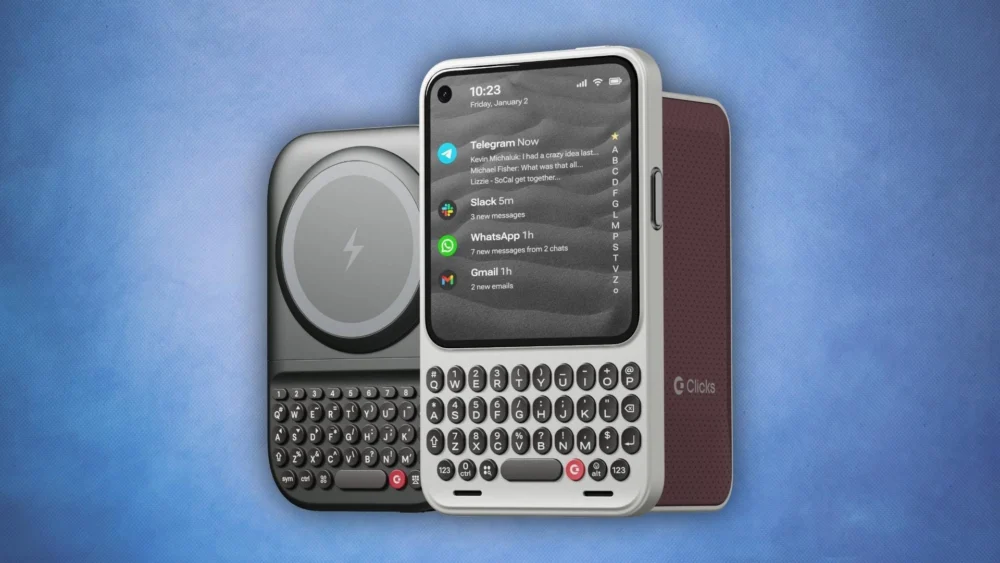
The evolution of the modern smartphone has been a relentless march toward the monolithic slab of glass. Since 2007, the industry has prioritized screen-to-body ratios and haptic simulations over the raw, tactile certainty of physical buttons. However, a growing cohort of "prosumers" and digital minimalists is beginning to push back, signaling a shift in the mobile paradigm. Clicks Technology, a company that first gained notoriety for its quirky iPhone keyboard cases, is now pivoting from niche accessory maker to a serious hardware contender. With the simultaneous announcement of the Clicks Power Keyboard and the Clicks Communicator, the firm is addressing two of the most significant pain points in modern mobile computing: the inaccuracy of virtual typing and the soul-crushing distractions of the modern "everything app" ecosystem.
The Clicks Power Keyboard represents a fundamental shift in the company’s engineering philosophy. While their previous iterations were precision-molded for specific iPhone models—effectively turning the phone into a taller, more specialized tool—the new Power Keyboard embraces a philosophy of universal interoperability. This is a strategic move designed to insulate the product from the annual hardware cycles of Apple and Google. By utilizing a sophisticated slide-out mechanism, the Power Keyboard can adjust its physical dimensions to accommodate a staggering array of devices. From the anticipated iPhone 17 series and the ultra-slim iPhone Air to the robust Google Pixel 9 and the complex form factors of the Samsung Galaxy Z Fold line, the accessory aims to be the last mobile keyboard a user needs to purchase.
Technologically, the Power Keyboard is more than just a peripheral; it is a multi-functional hub. The inclusion of Bluetooth connectivity with a multi-pairing system allows users to toggle between three different devices. This feature acknowledges the reality of the modern workflow, where a user might be drafting an email on a tablet, responding to a text on a phone, and navigating a smart TV or an AR/VR headset like the Apple Vision Pro. In the context of spatial computing, a physical keyboard is transformative. Typing on "floating" virtual keys in a Vision Pro or Meta Quest environment remains one of the primary barriers to productivity in the "metaverse." By providing a tactile anchor, Clicks is positioning itself as a vital bridge for early adopters of wearable displays.
Perhaps the most ingenious addition to the Power Keyboard is its integrated power management system. Housing a 2,150mAh internal battery, the device serves a dual purpose. First, it provides independent power for its backlit keys, ensuring that the accessory doesn’t drain the host device’s battery during late-night typing sessions. Second, it functions as a supplemental power bank. Supporting both MagSafe and the newer Qi2 wireless charging standards, it can deliver a 5W "trickle charge" to the docked smartphone. While 5W is far from the rapid-charging speeds of modern wall adapters, and a 2,150mAh capacity won’t fully charge a modern flagship, it acts as a critical buffer—a "safety net" that can provide the extra two or three hours of battery life needed to finish a workday or navigate home.

However, the more radical of the two announcements is the Clicks Communicator. This is not just an accessory; it is a full-fledged smartphone designed with a singular, contrarian purpose: to be a secondary device. In an era where flagship phones are designed to capture 100% of our attention through high-refresh-rate screens and endless algorithmic feeds, the Communicator is a deliberate step back toward the "utility-first" era of the BlackBerry. Priced at a launch MSRP of $499, with an aggressive pre-order incentive of $399, the device is aimed squarely at the "digital detox" movement and the professional communication market.
The hardware specifications of the Communicator reflect its focus on text-based efficiency. It features a 5.1-inch display—a size that would have been considered "large" a decade ago but is now refreshingly compact. This smaller screen is paired with a permanent, high-travel physical keyboard that occupies the lower third of the device. Unlike the Power Keyboard accessory, which is removable, the Communicator’s keyboard is integrated into the chassis, allowing for a more rigid and premium typing experience reminiscent of the legendary Bold or Curve series.
Internally, the Communicator is surprisingly well-equipped for a "minimalist" device. It offers 256GB of onboard storage, which is further expandable via a microSD slot up to 2TB. This makes it an ideal device for those who want to carry their entire library of documents, offline music, or podcasts without relying on cloud services. The inclusion of a physical SIM slot and a 3.5mm headphone jack—two features that have largely vanished from the flagship market—underscores the device’s commitment to utility and user agency.
The software experience is where the Clicks Communicator truly differentiates itself. Running on Android 16, the device utilizes a bespoke user interface developed in collaboration with the creators of Niagara Launcher. Niagara is widely regarded in the Android community as the gold standard for minimalist, efficient home screens. By stripping away the cluttered grid of icons and replacing them with a streamlined, list-based navigation system, the Communicator discourages "doom-scrolling" and encourages "intent-based" usage.
The device is optimized for a specific suite of communication tools: Gmail, Telegram, WhatsApp, Slack, and Discord. It is, quite literally, a machine built for conversation. To further this goal, Clicks has introduced a hardware "Prompt Key." This dedicated button is designed to instantly surface active group chats or AI-driven summaries of missed messages, allowing the user to stay informed without being sucked into the broader vortex of social media apps like TikTok or Instagram.

The industry implications of these releases are significant. We are currently witnessing a "Great Bifurcation" in mobile technology. On one side, we have the "Main Screen"—the iPhone Pro Max or Galaxy Ultra—which is becoming a portable cinema and a high-end gaming console. On the other side, there is a growing market for "Focused Devices." This includes E-ink tablets like the Remarkable, minimalist phones like the Light Phone II, and now, the Clicks Communicator. Clicks is betting that professionals are willing to carry two devices: one for consumption and photography, and another—the Communicator—for the "heavy lifting" of professional correspondence and coordination.
From an expert-level analysis, the Clicks Power Keyboard and Communicator are responses to the "ergonomic debt" of the last fifteen years. Typing on glass is fundamentally taxing on the human nervous system; it requires constant visual confirmation of finger placement because there is no tactile feedback to guide the hands. Physical keyboards allow for "blind typing," which frees up cognitive resources. For a journalist, a coder, or a project manager, the ability to type with tactile certainty while looking at the environment (in the case of AR) or the subject of their writing is a massive productivity gain.
Furthermore, the timing of these products aligns with the rise of generative AI. As mobile AI agents become more integrated into our operating systems, the need for precise, fast input to "prompt" these agents becomes paramount. The "Prompt Key" on the Communicator is a clear nod to this future, suggesting that the physical keyboard may become the primary interface for directing AI workflows on the go.
Looking toward the future, the success of Clicks Technology will likely depend on their ability to foster a developer ecosystem that takes advantage of their physical shortcuts. If third-party apps like Notion, Obsidian, or Trello begin to map specific functions to the Clicks hardware keys, the value proposition of these devices will move from "nostalgic" to "essential."
The broader trend here is the reclamation of the physical world. As we spend more of our lives in digital spaces, the quality of our physical interaction with those spaces matters more than ever. Clicks is not just selling a keyboard or a phone; they are selling a more deliberate, tactile, and focused way of existing in a hyper-connected world. Whether the mass market is ready to return to physical keys remains to be seen, but for the "power user" who values precision over polish, the Clicks Spring lineup represents the most exciting hardware pivot in years. By combining the battery-boosting utility of a power bank with the productivity of a universal keyboard, and following it up with a dedicated "distraction-free" smartphone, Clicks is making a bold claim: the future of mobile isn’t just about what you see on the screen—it’s about how it feels in your hands.