


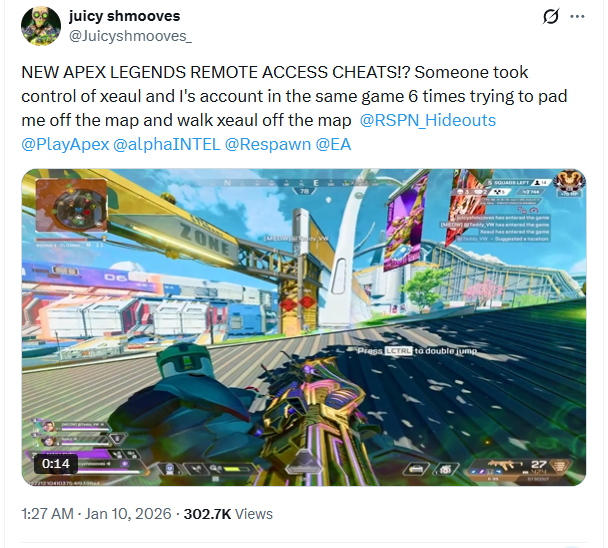
The competitive ecosystem of Apex Legends, Electronic Arts’ highly successful free-to-play battle royale hero shooter, was recently thrown into disarray as players across multiple platforms reported highly unusual and intrusive in-game anomalies. Throughout the preceding weekend, commencing around Friday, a coordinated security incident allowed an external threat actor to seize control of player inputs mid-match, force disconnections, and arbitrarily alter in-game usernames. This breach targeted the live gameplay environment, directly impacting the experience of hundreds of thousands of concurrent users, a testament to the game’s sustained popularity, which maintains an estimated daily concurrent player base nearing half a million across PC and console platforms as of mid-2025.
The nature of the reported interruptions suggested a level of access far beyond typical user-level cheating. Witnesses shared video evidence depicting their characters moving autonomously, often being deliberately walked off the map boundaries, a clear indication of external command execution. Furthermore, a disturbing pattern emerged where the usernames of forcibly ejected teammates were systematically replaced with the string ‘RSPN Admin’, a tactic likely intended to sow confusion or imply an internal administrative action was responsible for the disruption.
Respawn Entertainment, the studio behind the critically acclaimed title, was compelled to address the escalating situation publicly. The company issued a statement on Saturday acknowledging the "active security incident" characterized by the remote control of player inputs. Crucially, the initial assessment from Respawn attempted to temper community fears regarding the most severe classes of software vulnerability. The publisher explicitly stated that their preliminary investigation had uncovered no evidence suggesting the threat actors could execute arbitrary code, specifically ruling out Remote Code Execution (RCE) or complex injection attacks at that early stage. This distinction is vital: RCE vulnerabilities grant attackers deep system control, whereas the observed symptoms pointed toward manipulation of game state data or server-side input handling mechanisms.
Deeper Dive into the Exploitation Vector
While Respawn’s initial reassurance focused on preventing catastrophic system compromise, the ongoing reports from the player base painted a clearer picture of the exploit’s mechanics. Players observed that the hijacking extended beyond mere character movement; the ability to instantly kick players suggested a privilege escalation scenario. One detailed player analysis theorized that the perpetrator had managed to gain administrative or high-level debugging privileges on the live game servers. Such elevated access would grant the actor the ability to issue commands usually reserved for developers or dedicated server administrators—including the ability to inject cheat scripts like aimbots, force player state changes, and manage active connections.

The fact that player nicknames were being overwritten with ‘RSPN Admin’ strongly supports the theory of a privilege exploit rather than a standard client-side cheat. Client-side cheats operate within the boundaries of a single player’s local game instance and generally cannot impose direct, persistent changes on other players’ session data or the server’s perception of their identity. To achieve remote input control and nickname modification across multiple simultaneous matches points toward a vulnerability in the server architecture itself, specifically how it validates and processes commands originating from privileged accounts or debug tools that were somehow accessed or misused by the external party.
This incident underscores a persistent, high-stakes challenge in the massively multiplayer online (MMO) landscape: maintaining the security perimeter around administrative and debugging tools. Developers rely on these tools for rapid patching, debugging complex interactions, and monitoring performance in real-time. If these channels are compromised, the impact is immediate and severe, as seen here, where the integrity of a live match is completely undermined.
Industry Implications and Trust Erosion
For a game built upon competitive integrity, such as Apex Legends, incidents like this carry significant ramifications beyond the immediate frustration of players. The battle royale genre relies heavily on the perception of a level playing field. When players witness what appears to be systemic abuse of administrative power, faith in the developer’s ability to secure the competitive environment plummets.
This erosion of trust is compounded by the game’s history. Apex Legends has faced significant security scares before, most notably during high-stakes professional tournaments, such as the disruption witnessed in the North American competitive circuit last year. That previous event, which involved hackers compromising players during official ALGS matches, forced Electronic Arts to postpone finals and demonstrated the vulnerability of the game’s underlying security framework even under controlled, high-profile conditions.
When similar disruption methods resurface in general public matches, it suggests that the underlying architectural weaknesses, or at least the security posture surrounding administrative access, were not fully remediated following the previous crisis. For esports professionals and dedicated community members, this repeated failure to secure the core infrastructure against high-level intrusion is particularly damaging. It raises questions about the efficacy of the anti-cheat measures implemented post-incident.

The industry at large pays close attention to these events. Game developers must balance the need for robust security against the operational necessity of powerful diagnostic tools. If administrative backdoors—even unintentional ones—are exploited, it sets a dangerous precedent. It signals to sophisticated threat actors that the "high ground" of server administration is a viable target, potentially shifting focus away from developing complex client-side hacks toward exploiting the developer pipeline itself.
Respawn’s Response and the Anti-Cheat Dilemma
Approximately six hours after confirming the security breach, Respawn announced that the incident had been contained and resolved. While this swift remediation is positive, the accompanying details were sparse, focusing primarily on the continuous nature of anti-cheat development. The studio emphasized that user reports were critical to identifying and closing the vulnerability, framing the resolution as a success for community engagement in the ongoing "cat-and-mouse game" that defines anti-cheat warfare.
However, the limited technical disclosure leaves several critical questions unanswered for cybersecurity analysts and the dedicated player base. What specific endpoint or service was compromised to allow remote input control? Was it an improperly authenticated debugging console, an exposed API endpoint, or a compromised set of developer credentials? Until these details are clarified, the resolution remains a tactical victory rather than a strategic assurance of long-term security.
The reliance on user reports for identifying a privileged access exploit is telling. Ideally, systems monitoring internal server behavior should detect anomalous activities—such as an admin tool being used to arbitrarily move players or change session metadata—before players report the effects in public forums. This suggests a gap in the telemetry and anomaly detection systems governing the live servers.
Future Impact and Security Trends
The recent Apex Legends episode highlights several accelerating trends in online gaming security:
- The Shift to Server-Side Integrity: As anti-cheat technology matures on the client side (making client-side manipulation harder), sophisticated actors are increasingly targeting the server infrastructure itself. Exploits that grant administrative access bypass most traditional client-side integrity checks.
- The Debugging Tool Threat Surface: Modern game development relies on complex, often networked, debugging and telemetry systems. If these systems are not segmented and secured with the same rigor as the core game logic, they become the weakest link. The appearance of ‘RSPN Admin’ modification strongly suggests this vector was exploited.
- The Value of Player Data and Control: The ability to hijack an active player and alter their identity within the server’s perception is a potent form of digital vandalism. For high-profile games, the threat extends beyond simple cheating to potential denial-of-service on a targeted scale or reputational damage through forced in-game actions.
Moving forward, Respawn and EA will likely face pressure to enhance their server-side auditing capabilities. This includes implementing stricter multi-factor authentication for all administrative access, enforcing principle of least privilege rigorously, and employing real-time behavioral analysis tools that flag any admin-level command execution that deviates from established maintenance protocols.
For the Apex Legends community, this weekend served as a stark reminder that even the most polished and popular titles remain vulnerable to highly targeted, infrastructural attacks. The game’s success—and its massive concurrent player count—only increases its visibility and attractiveness as a target for actors seeking disruption or notoriety. The effectiveness of their next steps in hardening the server back-end will determine whether this incident becomes a footnote or a recurring threat to the longevity of the franchise’s competitive integrity. The industry watches, knowing that securing the server is the ultimate firewall against systemic collapse.