

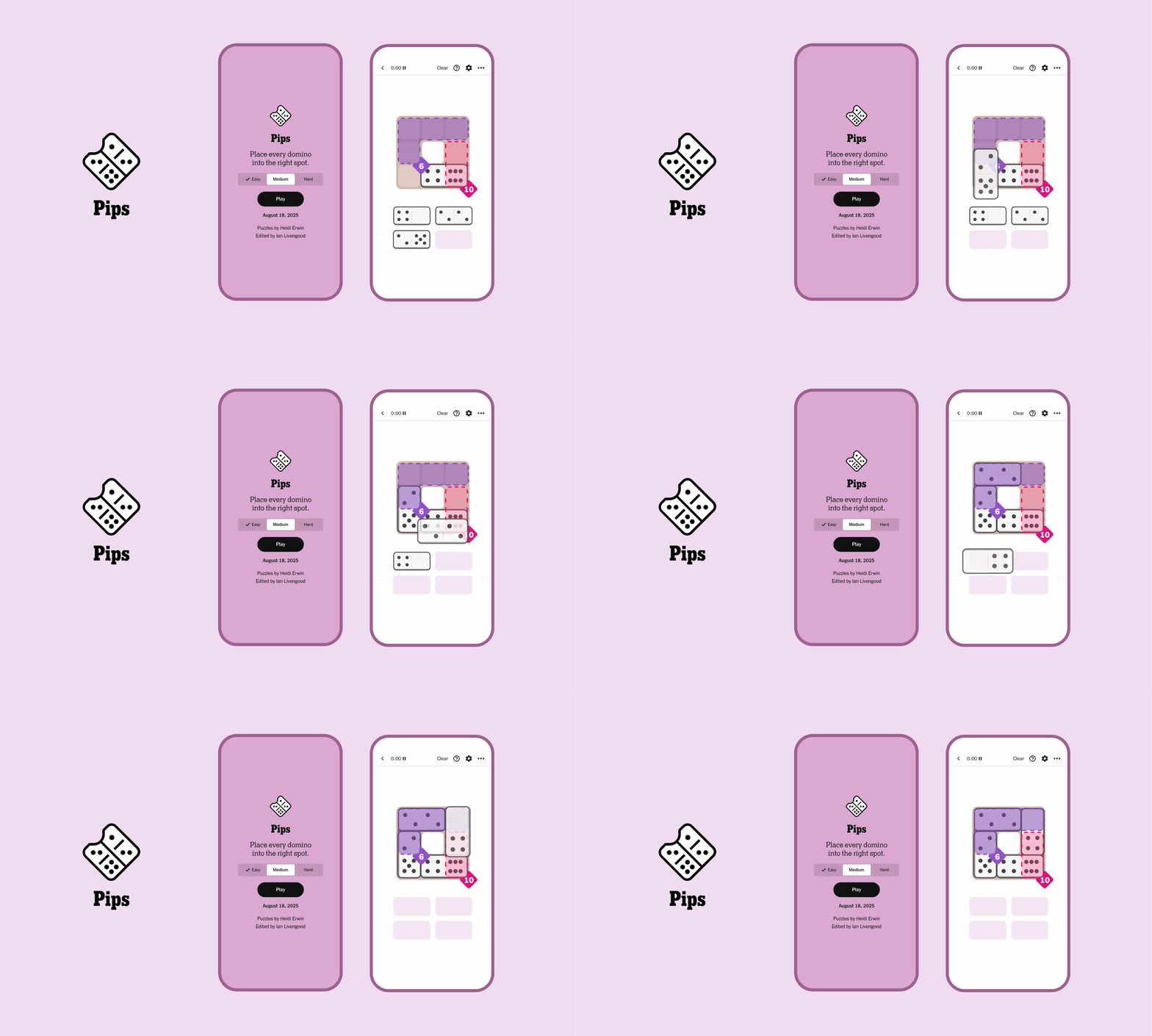
The landscape of digital entertainment has undergone a profound shift over the last decade, transitioning from high-fidelity, time-intensive experiences toward the elegant simplicity of daily micro-puzzles. Among the most recent additions to this intellectual arsenal is a logic-based challenge that utilizes the familiar mechanics of dominoes set within a framework of rigorous mathematical constraints. Known as Pips, this game has quickly ascended the ranks of daily digital habits, offering a tiered system of difficulty that tests spatial reasoning and deductive logic. As we approach the end of the year, specifically Tuesday, December 30, the complexity of these grids has reached a seasonal peak, requiring a sophisticated approach to solve.
The brilliance of the Pips architecture lies in its reliance on "conditions." Unlike traditional dominoes, where the primary objective is simply to match adjacent numbers, Pips introduces a layer of colored zones, each governed by a specific rule. These rules—ranging from sum totals and equality to "greater than" or "less than" inequalities—force the player to treat the grid not as a board, but as a system of simultaneous equations. To succeed, one must use every domino in the provided set, ensuring that every condition across the multicolored boxes is satisfied.

On this particular Tuesday, the puzzle designers have presented a curious anomaly: a Medium-tier challenge that arguably rivals or exceeds the Hard-tier in terms of initial friction. This phenomenon is well-known in the world of algorithmic puzzle design, where the number of variables in a "Medium" puzzle might be fewer, but the lack of an obvious entry point creates a psychological bottleneck for the player. Conversely, the Hard puzzle for December 30 features a distinctive "P" shaped configuration, which, despite its visual complexity, offers several logical anchors that allow for a systematic deconstruction.
Industry Implications: The Gamification of Daily Habits
The rise of games like Pips is not an isolated event but a calculated move within the broader media industry. Digital publishers have recognized that "sticky" content—puzzles that players return to every morning—is essential for reducing churn in subscription models. By integrating logic puzzles into news applications, companies are leveraging the "Zeigarnik Effect," a psychological phenomenon where people remember uncompleted or interrupted tasks better than completed ones. The daily reset of these puzzles creates a perpetual loop of engagement.
Furthermore, the "Easy, Medium, Hard" tiering system is a masterclass in user retention. It provides a "Goldilocks" zone for every demographic. The Easy tier serves as a cognitive warm-up, ensuring the user feels a sense of accomplishment. The Medium and Hard tiers provide the necessary friction to satisfy the "hardcore" logic enthusiast. When a Medium puzzle proves more difficult than a Hard one, as seen in today’s December 30 set, it sparks community discussion and social sharing, further driving organic growth for the platform.

December 30 Puzzle Walkthrough: Tactical Execution
To understand the specific logic required for today’s challenges, we must look at the constraints provided. The Easy and Medium puzzles today focused heavily on equality chains, but the Hard puzzle is where the most sophisticated reasoning is required.
Analyzing the Hard Tier: The "P" Grid Logic
The Hard puzzle for Tuesday, December 30, is characterized by a central "P" shape. The most significant hurdle for many players today was the presence of a "free tile" located in the center of the loop of the "P." In the context of Pips, a free tile is a blank space that carries no specific mathematical constraint, allowing it to act as a "buffer" for dominoes that don’t fit elsewhere.
Phase 1: Identifying the Anchor
In any complex logic grid, the first step is to find the "anchor"—the area with the fewest possible solutions. For the December 30 Hard puzzle, this is the Pink "=" group in the upper right. Through deduction, it becomes clear that this group requires a concentration of 5s.

The first move involves placing the 5/1 domino so that the 5 falls within the Pink zone and the 1 extends into the Blue "1" constraint. This is a critical move because the 5/1 is the only domino in today’s set featuring a 1, making its placement non-negotiable. Following this, the 5/5 domino must occupy the upper-rightmost tiles of the Pink zone. To complete the Pink constraint, the 5/3 domino is placed vertically, extending downward into the Orange "=" zone, while the 5/6 domino is placed horizontally, leading into the Purple "=" area.
Phase 2: Navigating the Core
Once the Pink anchor is set, the middle of the grid begins to reveal its requirements. The Purple "=" group now demands a 6 to match the 5/6 domino already placed. The 6/6 domino is the logical choice for the central Purple tiles. From there, the 6/4 domino must be placed to bridge the Purple zone with the center "free tile."
This move is pivotal because it dictates the flow of the rest of the board. With a 4 now occupying half of the free tile, the 4/0 domino must be used to connect that center space back to the Blue "1" group. Simultaneously, the Orange "=" zone, which already contains a 3 from the 5/3 domino, must be filled with the 3/3 domino to maintain the equality constraint.

Phase 3: Finalizing the Constraints
The final stage of the December 30 Hard puzzle requires careful management of the remaining low-value dominoes. The Orange zone connects to a Dark Blue "=" area. Having established a 3 in the previous step, the player must use the 3/2 domino to bridge Orange and Dark Blue. This leaves a 2 in the Dark Blue zone, which is satisfied by placing the 2/2 domino directly beneath it.
The Green "=" tiles are isolated at this point and are solved using the 0/0 domino. The final piece of the puzzle is the 2/4 domino, which lays horizontally from the Dark Blue "=" zone into the Purple "> 1" tile. This satisfies the final condition: the value of 4 is indeed greater than 1.
Expert Analysis: Why Today’s Medium Puzzle Felt Harder
A common sentiment among players today was that the Medium puzzle offered more resistance than the Hard one. This is often due to "transparency of constraints." In the Hard puzzle, the "P" shape and the specific Blue "1" constraint acted as a guide, narrowing the search space for the player. The Medium puzzle, however, featured more open-ended equality chains. When a puzzle has too many "valid" starting moves that eventually lead to a dead-end ten steps later, it increases the "cognitive load" on the player. This is a reminder that difficulty in logic games is not just about the number of rules, but about the clarity of the path forward.

Cognitive Benefits and the Science of Puzzles
Engaging with puzzles like Pips on a daily basis provides significant neurobiological benefits. These games require the use of working memory—the ability to hold and manipulate multiple pieces of information simultaneously. When you are calculating whether a 5/3 domino will satisfy both a Pink equality zone and an Orange sum zone, you are exercising the prefrontal cortex.
Moreover, the "Aha!" moment—the instant the final domino clicks into place and the grid turns green—triggers a release of dopamine. This reward mechanism is why digital puzzles have become such a successful part of the morning routine for millions. They provide a controlled environment where logic and order prevail, offering a brief respite from the unpredictability of daily life.
Future Trends in Digital Logic Gaming
As we move into the next year, we can expect the genre of digital logic games to evolve in three key areas:

- AI-Generated Dynamic Difficulty: Instead of a static puzzle for everyone, future platforms may use AI to adjust the constraints of a puzzle in real-time based on a player’s past performance, ensuring they are always in a state of "flow."
- Haptic and Spatial Integration: With the rise of augmented reality (AR) and spatial computing, games like Pips will likely move off the 2D screen. Imagine laying virtual dominoes on your physical coffee table, with the logic constraints projected as holographic fields.
- Social Competitive Logic: While current puzzles are mostly solitary, the next generation will likely feature "asynchronous multiplayer" modes, where players compete to solve the same grid with the fewest rotations or the fastest time, integrated directly into social messaging platforms.
The Pips puzzle for Tuesday, December 30, stands as a testament to the enduring appeal of logic. Whether navigating the deceptive simplicity of the Medium tier or deconstructing the "P" grid of the Hard tier, players are engaging in an ancient tradition of pattern recognition, updated for the digital age. As the year draws to a close, these daily mental exercises remain a vital tool for keeping the mind sharp and the spirit engaged.