

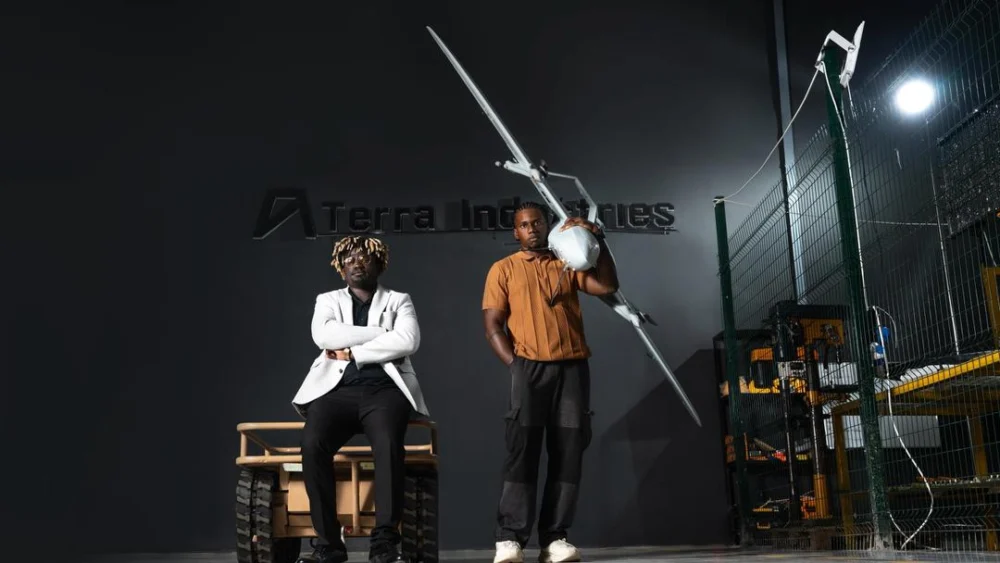
The landscape of global defense technology is undergoing a seismic shift, characterized by a move away from legacy aerospace conglomerates toward agile, software-first "defense primes." While this trend has been largely defined by Silicon Valley heavyweights, a new vanguard is emerging from the African continent. Terra Industries, a Nigeria-based defense technology startup led by two founders in their early twenties, has recently signaled its rapid ascent by securing an additional $22 million in funding. This capital injection comes a mere month after the company closed an $11.75 million seed round, bringing its total war chest to $34 million in less than 30 days.
Led by Lux Capital, a firm known for its bets on deep tech and frontier science, this extension round underscores a growing investor appetite for indigenous security solutions in emerging markets. The round also saw participation from 8VC—which led the previous month’s funding—alongside Nova Global and Resilience17 Capital, a fund established by Flutterwave CEO Olugbenga Agboola. The velocity of this fundraise, coming together in just under two weeks, reflects what CEO Nathan Nwachuku describes as "faster-than-expected traction" in both commercial partnerships and government contracts.
The Gen Z Architectures of Sovereignty
At the helm of Terra Industries are Nathan Nwachuku, 22, and Maxwell Maduka, 24. Their age is notable not for its novelty, but for the generational perspective they bring to a sector traditionally dominated by decades-long procurement cycles and aging bureaucratic structures. Founded in 2024, Terra Industries was born out of a realization that African nations remain dangerously dependent on foreign powers—specifically Russia, China, and Western Europe—for the intelligence, surveillance, and reconnaissance (ISR) systems required to maintain domestic stability.
Nwachuku’s stated goal is to build Africa’s first true "defense prime." In the defense industry, a prime contractor is the lead entity that manages major government projects, integrating various subsystems into a cohesive whole. By positioning Terra as a prime, the founders are aiming to move beyond being a mere hardware vendor. They are building the underlying infrastructure and autonomous systems that will allow African nations to monitor their borders, protect critical energy assets, and respond to asymmetric threats without relying on the diplomatic or technical whims of external actors.
The Geopolitical Necessity of Indigenous Tech
The necessity for a homegrown defense industry in Africa cannot be overstated. For decades, the Sahel region and sub-Saharan Africa have grappled with escalating insurgencies and the encroachment of extremist groups. Traditionally, responding to these threats meant purchasing hardware from foreign governments. However, these transactions often come with "black box" software that limits how the technology can be used, or they create a dependency on foreign technicians for maintenance and data analysis.
When a nation relies on a foreign power for its security intelligence, it effectively surrenders a portion of its sovereignty. If diplomatic relations sour, spare parts can be withheld, or software updates can be paused. Terra Industries addresses this vulnerability by offering locally designed and managed autonomous systems. By keeping the data, the manufacturing, and the intellectual property within the continent (or under the control of local partners), Terra provides a path toward strategic autonomy.
The company’s initial focus on infrastructure security is a calculated entry point. Terrorism and armed attacks on oil pipelines, power grids, and telecommunications hubs cost African economies billions of dollars annually. By protecting these assets, Terra isn’t just a defense company; it is an economic stability partner. Currently, the company claims to protect assets valued at approximately $11 billion, a figure that highlights the massive scale of the physical infrastructure at risk.
Traction, Revenue, and the "Anduril Effect"
In an era where many tech startups struggle to show a clear path to profitability, Terra Industries has demonstrated remarkable commercial viability early in its lifecycle. Nwachuku revealed that the company has already generated more than $2.5 million in commercial revenue. This is a significant milestone for a firm that is barely a year old, particularly in the "deep tech" space where research and development cycles often burn through millions before a single product is shipped.
The rapid funding of Terra Industries can be seen as part of the broader "Anduril Effect." Named after Palmer Luckey’s defense unicorn, this trend has seen venture capitalists realize that the modern battlefield is defined by software, autonomy, and low-cost hardware rather than the billion-dollar "exquisite" platforms of the past. Companies like Anduril, Shield AI, and Skydio have paved the way, proving that startups can compete with—and beat—established titans like Boeing or Lockheed Martin by iterating faster and leveraging artificial intelligence.

However, building hardware is notoriously capital-intensive. To put Terra’s $34 million into perspective, its American counterparts have raised billions: Anduril has secured over $2.5 billion, Shield AI roughly $1 billion, and naval autonomy firm Saronic around $830 million. For Terra to scale across a continent as diverse as Africa, this $34 million is likely just the beginning of a much larger capital requirement.
Cross-Border Expansion and the Saudi Connection
While Nigeria serves as Terra’s operational base, the company’s ambitions are global. One of the most significant developments accompanying the new funding is a partnership with AIC Steel. This deal will see Terra establish a joint manufacturing facility in Saudi Arabia. This move is strategic on multiple levels. First, it provides Terra with a foothold in the Middle East, a region with high demand for advanced surveillance and security infrastructure. Second, it allows the company to tap into more mature manufacturing supply chains while remaining focused on the specific needs of the "Global South."
Nwachuku has emphasized that the expansion strategy is focused on "major economies where the need for infrastructure security is urgent." This includes the Sahel region, where the intersection of climate change, resource scarcity, and political instability has created a complex security environment. By establishing manufacturing capabilities outside of Africa, Terra is diversifying its operational risk and preparing for a future where it can export its technologies to other emerging markets facing similar challenges.
The Role of Autonomous Systems in Modern Defense
The core of Terra’s offering lies in autonomous systems. In the context of African security, autonomy serves as a force multiplier. Many nations face the challenge of patrolling vast, porous borders with limited manpower. Traditional manned patrols are expensive, dangerous, and often ineffective at covering thousands of miles of desert or forest.
Autonomous drones and ground sensors can provide 24/7 persistence that human operators cannot match. When integrated with AI-driven analytics, these systems can distinguish between routine civilian movement and the early stages of a coordinated attack on a resource site. By automating the "find, fix, and track" stages of security, Terra allows government and commercial clients to respond to threats with precision, potentially saving lives and preventing the destruction of vital infrastructure.
Furthermore, the "autonomous" aspect reduces the need for the extensive training programs required for foreign-made platforms. If the system can navigate and identify threats independently, the barrier to entry for local security forces is lowered, allowing for faster deployment in crisis zones.
Future Outlook and Industry Implications
The rise of Terra Industries represents a coming-of-age for the African tech ecosystem. For years, the narrative of African tech was dominated by fintech and e-commerce. While those sectors remain vital, the emergence of a high-stakes defense tech firm suggests that the continent’s founders are now tackling the most fundamental problems of statecraft and national survival.
As Terra continues to scale, it will likely face significant challenges. The defense industry is fraught with ethical complexities and regulatory hurdles. Navigating the export controls of multiple nations while maintaining a commitment to "putting Africa’s defense back in the hands of Africans" will require a delicate balancing act. There is also the inevitable pressure from global incumbents who may view Terra’s rise as a threat to their long-standing market dominance on the continent.
However, the momentum behind the company is undeniable. With the backing of top-tier VCs like Lux Capital and 8VC, and a clear revenue-generating model, Terra Industries is no longer just a "startup to watch"—it is a pivotal player in the reorganization of African security. If Nwachuku and Maduka succeed in their vision, the next decade of African history could be defined not by the foreign systems that monitor its borders, but by the indigenous innovations that protect its future. The $34 million raised in a single month is not just a financial victory; it is a vote of confidence in a new era of African self-reliance.