

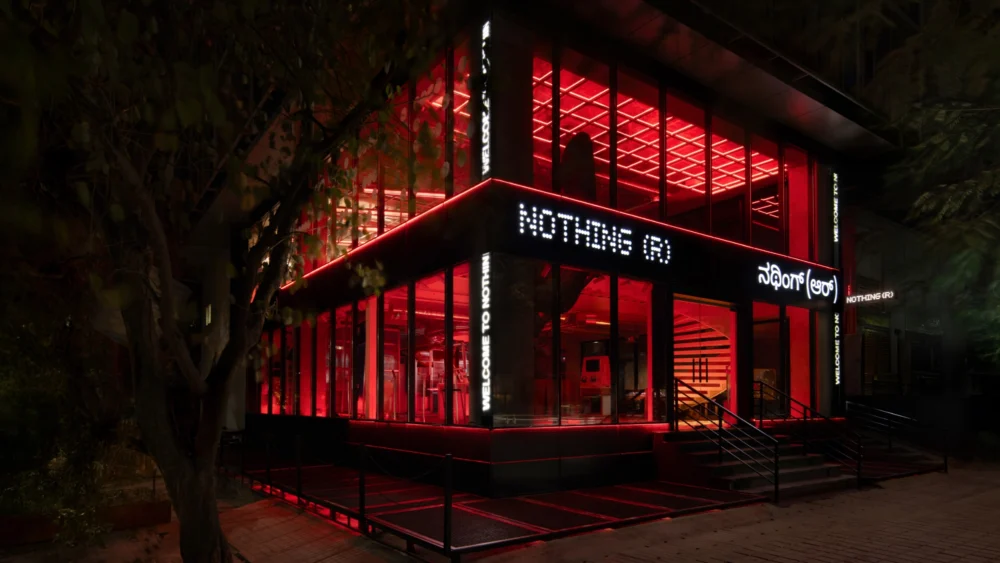
The intersection of high-concept industrial design and consumer electronics has found a new physical home in the heart of India’s technological capital. Nothing, the London-based hardware disruptor that has spent the last few years challenging the visual monotony of the smartphone industry, has officially inaugurated its first retail presence in India. Located in Bengaluru, a city often referred to as the "Silicon Valley of the East," the new flagship store represents a significant pivot for the Tiger Global-backed startup, transitioning from a digital-first challenger to a tangible, brick-and-mortar lifestyle brand.
The choice of Bengaluru is far from incidental. As the primary hub for India’s burgeoning tech talent and a massive concentration of the country’s early adopters, the city serves as the epicenter for Nothing’s most dedicated user base. For a company that prides itself on a "community-first" approach, establishing a physical touchpoint in its most successful global market is both a reward for its fans and a strategic necessity for its next phase of growth. This two-story installation is more than a point of sale; it is a manifestation of the brand’s transparent ethos, designed to demystify the hardware manufacturing process while offering a curated environment for product discovery.
A Retail Experience Rooted in Transparency
The architectural and interior philosophy of the Bengaluru store mirrors the design language of Nothing’s products. Since the launch of the Ear (1) and the Phone (1), the company has championed a "transparent" aesthetic, exposing the internal components of its devices to celebrate the engineering beneath the surface. The new retail space extends this concept to the shopping experience itself.
Co-founder and CEO Carl Pei has described the space as being heavily inspired by the industrial environment of the factory floor. In an era where most consumer electronics stores opt for sterile, minimalist white surfaces—a trend popularized by Apple—Nothing has taken a more visceral route. The store features elements that mimic a production line; when a customer completes a purchase, the product is delivered via a mechanism reminiscent of an automated factory belt.
Furthermore, the store serves as an educational gallery. Visitors can observe specialized machinery performing the rigorous quality-control tests that devices undergo during development. From USB port durability cycles to water-resistance testing, these displays are intended to bridge the gap between the polished end product and the gritty reality of hardware engineering. By showcasing the "stress" of the factory, Nothing aims to build a deeper level of consumer trust and brand affinity, turning a routine transaction into an immersive narrative of craftsmanship.
The Indian Stronghold: Growth and Strategy
The opening of the Bengaluru store underscores India’s position as Nothing’s most vital market. While many international brands struggle to find a foothold in the hyper-competitive Indian smartphone landscape—dominated for years by giants like Samsung and various BBK Electronics subsidiaries—Nothing has managed to carve out a distinct niche.
Market data from the second quarter of 2025 reveals a staggering trajectory for the young company. According to industry analysts, Nothing emerged as the fastest-growing brand in India during this period, recording an 85% year-over-year increase in shipments. With a market share already surpassing 2%, the company is punching well above its weight class in a region where hundreds of millions of users are looking to upgrade from budget devices to "aspirational" mid-range and premium hardware.
The Bengaluru flagship is a physical response to this momentum. In the Indian market, where "touch-and-feel" remains a critical component of the purchasing journey for premium electronics, having a flagship presence allows Nothing to compete on equal footing with legacy players. It provides a sanctuary for the brand to showcase its full ecosystem, including its primary smartphone line, audio products, and its newly spun-off sub-brand, CMF.
CMF by Nothing: The Dual-Brand Play
A key feature of the new retail space is the inclusion of CMF by Nothing. Launched as a more accessible alternative to the flagship "Nothing" line, CMF focuses on clean design and essential functionality at a lower price point. The strategic separation of these two brands is central to Carl Pei’s vision of market saturation.
During the store’s unveiling, Pei articulated the clear distinction between the two entities. Nothing is positioned as the "niche" offering—a premium, design-forward brand for those willing to pay a surplus for innovation and aesthetic uniqueness. CMF, conversely, is the "mass-market" vehicle. However, Pei is quick to differentiate CMF from the "off-the-shelf" rebranded products that typically populate the budget segment.
The CMF brand has a particularly strong Indian DNA. Headquartered in India and operating through a joint venture with the local original design manufacturer (ODM) Optiemus, CMF allows Nothing to leverage the "Make in India" initiative. This localization not only helps in managing costs and navigating import duties but also resonates with a domestic consumer base that increasingly values local manufacturing and design contributions. By housing both brands under one roof in Bengaluru, Nothing is effectively demonstrating its ability to cater to the entire spectrum of the Indian middle and upper-class consumer base.
The Broader Retail Renaissance in India
Nothing is not alone in its aggressive pursuit of physical retail in the subcontinent. The launch of the Bengaluru store coincides with a broader trend of global hardware makers doubling down on aspirational physical spaces in India. Apple, for instance, has been rapidly expanding its direct retail footprint, with a sixth store recently announced for Mumbai’s Borivali suburb.
This shift suggests a fundamental change in the Indian retail landscape. For years, the market was dominated by small, third-party "mom-and-pop" electronics shops and massive e-commerce platforms like Flipkart and Amazon India. However, as the Indian consumer becomes more sophisticated and the "premiumization" of the smartphone market accelerates, the demand for high-end, branded experience centers has skyrocketed. These stores are no longer just about moving inventory; they are about "brand building"—creating a lifestyle ecosystem that encourages long-term loyalty and cross-device integration.
Financial Backing and Global Ambitions
The confidence required to open a multi-story flagship in a prime international location is backed by significant venture capital. Last year, Nothing closed a $200 million Series C funding round led by Tiger Global, which valued the company at approximately $1.3 billion. This infusion of capital, supported by other high-profile investors like GV (formerly Google Ventures) and EQT, has provided the runway necessary for Nothing to move beyond its startup roots and into the realm of global hardware contender.
To date, the company has raised $450 million. While the Bengaluru store is the first of its kind outside of London, it is merely the beginning of a planned global retail offensive. Nothing has already signaled its intentions to establish similar flagship presences in Tokyo and New York. These locations are carefully chosen: Tokyo represents the pinnacle of consumer electronics design appreciation, while New York serves as the gateway to the massive, albeit difficult-to-penetrate, North American market.
Analysis: Can a Boutique Brand Sustain This Momentum?
The primary challenge for Nothing moving forward will be maintaining its "cool factor" while scaling to meet the demands of a mass market. Hardware is notoriously difficult; the margins are thin, the supply chains are volatile, and the competition is relentless. By investing heavily in physical retail, Nothing is taking a leaf out of the Apple and Sony playbook—building a "third space" where the brand identity can be controlled and curated without the interference of third-party retailers.
The success of the Bengaluru store will likely serve as a blueprint for the Tokyo and New York expansions. If Nothing can prove that its unique blend of industrial "factory-chic" and high-performance hardware can drive foot traffic and sustained sales in India, it will have a strong case for its $1.3 billion valuation.
Furthermore, the company’s hint at an "AI-first" device launch in the near future suggests that the Bengaluru store will soon house more than just phones and earbuds. As the industry pivots toward artificial intelligence and ambient computing, having a physical space to demonstrate these complex new technologies will be invaluable. It is much easier to explain the benefits of an AI-integrated ecosystem in person, through hands-on demonstration, than through a spec sheet on a website.
Conclusion
The opening of Nothing’s first Indian retail store is a watershed moment for the company. It marks the transition from a London-based experimental startup to a global player with deep roots in its most profitable territory. By blending the raw aesthetic of the factory with the polished experience of a luxury boutique, Nothing is attempting to redefine what a tech store can be.
As Bengaluru’s tech-savvy residents flock to the new two-storied location to customize their hardware and witness the "production line" in action, the rest of the industry will be watching closely. In a world of glass slabs and iterative updates, Nothing is betting that transparency—both in design and in business—is the key to winning the hearts and wallets of the next generation of consumers. Whether this physical expansion will lead to a permanent shift in market dynamics remains to be seen, but for now, Nothing has successfully turned the "void" of its name into a very tangible, very vibrant reality in the heart of India.