

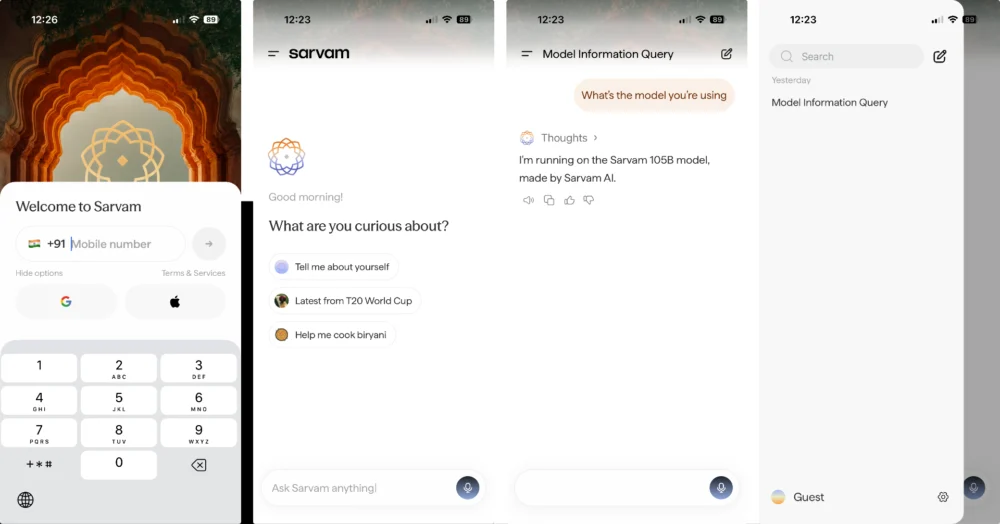
The global landscape of generative artificial intelligence is undergoing a significant shift as regional players begin to assert their presence against established Silicon Valley titans. In a move that signals a new chapter for India’s burgeoning tech ecosystem, Bengaluru-based startup Sarvam AI has officially entered the consumer space with the launch of "Indus," a sophisticated AI chat application designed specifically for the Indian market. Available across web, iOS, and Android platforms, the Indus app represents more than just another chatbot; it is a calculated attempt to reclaim digital sovereignty in a market currently dominated by the likes of OpenAI, Google, and Anthropic.
The debut of Indus follows the high-profile India AI Impact Summit in New Delhi, where Sarvam’s leadership team articulated a vision for a "sovereign AI" stack. This vision is built upon the premise that global models, while powerful, often fail to grasp the linguistic nuances, cultural contexts, and specific utility requirements of the Indian populace. By launching a direct-to-consumer interface, Sarvam is positioning itself as the primary local alternative, leveraging its proprietary large language models (LLMs) to provide a more tailored experience than its Western counterparts.
A Battleground of Scale and Adoption
To understand the weight of Sarvam’s entry, one must look at the current state of AI adoption in India. The country has rapidly become the most critical frontier for generative AI outside of the United States. Recent disclosures from OpenAI CEO Sam Altman indicate that ChatGPT boasts more than 100 million weekly active users in India alone, a staggering figure that underscores the country’s appetite for conversational AI. Similarly, Anthropic has noted that India accounts for nearly 6% of the total global usage for its Claude model, placing it second only to the U.S. market.
However, Sarvam’s strategy is built on the belief that "usage" does not necessarily equal "optimization." While millions of Indians use ChatGPT, they often do so in English or through rudimentary translation layers. Sarvam’s Indus app is built from the ground up to handle the complexities of the Indian linguistic landscape, where code-switching (mixing English with local languages like Hindi, Tamil, or Telugu) is the norm rather than the exception. By offering a platform that supports both text and high-quality audio interactions, Sarvam is targeting a demographic that extends beyond the urban, English-speaking elite to the "next billion" users who may prefer voice-first communication.
The Technical Backbone: Sarvam 105B and 30B
The Indus app serves as the consumer-facing portal for Sarvam’s most ambitious technical achievement to date: the Sarvam 105B model. This 105-billion-parameter large language model is the result of intensive training cycles focused on Indic data sets. In the world of machine learning, parameter count is often used as a proxy for a model’s "intelligence" and its ability to handle complex reasoning tasks. At 105 billion parameters, Sarvam’s model sits in a competitive "Goldilocks" zone—large enough to exhibit sophisticated emergent behaviors, yet optimized enough to run efficiently on modern cloud infrastructure.
In addition to the flagship 105B model, the company has also unveiled a 30B version. This tiered approach suggests a dual strategy: the larger model powers high-end reasoning and complex queries within the Indus app, while the smaller, more agile model can be deployed for enterprise applications where latency and cost-effectiveness are paramount. During the India AI Impact Summit, Sarvam emphasized that these models are not just translations of existing open-source architectures but are trained with a deep understanding of Indian syntax and semantics, which significantly reduces "hallucinations" when discussing local topics.
Navigating the Beta Phase: Features and Friction
As with any cutting-edge technology launch, the Indus app is currently in a beta phase, and its initial release comes with both innovative features and notable limitations. The user interface is clean and accessible, allowing for seamless transitions between typing and speaking. The audio component is particularly robust, reflecting Sarvam’s focus on the "oral-first" nature of many Indian communities. Users can authenticate through standard channels, including Google, Microsoft, Apple IDs, or simple phone number verification—a nod to the mobile-first identity of the Indian internet.
However, the "reasoning" feature within the app has become a point of discussion among early adopters. Currently, the app defaults to a high-reasoning mode that cannot be toggled off. While this ensures more accurate and thoughtful responses, it can lead to slower processing times compared to the near-instantaneous (if sometimes superficial) replies of global competitors. Furthermore, the app currently lacks a granular history management system; users cannot delete individual chat threads without deleting their entire account.

Pratyush Kumar, co-founder of Sarvam, has been transparent about these early-stage hurdles. He noted on social media that the company is gradually scaling its compute capacity to meet demand, which has necessitated the use of waitlists for new users. This cautious rollout is a common strategy among AI labs to prevent system crashes and ensure that the quality of inference remains high as the user base grows.
Beyond the Smartphone: The Hardware and Enterprise Play
What truly distinguishes Sarvam from many of its peers is its refusal to remain confined to the smartphone screen. The startup has announced a series of strategic partnerships that aim to embed its AI into the fabric of daily life in India. Perhaps the most striking of these is the collaboration with HMD Global, the manufacturer of Nokia-branded devices. Sarvam intends to bring AI capabilities to feature phones—the "dumb" phones that still dominate large swaths of rural India. By integrating voice-based AI into affordable hardware, Sarvam is attempting to bridge the digital divide in a way that high-end LLMs cannot.
Furthermore, Sarvam is eyeing the industrial and automotive sectors through a partnership with Bosch. The goal is to develop AI-enabled automotive applications that can handle voice commands in various Indian dialects, improving safety and user experience for drivers across the subcontinent. These enterprise initiatives suggest that Sarvam sees the Indus app as just one component of a much larger ecosystem that includes specialized hardware and B2B integrations.
Financial Moats and the Path to Sovereignty
The rapid ascent of Sarvam is backed by significant venture capital confidence. Since its founding in 2023, the company has raised $41 million from a syndicate of powerhouse investors, including Lightspeed Venture Partners, Peak XV Partners (formerly Sequoia India), and Khosla Ventures. The involvement of Vinod Khosla’s firm is particularly noteworthy, given his early and pivotal backing of OpenAI; it suggests that seasoned Silicon Valley investors see Sarvam as the definitive "national champion" for AI in India.
This financial backing is crucial because the "compute wars" are expensive. Training and maintaining 105-billion-parameter models requires massive investments in GPU clusters and specialized engineering talent. Sarvam’s ability to secure this level of funding early on allows it to compete for talent in a global market where AI researchers are commanding seven-figure salaries.
Moreover, the launch of Indus is a political statement as much as a technological one. The Indian government has increasingly voiced concerns about "data colonialism" and the reliance on foreign infrastructure for critical technologies. By building a domestic LLM stack, Sarvam is aligning itself with the national agenda of "Atmanirbhar Bharat" (Self-Reliant India). This alignment could prove advantageous as the Indian government begins to roll out its own AI missions and procurement policies that favor local IP.
The Road Ahead: Challenges and Evolution
Despite the momentum, Sarvam faces a steep climb. The "moat" in generative AI is notoriously difficult to maintain. OpenAI and Google have nearly bottomless pockets and are constantly iterating on their models. For Sarvam to succeed in the long term, the Indus app must move beyond being a "local version of ChatGPT" to offering utility that global models simply cannot replicate. This could include deeper integration with Indian digital public infrastructure, such as the Unified Payments Interface (UPI) or the ONDC (Open Network for Digital Commerce).
The company must also address the privacy and UX concerns raised by beta testers. In an era of heightened data sensitivity, the inability to manage chat history may deter professional users. However, if Sarvam can iterate quickly, leverage its local partnerships, and maintain the high quality of its Indic language processing, it has a genuine chance to dominate the South Asian AI market.
As Indus moves out of beta and Sarvam expands its compute capacity, the tech world will be watching closely. The success of this venture will serve as a litmus test for whether regional AI startups can truly carve out a space for themselves in an industry that has, until now, been a winner-take-all game played in English. For India, Sarvam is not just building an app; it is attempting to build the cognitive infrastructure of a digital superpower.