

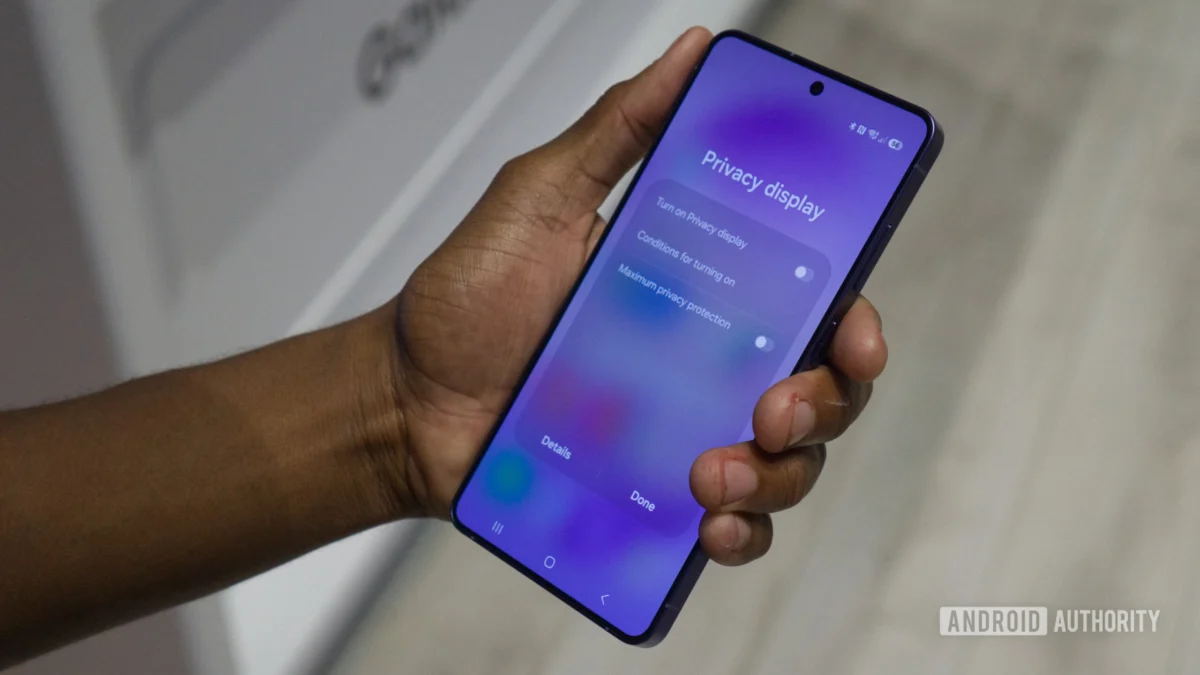
The unveiling of the Samsung Galaxy S26 Ultra introduced a significant hardware innovation aimed squarely at digital security: the Privacy Display. This feature, designed to physically restrict viewing angles to safeguard sensitive on-screen information from shoulder-surfing, represents a major push by the South Korean titan to integrate hardware-level privacy into its flagship mobile computing experience. However, the implementation of this sophisticated technology has not been without its initial turbulence. Following widespread anecdotal reports from early adopters and subsequent verification through rigorous laboratory analysis, Samsung has formally conceded that the Privacy Display mechanism introduces measurable variations in screen luminosity, particularly when the device is manipulated to extreme angles or when the display is pushed to its absolute peak brightness setting.
This acknowledgment, delivered in a formal communication to technology media outlets, marks a critical juncture in the commercial rollout of the S26 Ultra. While Samsung positions the feature as essential for modern mobile life—where public data exposure is a constant threat—the company simultaneously seeks to manage consumer expectations regarding the display’s performance envelope. The core of the issue lies in the nuanced engineering required to pivot between a standard, wide-viewing experience and the highly restricted, private mode.
The Engineering Behind Privacy: Narrow vs. Wide Pixels
To fully appreciate the ramifications of Samsung’s recent statement, one must understand the underlying technology. Unlike previous generations where privacy screens were often implemented via software overlays or fragile, add-on physical screen protectors, the Galaxy S26 Ultra employs a dynamic hardware solution built directly into the display panel itself. This system relies on a dual-pixel structure, featuring both "wide" and "narrow" sub-pixels.
In the standard, default operating mode—when the Privacy Display toggle is deactivated—both sets of pixels are fully engaged. This ensures maximum light output and the broad viewing angles expected from a premium AMOLED panel, delivering the "vivid visual experience" Samsung aims for during routine use.
When the Privacy Display function is activated, the system dynamically alters the illumination profile. Crucially, it prioritizes the illumination of the narrow pixels while significantly curtailing or entirely suppressing the light emission from the wide pixels. These wide pixels are engineered to scatter light across a broader arc; by deactivating them, the device physically restricts the visual cone of light emanating from the screen. Anyone viewing the device from an angle exceeding a specific, narrow tolerance—typically around 30 to 45 degrees off-center—will perceive the screen as heavily obscured or virtually black, effectively defeating casual eavesdropping.
The unavoidable trade-off, as now confirmed by the manufacturer, is that this selective illumination process inherently reduces the total available light output. When the user demands maximum brightness—a scenario often necessitated by bright outdoor environments—the system is forced to operate within tighter constraints dictated by the narrow pixel array. This results in a perceived dimming effect relative to the S25 Ultra, whose panel architecture was optimized solely for maximum brightness across all angles.
Samsung’s Official Stance: Minimizing the Impact
Samsung’s communication addressed the disparity directly, stating: "Privacy Display is designed to protect user’s privacy by providing a vivid visual experience for using the phone in normal use cases. Some variation will be seen when the phone is held at certain angles and when set to maximum brightness, however, any impact on actual usage when holding the phone should be negligible."
The inclusion of the term "negligible" is where the interpretation becomes subjective and potentially contentious for certain consumers. For a user primarily concerned with absolute peak luminance—perhaps for HDR content consumption or use in extremely high ambient light conditions—any reduction, even if technically small on a logarithmic scale, can be perceived as significant. Initial performance benchmarks comparing the S26 Ultra’s maximum sustained brightness against its predecessor have indeed shown a quantifiable drop when the privacy mode is engaged, leading to the early user critiques.
Furthermore, the statement implies that the dimming effect is most pronounced when the system is running at its limits (maximum brightness). It suggests that at lower or moderate brightness settings, where the disparity between the wide and narrow pixel output is less extreme relative to the required ambient brightness, the user experience degradation is less noticeable. This distinction is vital for understanding the feature’s practical utility versus its headline performance metrics.
Industry Implications: The Shifting Calculus of Feature Prioritization
The Galaxy S26 Ultra’s situation highlights a persistent tension in consumer electronics: the balance between introducing innovative, high-value features and maintaining uncompromising baseline performance metrics. For years, the primary battleground for flagship smartphones has been peak screen brightness, often measured in nits, because it directly correlates to outdoor usability and high-dynamic-range (HDR) content fidelity.
Samsung’s decision to prioritize hardware-enforced privacy, even at the cost of reducing this benchmark metric, signals a maturation in consumer demands beyond raw specifications. In an era defined by digital surveillance concerns, data breaches, and increased remote work necessitating sensitive document viewing on the go, hardware-level privacy is becoming a premium feature category unto itself.
This move sets a precedent for other major manufacturers. If the S26 Ultra proves to be a sales success despite, or perhaps because of, its integrated security enhancements, competitors will inevitably accelerate their own research into dynamic display privacy solutions. The industry may be transitioning from a race for the brightest screen to a race for the most secure screen, forcing engineers to master the complex interplay between photon emission control and visual fidelity.
The immediate implication for the Android ecosystem is a potential bifurcation. Users prioritizing absolute photographic quality, gaming performance, or maximum screen visibility in all conditions might hesitate, potentially favoring iterative upgrades to non-Ultra models or competitors who have not yet adopted this specific hardware constraint. Conversely, enterprise users, high-level executives, and security-conscious consumers may view the Privacy Display as the defining feature justifying the S26 Ultra’s premium price tag, accepting the luminosity trade-off as a necessary toll for digital invisibility.
Expert Analysis: The Physics of Pixel Control
From a technical standpoint, the phenomenon observed is an expected consequence of manipulating the angular light distribution (ALD) of an emissive display. Traditional OLEDs distribute light relatively uniformly, leading to wide viewing angles. To create a sharp drop-off in visibility off-axis, manufacturers must introduce an optical element that directs light more narrowly.
In the case of the S26 Ultra, this redirection is achieved by modulating the physical structure of the sub-pixels themselves. Narrow pixels are designed with micro-lenses or light guides that channel photons primarily perpendicular to the display surface. When these are the only active elements, the light path is highly collimated.
The introduction of "variation" likely stems from a few factors:
- Pixel Gating Inefficiency: Perfect switching between wide and narrow pixel illumination is difficult to achieve instantaneously or uniformly across the entire panel matrix. Minor power fluctuations or slight variances in the liquid crystal or organic layer behavior during the transition can lead to slight brightness bleed in the restricted zones.
- Viewing Angle Dependency: Even when the narrow pixels are active, the perceived brightness will naturally diminish as the viewing angle increases. The "variation" Samsung acknowledges might be the noticeable difference between the center-on view and the edge of the acceptable viewing cone, which is inherently dimmer than the center.
- Maximum Output Limitation: In high brightness mode, the power draw required to drive the narrow pixels to their absolute maximum might be constrained by thermal management or battery safety protocols, resulting in a lower actual peak output compared to the S25 Ultra’s unrestricted panel when both are set to their respective "maximums."
The challenge for Samsung’s next iteration will be developing a control mechanism that allows for a steeper privacy cutoff angle without requiring such a significant reduction in perceived brightness, perhaps through advanced diffractive optics or dynamic liquid crystal alignment layers that offer more nuanced light steering.
Future Trajectory: Beyond Simple Dimming
The Privacy Display is not merely a gimmick; it is an indicator of where mobile interaction is heading. As screens grow larger and devices become more integrated into our professional workflows—handling everything from banking details to proprietary corporate data—the need for robust, instantaneous privacy will only intensify.
Looking forward, we can anticipate several developments stemming from this foundational technology:
Adaptive Privacy Thresholds: Future iterations might allow users to fine-tune the privacy angle. Instead of a binary on/off switch, a slider could allow users to choose between "Light Privacy" (slight dimming, wider angle) and "Max Security" (near blackout off-axis, maximum dimming).
Contextual Privacy: Leveraging on-device AI and sensors, the phone could automatically engage the Privacy Display when it detects specific environmental cues—such as being in a crowded public space (via accelerometer/gyroscope analysis) or detecting ambient noise levels indicative of nearby conversations.
Integrated Biometric Authentication: The next logical step involves tying the privacy mode to user authentication. Imagine the screen remaining fully bright only when the user’s unique gaze signature (via advanced front-facing sensors) is detected, instantly reverting to privacy mode if the viewing angle shifts to an unrecognized profile.
Transparency Modes: Conversely, the technology could enable precise, user-controlled sharing. A user might set the screen to be visible to one person standing directly beside them (e.g., a 60-degree cone) while remaining private to everyone else. This level of granular control over light emission would represent the true zenith of display engineering.
Samsung’s acknowledgment of the current limitations surrounding the S26 Ultra’s Privacy Display is a necessary step in establishing transparency with its user base. While some may view the reduced brightness as a flaw, the company is clearly betting that the value proposition of integrated, hardware-backed digital security outweighs the minor compromise in peak luminosity for the majority of users. The market response over the coming quarters will determine whether this technological wager pays off and sets the standard for mobile privacy for the remainder of the decade. The conversation now shifts from if privacy displays are necessary to how effectively they can be implemented without penalizing core display performance.