

The generative artificial intelligence revolution has reached a critical inflection point where the primary constraint on progress is no longer the complexity of neural networks or the availability of specialized silicon, but the raw physics of electricity. As the global race to build massive high-density data centers intensifies, the industry is colliding with a "power wall"—a point where the sheer volume of electricity required and the inefficiencies in delivering it to the processor have become the dominant bottlenecks. This paradigm shift has fundamentally altered the investment landscape, moving the focus from the compute layer to the infrastructure layer. In a significant move to address this crisis, Peak XV Partners has led a $15 million Series A funding round for C2i Semiconductors, a Bengaluru-based startup tasked with reimagining how power is converted, controlled, and consumed within the world’s most advanced AI facilities.
C2i Semiconductors, whose name stands for Control, Conversion, and Intelligence, is emerging from stealth with a mandate to fix the "leaky pipe" of modern power delivery. The round, which also saw participation from Yali Deeptech and TDK Ventures, brings the two-year-old company’s total funding to $19 million. This capital infusion arrives at a moment of existential anxiety for hyperscalers like Microsoft, Amazon, and Google, who are finding that while they can order hundreds of thousands of Nvidia GPUs, they cannot always find the power to run them. The investment signals a growing conviction among top-tier venture capitalists that the next billion-dollar opportunities in AI will not be found in software alone, but in the hard-tech solutions that make the hardware economically viable.
The scale of the energy challenge is difficult to overstate. According to recent industry forecasts, data center electricity consumption is on a trajectory to nearly triple by 2035. Goldman Sachs Research has estimated that by 2030, data center power demand could surge by 175% compared to 2023 levels. To put this in perspective, this increase is roughly equivalent to adding a top-10 power-consuming nation to the global grid. However, the problem is not merely a matter of generation; it is a matter of distribution and conversion. Within a data center, electricity undergoes a series of high-stakes transformations. High-voltage power from the utility grid must be stepped down through transformers and converters multiple times before it reaches the sub-one-volt levels required by a GPU’s logic gates.
In current architectures, this conversion process is notoriously inefficient. Preetam Tadeparthy, co-founder and CTO of C2i, notes that approximately 15% to 20% of energy is lost as heat during these conversion steps. In the context of a facility consuming hundreds of megawatts, these "parasitic losses" represent tens of millions of dollars in wasted electricity and, perhaps more importantly, an enormous cooling burden. Every watt wasted in conversion is a watt that generates heat, which then requires even more energy to remove via fans or liquid cooling systems. As data centers move from 400-volt to 800-volt bus architectures to handle higher densities, the technical difficulty of maintaining efficiency grows exponentially.
C2i’s approach is fundamentally different from the modular, piecemeal solutions offered by traditional power component manufacturers. Instead of selling individual chips or converters, the startup is designing a "grid-to-GPU" system. This integrated platform treats power delivery as a holistic architecture, spanning from the data center’s main power bus directly to the processor package. By optimizing the silicon, the packaging, and the control algorithms simultaneously, C2i estimates it can reduce end-to-end energy losses by roughly 10%. This translates to a saving of 100 kilowatts for every megawatt of power consumed—a figure that drastically alters the Total Cost of Ownership (TCO) for data center operators.
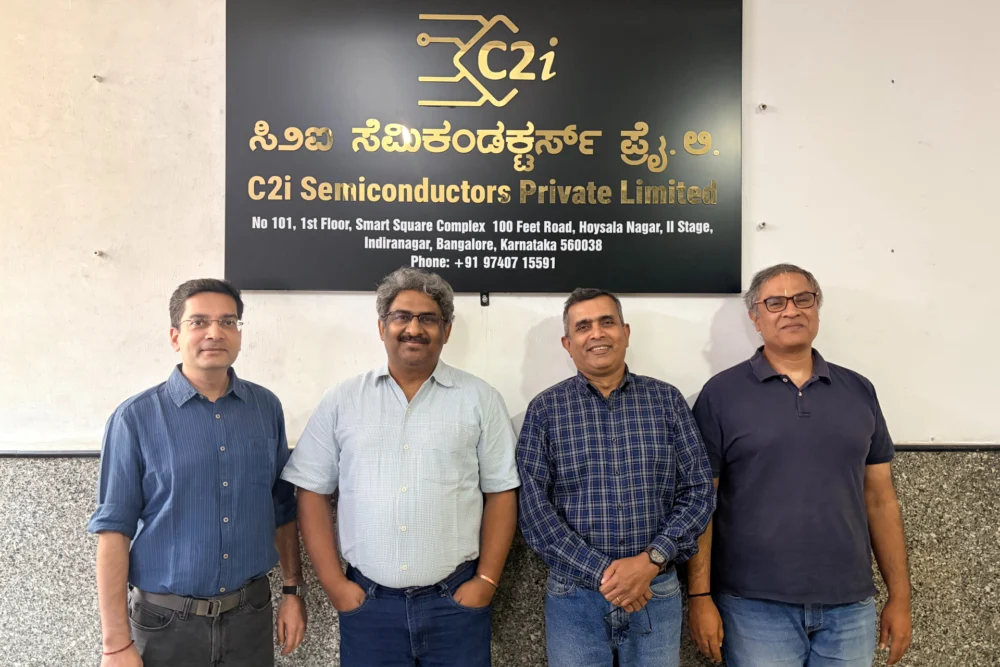
The founding team at C2i brings a level of pedigree that is rare in the startup world. Composed of former senior executives from Texas Instruments, including Ram Anant, Vikram Gakhar, Preetam Tadeparthy, and Dattatreya Suryanarayana, the leadership team possesses decades of experience in high-performance power management. This "institutional memory" is critical in a sector where the barrier to entry is not just capital, but the deep physics of semiconductor design and the long-term reliability standards of industrial-grade infrastructure. They are joined by Harsha S. B and Muthusubramanian N. V, rounding out a team that understands the nuances of the global semiconductor supply chain.

For Peak XV Partners, which rebranded from Sequoia Capital’s India and Southeast Asia units in 2023, the investment in C2i is a bet on the changing unit economics of AI. Rajan Anandan, Managing Director at Peak XV, emphasizes that once the massive upfront capital expenditure for servers and buildings is accounted for, energy becomes the largest recurring operational expense. In the hyper-competitive world of cloud computing, a 10% to 30% reduction in energy costs is not just a marginal improvement; it is a competitive moat. Anandan suggests that across the global fleet of AI data centers, these efficiencies could eventually represent tens of billions of dollars in reclaimed value.
However, the path to market for a semiconductor startup is fraught with "valley of death" risks. Unlike software startups that can iterate weekly, hardware companies face long fabrication cycles and rigorous qualification processes. C2i is currently approaching a pivotal milestone: its first two silicon designs are expected to return from fabrication between April and June. Following this, the company will enter a phase of intense validation with hyperscalers and data center operators. These potential customers are eager for solutions but are historically risk-averse; a failure in a power delivery system can lead to catastrophic hardware damage or prolonged downtime.
The emergence of C2i also highlights the rapid maturation of India’s semiconductor ecosystem. For decades, India was primarily seen as a hub for "captive" design centers—offices where global giants like Intel, TI, and Qualcomm outsourced engineering tasks. Today, the landscape is shifting toward homegrown product companies. Anandan likens the current state of Indian semiconductors to the "2008 moment" for Indian e-commerce—a period of nascent but explosive potential. This shift is supported by the Indian government’s Design-Linked Incentive (DLI) schemes, which provide financial support for "tape-outs" (the final stage of the design process before manufacturing), lowering the risk for startups to build globally competitive products.
The broader industry implications of C2i’s success would be profound. As AI models like GPT-5 and its successors demand even more compute power, the physical density of server racks is increasing. We are moving from racks that draw 10-20 kilowatts to "AI clusters" where a single rack might demand 100 kilowatts or more. At these densities, traditional air cooling is insufficient, and the space available for power conversion hardware is shrinking. C2i’s integrated, "plug-and-play" system-level approach is designed specifically for this high-density future, offering a smaller footprint and better thermal characteristics than legacy systems.
Looking ahead, the next six months will be the ultimate litmus test for C2i’s thesis. The startup, which has grown to 65 engineers and is establishing a presence in the U.S. and Taiwan, must prove that its integrated silicon can survive the harsh electrical environments of a live data center while delivering on its efficiency promises. If C2i can successfully validate its "grid-to-GPU" architecture, it could become a foundational player in the AI infrastructure stack, moving from a regional startup to a global linchpin.
In the final analysis, the AI boom is a story of three layers: the algorithms that provide the "brain," the GPUs that provide the "muscle," and the power systems that provide the "blood." While the world has been transfixed by the first two, the third layer is where the limits of scaling will ultimately be decided. By focusing on the unglamorous but essential physics of power conversion, C2i Semiconductors is positioning itself at the very center of the most important infrastructure build-out of the 21st century. The investment by Peak XV and its partners is more than just a financial bet; it is a recognition that the future of intelligence depends on our ability to master the flow of electrons.