

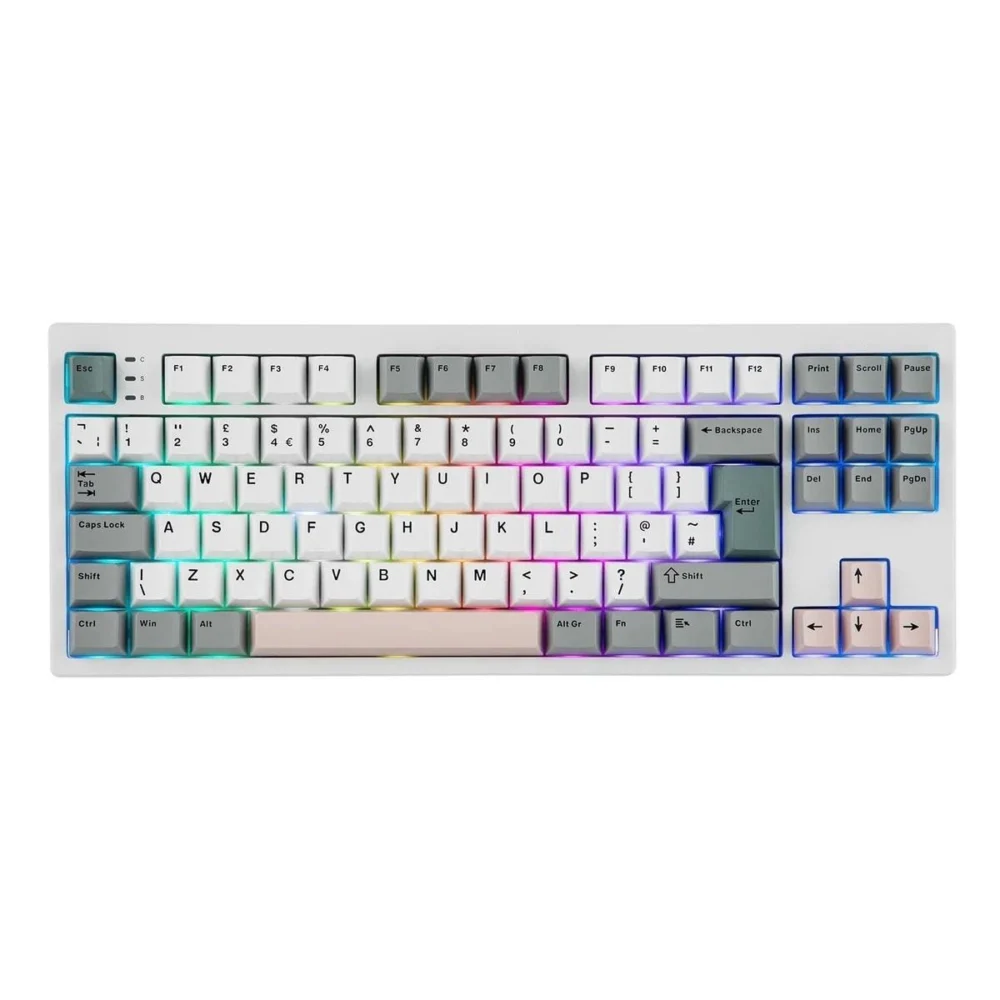
The landscape of personal computing peripherals has undergone a radical transformation over the last decade, shifting from a market dominated by utilitarian, "throwaway" membrane keyboards to one where the mechanical switch reigns supreme. This "mechanical renaissance" is driven by a growing consumer realization that the primary interface between human and machine—the keyboard—should offer more than just a spongy, tactilely vacant experience. Into this competitive fray steps the Epomaker TH87, a Tenkeyless (TKL) wireless gaming keyboard that seeks to redefine the standards of endurance and acoustic performance in the mid-range enthusiast segment. While many manufacturers focus solely on RGB lighting or aesthetic gimmicks, Epomaker’s latest release targets a specific pain point that has long plagued wireless mechanical keyboards: battery anxiety.
At the heart of the TH87’s value proposition is a staggering 10,000mAh rechargeable battery. To put this into perspective, the vast majority of high-end wireless mechanical keyboards on the market currently ship with batteries ranging from 2,000mAh to 4,000mAh. By more than doubling the industry standard, Epomaker is addressing a critical hurdle for users who want the cleanliness of a cable-free desk without the constant chore of plugging in their device every few days. According to the manufacturer’s specifications, this massive reservoir of power translates to approximately 45 hours of continuous use even with the RGB backlighting pushed to its maximum brightness. For users who prefer a more understated look and opt to disable the LEDs, the endurance stretches to an impressive 200 hours. This is a significant milestone for a TKL board, effectively bridging the gap between the convenience of wireless connectivity and the reliability of a wired connection.
The Engineering of Sound and Feel: Beyond the Battery
While the battery life is the headline feature, the internal architecture of the TH87 reveals a deep commitment to the "custom keyboard" philosophy that has recently trickled down into mass-produced units. The keyboard utilizes a gasket-mounted structure, a design choice once reserved for boutique, small-run aluminum kits costing hundreds of dollars. In a gasket-mount system, the plate that holds the switches is not screwed directly into the case; instead, it is sandwiched between layers of dampening material, usually silicone or foam. This allows for a slight amount of "flex" during typing, which significantly reduces the harshness of bottoming out and creates a more consistent acoustic profile across the entire board.
To complement this structural choice, Epomaker has integrated five distinct layers of sound-optimizing materials. These layers are engineered to absorb the high-frequency "clack" and metallic pings that often plague plastic-chassis keyboards, replacing them with the deep, muted "thock" sound that mechanical keyboard enthusiasts crave. This focus on acoustics is further bolstered by the inclusion of Epomaker’s own "Sea Salt" silent switches. These switches are linear in nature, providing a smooth travel without a tactile bump, and are designed to be quiet enough for an office environment while remaining responsive enough for high-stakes gaming.
Furthermore, the TH87 embraces the "hot-swappable" trend, featuring a PCB that allows users to pull out switches and replace them without ever touching a soldering iron. This modularity is a crucial feature for modern consumers; it ensures the longevity of the keyboard by allowing for easy repairs of individual keys and provides a platform for users to experiment with different switch types—be they clicky, tactile, or heavier linear options—as their preferences evolve.
Ergonomics and Aesthetic Versatility
The TH87 adopts the Tenkeyless (87-key) layout, a form factor that has become the gold standard for gamers and productivity enthusiasts alike. By removing the integrated number pad, the keyboard reduces its footprint significantly, allowing for a more ergonomic posture where the user’s mouse hand can be positioned closer to their typing hand. This reduction in shoulder strain is a primary reason for the TKL’s dominance in the professional gaming circuit.
Aesthetically, the TH87 moves away from the aggressive "gamer" tropes of sharp angles and black-on-black plastic. Instead, it presents a sophisticated palette of gray, soft teal, and light blush. The keycaps are crafted from PBT (Polybutylene Terephthalate), a material far superior to the ABS plastic found on most consumer-grade boards. PBT is known for its durability and resistance to the "shine" caused by skin oils over time. The keycaps utilize a Cherry profile, which is slightly lower and more sculpted than the standard OEM profile, facilitating a more comfortable typing rhythm over long sessions.

To further accommodate user comfort, the underside of the TH87 features a two-stage kickstand. This allows for three distinct typing angles—6, 8, and 10.5 degrees—ensuring that users can find the optimal tilt to prevent wrist fatigue. This attention to detail extends to the lighting as well; the TH87 utilizes south-facing LEDs. For the uninitiated, south-facing LEDs are a vital feature for keyboard customizers, as they prevent interference with thicker, enthusiast-grade Cherry profile keycaps, ensuring that the keys can bottom out fully without hitting the LED housing.
Connectivity and Technical Performance
In the realm of wireless performance, the TH87 is a "tri-mode" powerhouse. It supports Bluetooth 5.0, 2.4GHz wireless (via an included dongle), and a traditional wired USB-C connection. For productivity users, the Bluetooth mode is particularly useful, as it can store and switch between three different host devices. A user can seamlessly transition from typing an email on a MacBook to responding to a text on a tablet, and then switch to a Windows workstation with a few keystrokes.
However, for gaming, the 2.4GHz connection is the star of the show. Utilizing a 1000Hz polling rate, the TH87 achieves a latency of just 5ms. While Bluetooth’s 11ms latency is perfectly acceptable for typing, the 5ms response time over 2.4GHz is virtually indistinguishable from a wired connection, meeting the rigorous demands of competitive first-person shooters and rhythm games. This high-speed wireless capability, combined with the massive battery, makes the TH87 a formidable tool for gamers who demand performance without the clutter of cables.
Industry Implications and Expert Analysis
The release of the Epomaker TH87 signals a broader shift in the peripheral industry. We are seeing a "feature war" where mid-range manufacturers are now including specifications that were once the exclusive domain of the enthusiast hobbyist community. Features like gasket mounting, multi-layer sound dampening, and high-capacity batteries are becoming the new baseline. For the consumer, this is a net positive, as the price-to-performance ratio continues to improve. At a retail price of $75.99, the TH87 is positioned aggressively, challenging established giants who often charge twice as much for keyboards with half the battery capacity and inferior build materials.
However, there are areas where the industry still has room to grow. The TH87’s programmable software remains a Windows-only affair. As the "prosumer" market continues to blend Windows gaming with macOS productivity, the lack of cross-platform software support is a lingering hurdle. While the keyboard functions perfectly on a Mac, the ability to remap keys or create complex macros currently requires access to a Windows machine. Furthermore, as layouts become more global, Epomaker’s commitment to offering ISO-DE and ISO-UK layouts is a welcome change in a market that often ignores European and British standards in favor of the US-centric ANSI layout.
Future Trends and Concluding Thoughts
Looking ahead, the success of devices like the TH87 suggests that the next frontier for mechanical keyboards will be power management and sustainable materials. As batteries grow larger, the industry will eventually need to reckon with the environmental impact of these components, perhaps moving toward more easily replaceable battery cells or even solar-assisted charging for low-power modes.
Additionally, the rise of "creamy" and "thocky" sound profiles indicates that haptics and acoustics are now just as important to the consumer as raw performance. We can expect future iterations of this technology to include even more advanced materials, perhaps even integrating AI-driven software to help users customize their RGB effects or macro sequences based on their specific usage patterns.
In conclusion, the Epomaker TH87 is more than just a keyboard with a large battery; it is a manifestation of how far the mechanical keyboard industry has come. By combining enthusiast-grade construction techniques with mainstream wireless convenience and a price point that remains accessible, Epomaker has created a compelling package for anyone looking to upgrade their digital interface. Whether for the coder spending twelve hours a day at the terminal, the writer seeking a tactilely satisfying experience, or the gamer requiring low-latency precision, the TH87 represents a significant step forward in the evolution of the modern desktop. As it becomes available in early February 2026, it will likely serve as a benchmark for what users should expect from a wireless TKL keyboard in the years to come.