

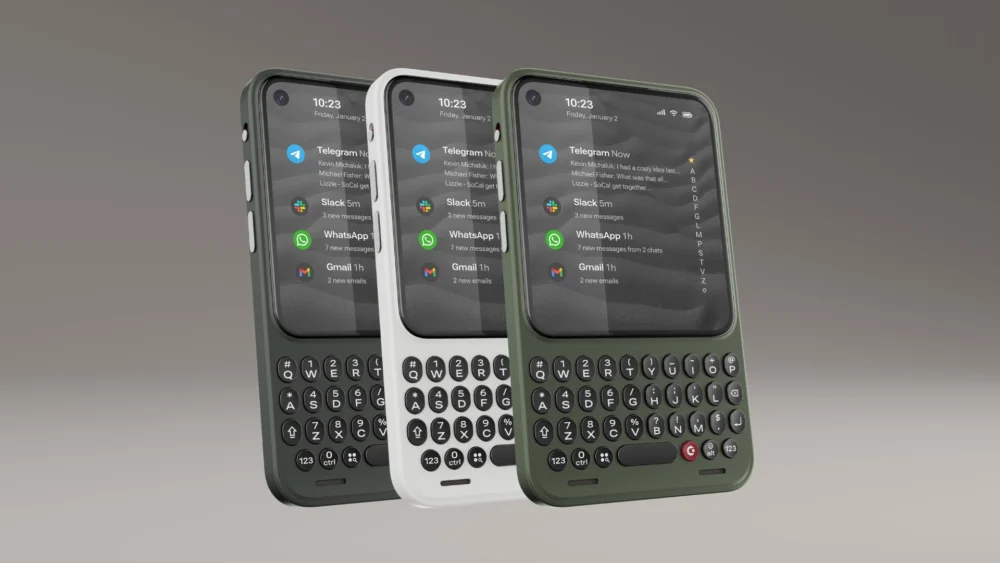
The annual Consumer Electronics Show (CES) often serves as a launchpad for the next generation of consumer electronics, yet sometimes, the most compelling innovations are those that look backward while driving forward. Ahead of this year’s Las Vegas exhibition, Clicks Technology, a company that carved out a specialized niche designing high-quality physical keyboards for modern smartphones, is escalating its hardware ambitions. The company is poised to introduce two pivotal products: its inaugural smartphone, the Communicator, and a versatile, magnetic slide-out peripheral dubbed the Power Keyboard. These devices are strategically engineered not merely as alternatives to standard mobile technology, but as purpose-built tools designed to reclaim productivity and mitigate the pervasive digital distraction that defines the contemporary smartphone experience.
The launch of the Communicator, priced at $499, represents a decisive pivot for Clicks from accessory manufacturer to full-stack device producer. This new Android handset openly embraces the design language and core philosophy of the physical-keyboard era, most notably recalling the legendary BlackBerry devices that once dominated corporate communication. This aesthetic resemblance is highly intentional, targeting a user demographic—the busy professional, the dual-device carrier, and the digital minimalist—who prioritize rapid, tactile input over large, immersive screens.
The Communicator: A Thesis on Purpose-Built Mobile Computing
The underlying market thesis for the Communicator is centered on the professional who maintains separate devices for work and personal life. Clicks views this segment as starved for a device optimized exclusively for high-volume text entry and core productivity tasks. For individuals engaged heavily in instant messaging, complex email composition, or document handling while mobile, the physical QWERTY keyboard offers distinct, measurable advantages in speed and accuracy compared to the ubiquitous, but inherently limited, glass touchscreen.

In a bold move that directly challenges the norms of modern smartphone operating systems, the Communicator integrates a highly restrictive, productivity-focused software layer. Rather than bundling a conventional Android interface, Clicks has collaborated with the developers of the Niagara Launcher. This partnership creates an intentionally sparse environment that steers users toward essential communication and enterprise applications such as Gmail, Telegram, WhatsApp, and Slack. Crucially, access to conventionally "addictive" applications—social media feeds, streaming video services, and high-fidelity games—is either curtailed or entirely removed by design, framing the Communicator as an instrument of focus rather than a portal for endless consumption.
Beyond the keyboard itself, Clicks has integrated several specialized hardware features designed to enhance immediate, focused communication. The most notable is the Signal Light, a customizable light-up button situated on the device’s side. This feature allows users to configure distinct color patterns and luminosity pulses based on the sender, group, or application generating a notification. For example, critical messages from executive VIPs could illuminate the device purple, while less urgent group chats from a specific platform might pulse green. This mechanism effectively provides a highly filtered, ambient awareness system, allowing the user to triage communication urgency without needing to unlock the screen.
Adjacent to the Signal Light is the Prompt Key. This dedicated tactile button currently facilitates quick voice dictation within a text field or the recording of an immediate voice note. However, Clicks is strategically positioning the Prompt Key as a crucial interface for future artificial intelligence (AI) integration. The company anticipates that this physical access point will serve as a launch button for specialized AI agents, rapid note-taking systems, or voice-controlled productivity tools, setting the stage for a hardware-accelerated interaction model with nascent AI technology that is not yet fully realized in the current build.
The Ergonomics of Efficiency
The tactile keyboard is the core differentiating factor of the Communicator. It features an ergonomic layout with physical keys engineered for superior responsiveness and reduced typing fatigue. A significant technical advancement is the keyboard’s touch sensitivity. Unlike earlier generations of physical-key devices, the Communicator’s keyboard doubles as a navigation tool, allowing users to scroll through messages, application lists, and web pages by swiping across the key surface, circumventing the need to constantly lift fingers to interact with the touchscreen. This merging of input methods accelerates workflow and retains the user’s focus on the lower half of the device.

Clicks has also embraced a number of legacy hardware standards often lamented for their absence in modern flagship phones. The Communicator includes a 3.5mm headphone jack, catering to audio professionals and users who prefer wired fidelity or reliability. It supports expandable storage via a microSD slot, accommodating up to 2TB, and features a combined physical SIM and eSIM capability, offering flexibility for dual-line carriers. Furthermore, a configurable tactile switch, initially assigned to airplane mode activation, provides another opportunity for custom user experience, allowing its function to be remapped to control the Signal Light or the keyboard’s touch input. The device is offered in multiple colorways—Smoke, Clover (dark green), and Onyx—with interchangeable back covers to facilitate personalization.
The pricing structure reflects a targeted market approach: a standard retail price of $499 is set, with an early-bird incentive lowering the cost to $399 for customers who place a deposit before the February cutoff. The phone is slated for shipment later in the year.
The Power Keyboard: Modularity and Universal Input
In parallel with the Communicator, Clicks is expanding its successful line of accessories with the Power Keyboard, a highly portable and versatile slide-out peripheral. While Clicks initially built its reputation on dedicated keyboard cases for existing smartphone models, the Power Keyboard represents a step toward universal, cross-platform input solutions.
The Power Keyboard is engineered for maximum adaptability, capable of attaching magnetically to a variety of devices, including smartphones and tablets, utilizing modern standards like MagSafe and Qi2. Its utility extends far beyond handheld devices, offering a practical solution for inputting text on smart TVs, tablets, or even emerging interfaces such as AR/VR headsets, where the reliance on on-screen typing can be cumbersome. The unit is powered by an internal 2,150 mAh battery, ensuring independence from the host device’s power supply.

The design incorporates multiple slider positions, allowing it to securely accommodate various device sizes and orientations, whether used in portrait or landscape mode. The product retains the tactile feedback characteristic of Clicks’ previous designs and offers customization of its functions via an accompanying mobile application available for both iOS and Android. This modular approach allows users of flagship touchscreen devices—who may not commit to a secondary phone like the Communicator—to temporarily augment their productivity during periods of high text volume.
The Power Keyboard is launching at an early-bird price of $79, with a planned retail price of $109, positioning it as an accessible upgrade for professionals seeking improved mobile input.
Industry Implications and the Resurgence of Tactile Input
The launch of Clicks’ new hardware portfolio is not merely a product announcement; it signifies a maturing trend in the post-smartphone era: the bifurcation of mobile device markets based on user intent.
Background Context: The QWERTY Legacy
The physical keyboard was effectively marginalized during the smartphone revolution, primarily because large, bezel-less touchscreens offered a superior platform for multimedia consumption and application diversity. However, the trade-off was a severe degradation in typing efficiency and accuracy. While predictive text and swipe-typing have softened the blow, they have never fully replicated the muscle memory, speed, and cognitive certainty provided by physical keys.

Clicks’ success in shipping over 100,000 keyboard accessories globally, as highlighted by CEO Adrian Li, demonstrates that the demand for tactile input is far from extinct; it is simply underserved by mainstream manufacturers. Li notes that this response validated the market for "purpose-built products that help people communicate with confidence and take action." This movement toward highly specialized devices contrasts sharply with the generalist, one-size-fits-all approach of Apple and Samsung.
Expert-Level Analysis: Digital Segregation and Focus Hardware
The most potent aspect of the Communicator is its embrace of digital segregation. In an environment saturated with notifications and the endless scroll of social feeds, companies like Clicks, alongside minimalist phone makers (e.g., Light Phone), are capitalizing on a growing anti-distraction movement.
For enterprise users, the concept of carrying two phones—one dedicated to work, secured, and focused (the Communicator), and one for personal life and entertainment (a standard flagship)—is becoming a necessary strategy for maintaining work-life boundaries and achieving deep work states. The Communicator’s use of the Niagara Launcher reinforces this boundary at the software level, eliminating the constant temptation of non-essential apps.
Furthermore, the integration of tactile keyboards offers tangible cognitive benefits. Research into mobile input suggests that the haptic feedback and physical registration of keys reduce cognitive load associated with typing, allowing users to focus more on content generation and less on error correction. For high-stakes communication like rapid email responses or live collaboration in tools like Slack, this efficiency is paramount. The $499 price point positions the Communicator affordably within the secondary device category, making the investment justifiable for users whose livelihood depends on fast, accurate mobile text input.

The Modularity Trend:
The Power Keyboard highlights another crucial trend: modularity and cross-device compatibility. As the definition of "smart devices" expands to include AR/VR headsets, smart glasses, and specialized industrial tools, the need for a reliable, portable, universal input method grows. By utilizing standard magnetic attachment systems and Bluetooth connectivity, the Power Keyboard positions itself as a critical bridge, extending tactile QWERTY functionality to devices that inherently lack robust native input methods. The 2,150 mAh internal battery also speaks to the professional need for reliable, extended use without draining the host device.
Future Impact and Trends
The path forward for Clicks and its new Communicator is tied intrinsically to emerging technologies, particularly the accelerating adoption of ambient and generative AI.
The Prompt Key is perhaps the most forward-looking feature on the Communicator. While currently limited to voice dictation, its true potential lies in its role as a dedicated "AI button." As AI agents become more sophisticated—capable of summarizing emails, drafting complex responses, or executing multi-step tasks based on a simple voice prompt—a physical, instant-access button becomes indispensable. This contrasts with accessing AI via a general-purpose voice assistant (like Siri or Google Assistant), which is often buried under layers of competing features. Clicks is betting that the efficiency-driven user will demand dedicated hardware to interface seamlessly with their productivity AI.
If Clicks can successfully foster a community of developers around its platform, leveraging the Niagara Launcher integration to create specialized, distraction-free productivity tools, the Communicator could evolve from a niche device into a powerful micro-platform.

However, challenges remain. The long-term sustainability of the Communicator hinges on consistent software support, security updates, and a competitive hardware refresh cycle, areas where niche players often struggle against industry giants. Furthermore, while the physical keyboard is highly valued by its target demographic, the overall market for dedicated QWERTY devices remains small. Clicks must maintain its focus on the "power user" and the enterprise segment, avoiding the temptation to compete directly with mainstream multimedia-focused flagships.
Ultimately, the Clicks Communicator and Power Keyboard are more than nostalgic throwbacks; they represent a calculated response to the inefficiencies inherent in the monolithic touchscreen paradigm. By championing tactile feedback, anti-distraction software, and modular input, Clicks is positioning itself as a leader in the growing ecosystem of focused, purpose-built mobile technology, offering professionals a deliberate choice to optimize their digital workflow for output, not consumption.