

The evolution of artificial intelligence is rapidly moving beyond simple conversational interfaces and into the very fabric of our digital workspaces. OpenAI’s experimental, Chromium-based web browser, known as Atlas, is undergoing significant feature augmentation that signals a major shift toward deeply integrated, autonomous digital assistance. Recent observations and internal updates suggest the platform is actively testing a sophisticated new capability tentatively labeled "Actions," alongside the development of advanced multimodal understanding, specifically concerning video content. This convergence of proactive task execution and richer sensory input places Atlas at a critical inflection point in the development of truly functional AI agents capable of navigating and manipulating the web on a user’s behalf.
ChatGPT Atlas fundamentally redefines the relationship between a user and the internet by embedding the core power of the large language model (LLM) directly into the browsing environment. The traditional friction point in digital workflows—the constant context switching between a browser window and a separate AI chat application, requiring manual data transfer via copying links, text snippets, or screenshots—is systematically being eliminated. In Atlas, the AI is not merely an external tool; it is an intrinsic co-pilot embedded within the browsing pane. This allows users to pose complex queries, request research synthesis, demand immediate explanations of on-screen content, or even initiate multi-step task completion without ever leaving the current webpage.
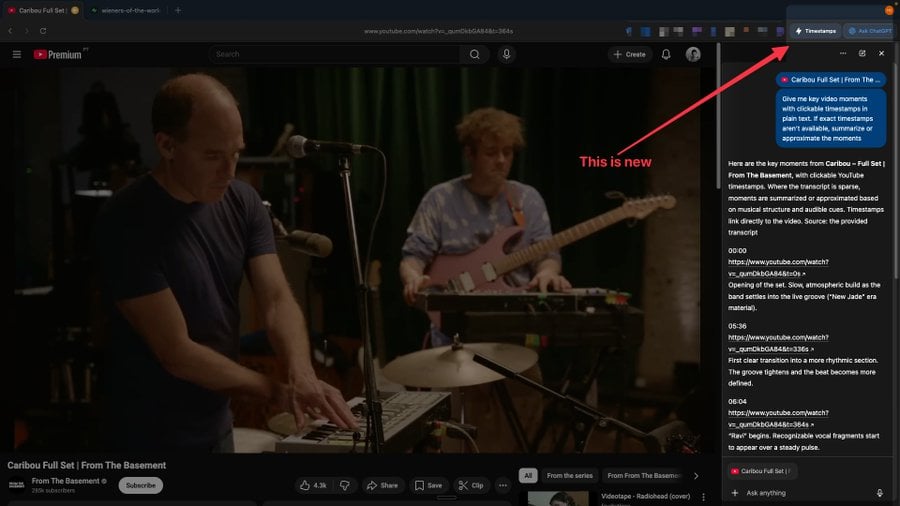
The recent spotlight on video comprehension underscores the platform’s expanding perceptual capabilities. Users have begun noticing the appearance of a "Timestamps" button integrated within the Atlas interface when viewing platforms like YouTube. This feature leverages the AI’s ability to process and structure the context of video content, enabling it to generate precise time markers that link directly to specific segments or topics within the video stream. This is more than a simple transcription aid; it represents a move toward semantic indexing of dynamic media, allowing users to ask the AI, "Summarize the argument made around the 4:30 mark regarding supply chain logistics," and receive an accurate, context-specific answer sourced directly from the video timeline. This capacity for deep media analysis is crucial for industries reliant on continuous learning, such as technical training, financial analysis of broadcasts, or academic research utilizing multimedia sources.
Central to Atlas’s ambition is the concept of persistent, contextual awareness, facilitated by the optional "browser memories" feature. When activated, this capability allows the AI to maintain a longitudinal understanding of the user’s browsing history and preferences across sessions. For instance, if a user is comparing multiple job postings, contract drafts, or complex technical specifications across several tabs visited over days, the browser memory ensures that the AI retains the necessary context to draw meaningful comparisons or synthesize requirements when prompted again. This moves the AI from being purely reactive to being proactively informed by the user’s ongoing digital journey, transforming it into a genuine persistent research assistant.
The most significant leap, hinted at by the emerging "Actions" feature, involves transitioning from passive assistance to active execution. While "Actions" remains in early testing phases, its implications are profound. This functionality suggests the AI will be authorized to interact with the webpage interface—opening new tabs, navigating predefined workflows, filling out forms, or executing clicks based on high-level user commands. Imagine instructing Atlas, "Find three flights matching these dates and book the cheapest one that allows carry-on luggage." The system would theoretically use its "agent mode" to traverse airline websites, interpret dynamic forms, and initiate transactions. OpenAI is understandably approaching this with stringent guardrails, implementing safety limits and heightened scrutiny when the agent operates on sensitive sites, acknowledging the inherent security and trust challenges of granting an LLM autonomy over user actions.
Industry Implications and the Battle for the Browser
The development of Atlas is not merely a feature update for ChatGPT; it represents a direct and existential challenge to the established browser oligopoly dominated by Google Chrome and Microsoft Edge. For decades, the browser has served as the foundational gateway to the digital economy. By deeply embedding an LLM—especially one as powerful as GPT—into the core rendering engine, OpenAI is attempting to re-architect the user experience around AI interaction rather than traditional navigation paradigms.
If Atlas achieves widespread adoption, it threatens to sever the direct connection between users and the underlying web architecture that current browsers maintain. Instead of users relying on search engine optimization (SEO) or direct URL navigation, the primary point of entry becomes the AI’s interpretation of the web. This shift implies that the value accrues to the entity controlling the most capable browsing AI, rather than the entity controlling the most widely used rendering engine.
Furthermore, the integration of "Actions" forces a re-evaluation of software interface design. Current web applications are built around human interaction models (clicks, scrolls, keyboard inputs). Atlas aims to replace this with an agentic model, where workflows are defined by natural language commands executed by an AI interpreter. This places immense pressure on developers to ensure their sites are easily parsable and safely executable by these nascent AI agents. Poorly designed forms or reliance on complex JavaScript interactions could become immediate roadblocks for autonomous browsing.
Expert Analysis: The Architecture of Trust and Agency
From a technical standpoint, Atlas’s success hinges on solving several monumental challenges in AI alignment and computational efficiency. The ability to reliably process live, dynamic webpage DOM structures, coupled with the complexity of video streams, demands highly optimized multimodal models running with low latency.
The "browser memories" feature touches upon advanced concepts in personalized AI. Maintaining context across sessions without incurring prohibitive computational costs or violating privacy expectations requires sophisticated memory management techniques, likely involving local processing or highly secure, anonymized vector databases. The core challenge here is balancing utility (remembering crucial details) against data sprawl and potential over-reliance on historical context that might become outdated or biased.
The "Actions" feature introduces the thorny issue of AI safety and reliability, often discussed in the context of securing AI agents. When an agent is permitted to execute commands, the potential for error escalation is significant. A simple misinterpretation of a command could lead to unintended financial transactions, the deletion of data, or the compromise of account credentials if security protocols are bypassed or misinterpreted. OpenAI’s focus on "safety limits and extra caution" suggests they are implementing a layered control structure—perhaps requiring explicit user confirmation for high-risk actions, or using smaller, specialized models for task execution that are more constrained than the core conversational LLM. The long-term viability of agentic browsing depends entirely on establishing a near-perfect chain of verifiable intent between the user’s natural language request and the agent’s final execution.
Beyond Stability: Quality of Life and Platform Expansion
While the headline features capture attention, the underlying infrastructure updates detailed in recent release notes confirm a serious commitment to making Atlas a robust daily driver, not just a technological showcase. Significant engineering effort is being directed toward resolving memory overuse bugs—a common pitfall in integrating resource-intensive LLMs into client-side applications—and refining the user interface (UI) experience.
Improvements to the "what to ask next" suggestions, even when the sidebar is minimized, indicate a focus on seamless integration into existing user habits. If the AI can proactively prompt the user with relevant follow-up questions based on the page content, it reduces the cognitive load required to initiate AI interaction. Similarly, quality-of-life enhancements like the instant display of the five most recent tabs in the Tab Search function, and the universal shortcut mapping (Cmd+K) for search activation, demonstrate an understanding that power must be paired with usability. These are the details that convert a novel technology into indispensable software.
The announced intention to bring Atlas support to Windows 11 broadens the potential user base significantly. By targeting a major desktop operating system, OpenAI signals a strategy aimed at mass-market adoption rather than confining the technology to a niche early-adopter group. This expansion suggests that the core engine has reached a level of stability deemed sufficient for deployment outside of potentially more controlled early testing environments.
Future Trajectories: The Agent Ecosystem
The trajectory suggested by Atlas—a multimodal, context-aware, and increasingly autonomous browsing agent—points toward a future where personalized LLMs act as the primary interface layer for all digital interaction.
-
Hyper-Personalized Browsing: Future iterations of Atlas will likely integrate deeply with personal data ecosystems (with explicit user permission), allowing the AI to tailor search results, content filtering, and task execution based not just on current browsing context, but on years of personal correspondence, work history, and financial data accessible via secure plugins or APIs.
-
The Death of the Web Form: If agentic capabilities mature, users may cease interacting with traditional web forms entirely. Instead, they will provide an end goal ("Renew my car insurance policy for next year, ensuring comprehensive coverage is maintained"), and the agent will navigate the required steps across potentially disparate provider sites to achieve the outcome.
-
New Security Paradigms: The rise of agentic browsers necessitates a complete overhaul of current web security models. Traditional defenses against cross-site scripting (XSS) or phishing, which rely on preventing malicious code execution or user deception, become insufficient when the primary actor is a trusted, highly capable AI. Future security will rely heavily on verifiable intent protocols, fine-grained permissioning for agent actions, and cryptographic proof that the AI is executing the user’s desired workflow, rather than an unintended or malicious one.
OpenAI’s Atlas is positioning itself as the vanguard in the transformation of the browser from a document retrieval tool into a sophisticated, proactive operating system overlay. The integration of "Actions" and enhanced media understanding indicates a clear path toward generalized digital agency, a development that will reshape how individuals and enterprises interact with the internet fundamentally.