

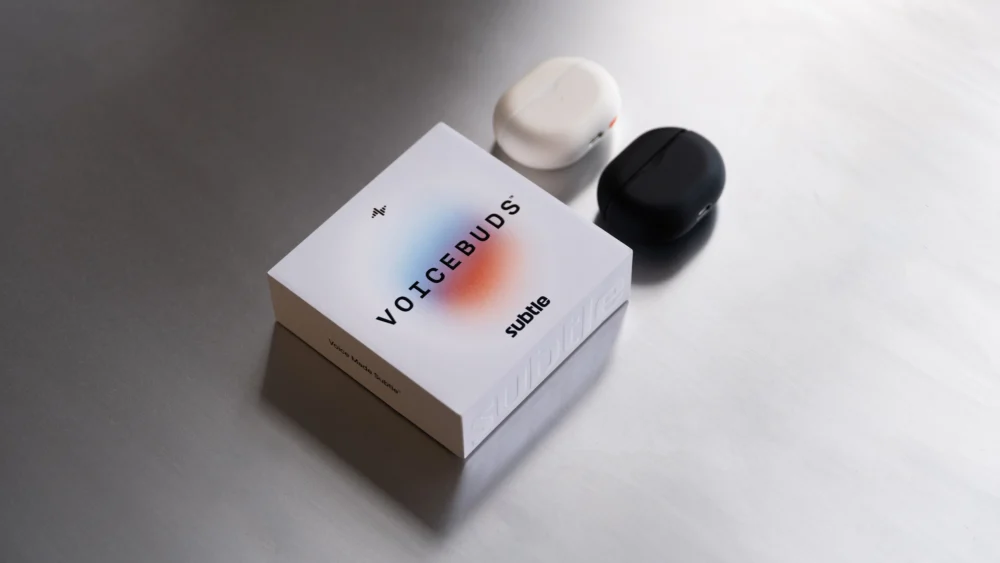
The integration of advanced artificial intelligence directly into personal audio hardware has reached a critical inflection point, highlighted by the recent announcement from Subtle, a voice AI startup specializing in sophisticated acoustic isolation models. Unveiling its inaugural consumer hardware product, the Voicebuds, Subtle is making a decisive entry into the highly competitive true wireless stereo (TWS) market, not merely as a high-fidelity audio device, but as a dedicated, hyper-accurate machine interface for the emerging ambient computing paradigm.
Ahead of the highly anticipated Consumer Electronics Show (CES) in Las Vegas, Subtle formally introduced these wireless earbuds, positioning them as a radical solution to the perennial problem of accurate voice transcription and communication in loud or complex acoustic environments. The core proposition is straightforward: leveraging Subtle’s proprietary voice isolation technology, the Voicebuds promise crystal-clear vocal capture for remote calls and, crucially, flawless transcription accuracy for dictation and interaction with generative AI services. The company has confirmed that the Voicebuds, priced at $199, are slated for shipment in the U.S. within the coming months, bundled with a year-long subscription to the companion iOS and Mac application.
This bundled software ecosystem is essential to the Voicebuds’ value proposition, allowing users to initiate voice notes, dictate complex documents, or engage in real-time conversations with large language models (LLMs) without the need to physically press or interact with the host device. A significant technical achievement touted by Subtle is the integration of specialized silicon within the buds that facilitates a low-power "always-listening" state, capable of waking a locked iPhone instantaneously upon receiving a voice command. This feature bypasses many of the current limitations inherent in standard Bluetooth accessory protocols, moving closer to a truly seamless, hands-free interaction model.
The Technical Edge in Acoustic Isolation
Subtle’s foundation rests upon its expertise in deep learning models engineered specifically for environmental noise suppression and speaker diarization—the ability to isolate a single human voice amidst competing sounds, including other voices, traffic, or music. While many contemporary noise-canceling headphones focus on eliminating incoming ambient noise for the listener (Active Noise Cancellation, or ANC), Subtle focuses on the reverse: isolating the user’s voice for the computer or the recipient on the other end of a call.
The performance claims surrounding the Voicebuds are ambitious and directly target the industry leaders. Subtle asserted that their hardware, when combined with their proprietary acoustic models, yields five times fewer transcription errors compared to a premium market standard—specifically citing Apple’s AirPods Pro 3 utilized in conjunction with leading third-party transcription services, such as those powered by OpenAI’s models.
This quantitative claim highlights a sophisticated approach to Automatic Speech Recognition (ASR) optimization. Traditional transcription models struggle significantly when the input audio quality degrades due to proximity to the microphone, environmental noise contamination, or dynamic changes in the speaker’s vocal volume. Subtle’s co-founder and CEO, Tyler Chen, demonstrated the technology’s capability by capturing audio accurately in a highly noisy setting. Even more compelling was the demonstration of capturing a voice note precisely when Chen spoke in a barely audible whispering tone. This "whisper capture" ability is a hallmark of advanced acoustic filtering, proving the system can reliably differentiate ultra-low-volume human speech from background hiss and noise floor—a capability vital for maintaining privacy and usability in shared public spaces.
Chen articulated the company’s strategic vision, noting, “We are seeing that there is a huge move towards voice as a new interface that a lot of folks are adopting. You can do much more with voice in a natural way than with a keyboard. However, we saw that voice is rarely an interface people use when others are around. So that using our noise isolation model, we will give consumers a way to experience a voice interface in the form of our earbuds.”
Redefining the Voice Dictation Battleground
The launch of the Voicebuds immediately escalates competition within the increasingly crowded AI-powered dictation and productivity sector. Subtle is entering a field currently dominated by sophisticated software solutions such as Wispr Flow, Willow, Monolouge, and Superwhisper. These applications have revolutionized text input by utilizing cloud-based AI to transcribe complex vocabulary and context-heavy speech. However, these software-only solutions remain fundamentally reliant on the quality of the raw audio input provided by the device’s microphone—which, in the case of standard phone microphones or even typical TWS earbuds, is often insufficient for perfect accuracy in non-ideal settings.
Subtle’s strategy is to vertically integrate the hardware, the acoustic models, and the software interface, thus controlling the entire signal chain from sound wave to processed text. By achieving superior noise isolation at the hardware level, Subtle minimizes the computational burden and error rate for the downstream ASR algorithms, giving them a significant advantage over software competitors forced to process noisy, compromised audio streams. Furthermore, the Voicebuds are designed to function as an omnipresent input device, allowing users to dictate directly into any application on their host device, seamlessly overriding the standard keyboard input method.
This move mirrors a broader industry trend where specialized, purpose-built hardware is emerging to support highly specific AI functions. In the past year, we have seen the rise of dedicated, minimalist devices focused purely on ambient note-taking, such as smart rings launched by companies like Sandbar and Pebble. While these wearables emphasize discretion and rapid capture, Chen emphasizes that the Voicebuds aim for comprehensive integration, offering dictation, AI chat, and voice notes combined into a single, cohesive package, capitalizing on the user’s existing habit of wearing earbuds.
Expert Analysis: Edge AI, Latency, and Privacy
The decision by Subtle to integrate dedicated processing capabilities—the specialized chip that enables waking a locked host device—is a critical component of their Edge AI strategy. Traditional cloud-based ASR systems, while powerful, suffer from inherent latency issues and reliance on persistent internet connectivity. For a voice interface to truly supplant the keyboard, it must be instantaneous. The ability to process initial commands and acoustic filtering at the edge (on the earbuds themselves) drastically reduces latency, creating a snappier, more natural user experience.
Moreover, the Edge AI approach carries significant implications for data privacy. By performing the intense voice isolation and initial transcription processing locally on the hardware before sending the refined, clean vocal data to the host device or the cloud, Subtle potentially reduces the amount of raw, private acoustic data transmitted over networks. This architecture aligns with growing consumer demand for greater control over personal data, especially sensitive biometric voice data.
The Voicebuds’ pricing strategy is also noteworthy. At $199, they are competitively priced against mid-to-high-tier consumer TWS devices, but the mandatory inclusion of a year-long subscription signals a commitment to a software-as-a-service (SaaS) model for the advanced features. This recurring revenue stream suggests that the core value lies not just in the physical transducers and microphones, but in the continually updated, proprietary noise isolation and ASR optimization models. This guarantees ongoing development and refinement of the AI experience, differentiating them from traditional hardware vendors whose product functionality often stagnates post-launch.
Industry Implications and Strategic Partnerships
Subtle is not operating in a vacuum. The startup has successfully raised $6 million in seed funding, a testament to the perceived value of their core voice isolation intellectual property (IP). Crucially, the company has been collaborating with established consumer electronics giants, including chipmaker Qualcomm and hardware innovator Nothing, to deploy its voice isolation models into their products.
These partnerships reveal a dual strategy: first, establishing Subtle as a key B2B provider of foundational acoustic AI for other hardware manufacturers; and second, leveraging this validated technology to launch its own flagship consumer product. Working with Qualcomm, a leader in mobile processor and audio technology, validates the robustness and efficiency of Subtle’s algorithms, suggesting they are optimized for real-world application on constrained mobile hardware.
The broader industry implication is that the future of personal audio is rapidly diverging from pure entertainment. Earbuds are transitioning from devices focused solely on music playback or basic communication to highly personalized, proactive computing interfaces. This trend, often termed "hearables" or "ambient computing," requires devices that can intelligently filter the world, capture user intent flawlessly, and facilitate interaction with complex AI systems—whether that is dictating a novel, generating code via voice command, or querying a generative model while walking through a busy city intersection.
The Future Trajectory of Conversational AI and Wearables
The introduction of the Voicebuds accelerates the transition toward a voice-first computing environment, particularly in professional and high-productivity settings. For professions that rely heavily on accurate documentation—journalism, medicine, law enforcement—the error rate of transcription is a decisive factor. A 5x reduction in errors, as claimed by Subtle, translates directly into massive time savings by minimizing the need for manual correction and editing, dramatically increasing the feasibility of utilizing voice dictation as a primary input method for long-form content.
Looking ahead, Subtle’s success will hinge on two factors: maintaining its technical lead in voice isolation and successfully building out the application ecosystem. The current offering focuses on dictation and AI chat, but the potential is far broader. Future iterations could integrate real-time language translation enhanced by noise isolation, allowing for clear cross-lingual conversations in chaotic environments. Furthermore, integrating subtle biometrics—monitoring heart rate or stress levels based on vocal tone changes—could turn the Voicebuds into a comprehensive wellness and productivity companion.
The competitive pressure applied by startups like Subtle is forcing established giants like Apple, Google, and Samsung to rapidly enhance the microphone and ASR capabilities of their own TWS devices. The era of generic noise cancellation is giving way to targeted voice intelligence. Subtle has staked its claim on the premise that the quality of the input is paramount, challenging the prevailing notion that software optimization alone can solve the problems inherent in noisy acoustic capture.
Available for pre-order in classic black and white colorways via the startup’s website, the Voicebuds represent a bold step in hardware-AI integration. By solving the fundamental challenge of reliable voice input in a diverse world, Subtle aims to make the promise of voice as the ultimate, natural interface a practical reality for the masses, fundamentally altering how users interact with their digital ecosystems in 2026 and beyond.