

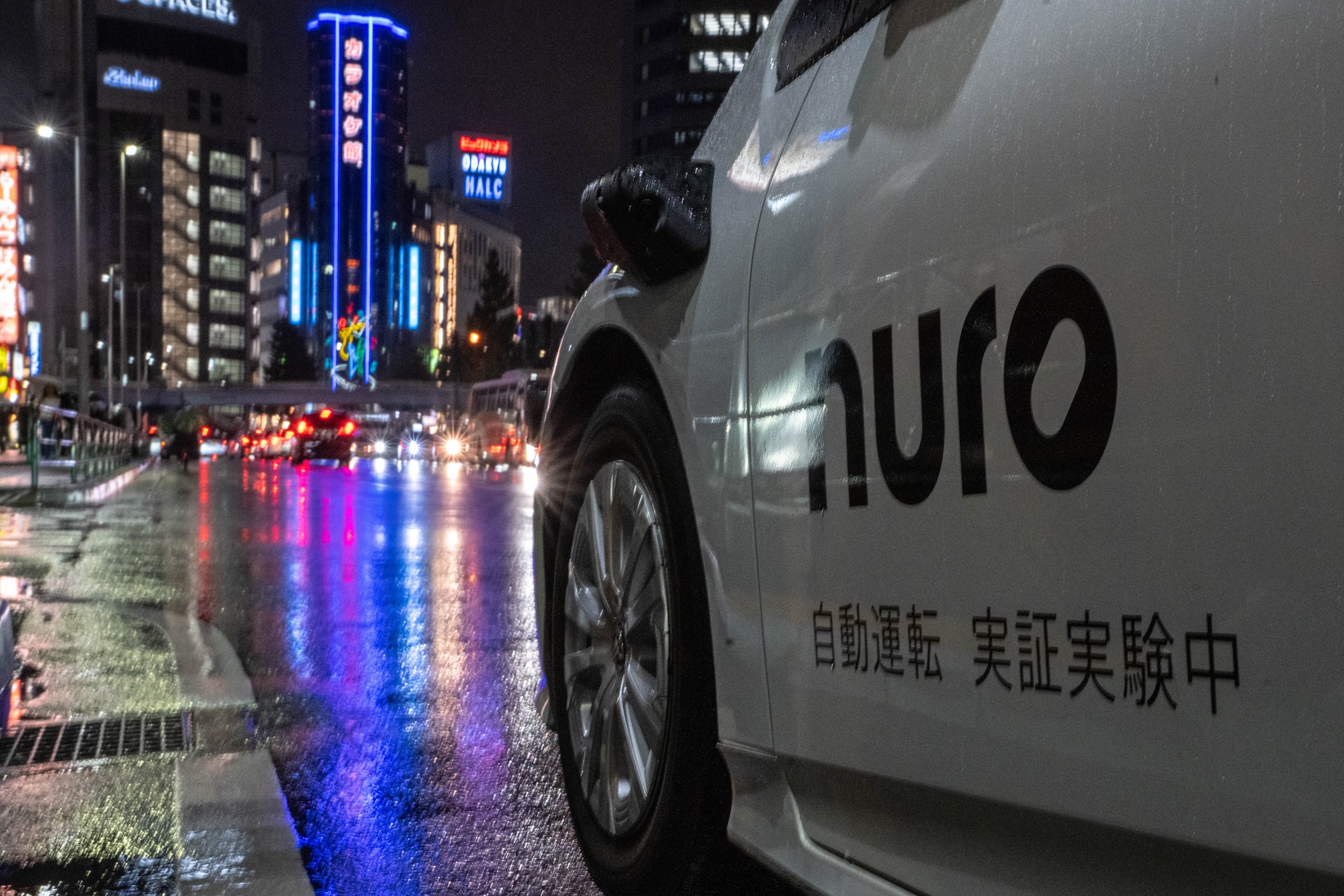
The streets of Tokyo, renowned for their intricate geometry, dense pedestrian surges, and the disciplined chaos of left-hand traffic, have become the latest proving ground for Silicon Valley’s most ambitious pivot in the autonomous vehicle (AV) sector. Nuro, the robotics firm that rose to prominence on the promise of specialized delivery "toasters," has officially commenced public road testing in Japan’s capital. This move is far more than a simple geographic expansion; it represents a high-stakes validation of Nuro’s radical transition from a hardware-centric delivery startup to a software-first licensing powerhouse, powered by a new generation of "zero-shot" artificial intelligence.
For several weeks, a fleet of Toyota Prius vehicles, retrofitted with Nuro’s sophisticated sensor suites and proprietary autonomy stack, has been weaving through the narrow arteries of Tokyo. While human safety operators remain vigilantly behind the wheel—a standard protocol for early-stage urban testing—the software at the helm is attempting to prove a thesis that could redefine the industry: that a foundation model trained primarily on American roads can generalize its intelligence to navigate a foreign metropolis with almost no prior exposure.
The Great Pivot: From Delivery Bots to Licensing Logic
To understand the weight of Nuro’s Tokyo mission, one must look back at the company’s dramatic structural evolution. Founded in 2016 by Dave Ferguson and Jiajun Zhu—two alumni of Google’s pioneering self-driving project, now known as Waymo—Nuro initially sought to own the "last mile" of logistics. Their vision was the R1 and later the R2: narrow, unmanned electric pods designed solely to carry groceries, laundry, or pizza. By removing the passenger from the vehicle, Nuro argued it could prioritize safety and lower costs, bypassing the stringent crash-test requirements of passenger-carrying cars.
This vision attracted staggering capital, most notably a $940 million infusion from the SoftBank Vision Fund in 2019. However, the reality of the AV industry in the early 2020s proved harsh. The high capital expenditure required to manufacture and maintain a massive fleet of custom robots, combined with the slow pace of regulatory approval for driverless delivery, forced a reckoning. In 2024, Nuro fundamentally upended its business model. It moved away from operating its own delivery fleet and toward licensing its autonomy stack to third-party manufacturers and mobility providers.
The Tokyo testing is the first tangible evidence of this "Asset Light" strategy. By utilizing the Toyota Prius—a staple of the Japanese automotive landscape—Nuro is demonstrating that its software is platform-agnostic. It is no longer just a robot company; it is an AI company aiming to be the operating system for the next generation of mobility.
The Technical Frontier: End-to-End AI and "Zero-Shot" Driving
The core of Nuro’s value proposition lies in its shift toward an "end-to-end" AI architecture. Traditionally, autonomous driving systems were modular. One part of the software would detect objects (perception), another would predict their movement (prediction), and a third would decide the car’s path (planning). While effective, these systems often struggle with "edge cases"—rare scenarios that engineers didn’t specifically code for.
Nuro’s new approach utilizes a large-scale AI foundation model, similar in philosophy to the Large Language Models (LLMs) that power ChatGPT. This system processes raw sensor data—video, lidar, and radar—and translates it directly into driving commands. The company refers to this capability as "zero-shot autonomous driving." In theory, because the model has learned the fundamental "grammar" of driving from millions of hours of data, it can be dropped into a new environment, like Tokyo, and understand how to navigate without needing a pre-mapped "geofence" or thousands of hours of local training data.
Testing in Japan provides the ultimate stress test for this AI. Tokyo’s road ecosystem is vastly different from the wide, gridded boulevards of Mountain View or Houston. The shift to left-hand driving is the most obvious hurdle, but the nuances go deeper. Japanese road signs use different iconography; lane markings are often narrower and more complex; and the etiquette of interacting with cyclists and pedestrians follows a distinct cultural logic. Nuro’s ability to handle these variables in "shadow mode"—where the AI calculates its intended actions in real-time while a human drives—is the prerequisite for eventual fully autonomous operation.
Why Japan? The Strategic and Demographic Magnet
Nuro’s choice of Tokyo as its first international hub is a calculated move that aligns with Japan’s broader socio-economic needs. Japan is currently facing a demographic crisis characterized by a rapidly aging population and a shrinking workforce. This has led to a critical shortage of commercial drivers, threatening the nation’s robust logistics and taxi networks.
The Japanese government has responded by becoming one of the most proactive regulators in the AV space, actively encouraging the deployment of Level 4 autonomous systems (vehicles that can drive themselves under specific conditions without human intervention). For Nuro, Japan represents a market that is not just technologically ready, but socially desperate for autonomous solutions.
Furthermore, the presence of SoftBank and Toyota in Japan provides a natural ecosystem of support. While Nuro has not officially announced a deep partnership with Toyota beyond the use of their vehicles for testing, the proximity is telling. As traditional automakers scramble to compete with Tesla’s "Full Self-Driving" (FSD) and Waymo’s robotaxis, the ability to license a proven, globally adaptable AI stack like Nuro’s becomes an attractive shortcut to modernization.
The Financial Engine: Backing from the Titans
Nuro’s pivot and expansion are fueled by a recent $203 million Series E funding round, which notably included participation from Nvidia and Uber. Nvidia’s involvement is particularly significant. As the world’s leading provider of the GPUs used to train AI models, Nvidia is increasingly positioning itself as the foundational hardware layer for the autonomous revolution. Their investment in Nuro suggests a belief that Nuro’s end-to-end AI approach is the correct technical path.
Uber’s involvement adds another layer of intrigue. Having sold off its own internal self-driving unit years ago, Uber is now pursuing a strategy of becoming the "platform of choice" for all AV developers. By investing in Nuro—and recently announcing a multi-million-dollar deal involving the electric car maker Lucid—Uber is securing its future as the bridge between autonomous technology and the consumer. If Nuro’s tech proves successful in the dense urban environment of Tokyo, it could eventually power a fleet of Uber-branded robotaxis or delivery vehicles across Asia and beyond.
Safety in the Shadow Mode
Despite the bullish technical claims, Nuro is treading carefully. The company’s safety protocol involves a multi-stage validation process. Before a single tire touched Tokyo pavement, the "universal autonomy model" was put through thousands of hours of simulation, testing "edge cases" that would be too dangerous to attempt in the real world.
Once on the road, the vehicles operate in "shadow mode." In this state, the AI is "driving" in a virtual sense—calculating every turn, brake, and acceleration—but its commands are blocked from reaching the car’s actuators. Nuro’s engineers then compare the AI’s intended actions against the human driver’s actual movements. Only when the software consistently proves it can match or exceed human performance in these complex environments will the safety drivers be phased out.
Competitive Landscape: The Global AI Arms Race
Nuro is not alone in its pursuit of end-to-end AI for driving. The U.K.-based startup Wayve recently secured a massive $1.2 billion investment, also backed by Nvidia and Uber, to pursue a remarkably similar path. Meanwhile, Tesla continues to iterate on its vision-based FSD system, and Waymo remains the gold standard for deployed, geofenced autonomy.
The competition is no longer just about who can build the best car; it is about who can build the most "generalized" intelligence. If Nuro can successfully navigate Tokyo—a city that would typically require a ground-up rebuild of a traditional modular AV system—it proves that its AI is a "global citizen." This portability is the "holy grail" for licensing. A car manufacturer in Europe or a delivery firm in Southeast Asia could, in theory, adopt Nuro’s tech and have a functional fleet in weeks rather than years.
Conclusion: The Road Ahead
As Nuro’s Priuses continue their silent loops through Shinjuku and Shibuya, they are carrying the weight of a company’s future and the industry’s expectations. The "compounding benefits of global deployment," as Nuro describes them, are clear: every kilometer driven in Tokyo makes the AI smarter in San Francisco, and vice versa.
The transition from a quirky delivery bot startup to a global AI architect is a bold gambit. It acknowledges that in the world of autonomous vehicles, the hardware is a commodity, but the intelligence is the prize. If Nuro can master the neon-lit complexity of Tokyo’s streets, it will have done more than just expand its territory; it will have proven that the future of mobility is not built in a factory, but in the neural networks of a foundation model that views the world’s roads as one single, solvable puzzle. For the citizens of Tokyo, and the global logistics industry watching from the sidelines, the arrival of Nuro signals that the era of truly borderless autonomous intelligence is no longer a distant horizon, but a present reality.