

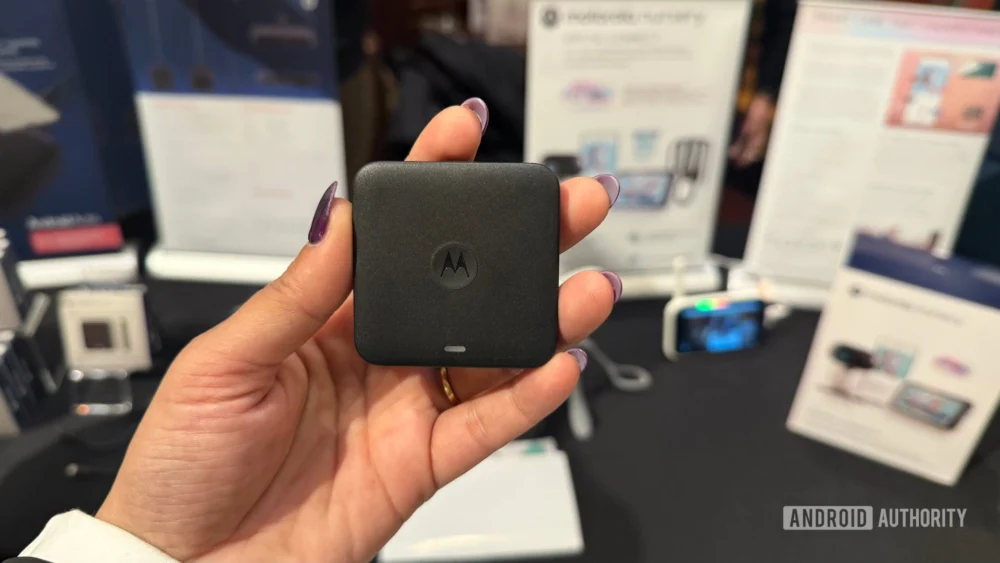
The proliferation of seamless in-car connectivity remains a critical battleground for consumer electronics, and Motorola’s latest offering, the MA2 wireless adapter, signals a determined push to eliminate the last vestiges of cable dependency for Android Auto users. Unveiled amidst the bustling exhibits of Mobile World Congress (MWC) 2026, this compact piece of hardware positions itself not just as an iterative upgrade but as a strategic move to capture significant market share in the aftermarket automotive accessory sector.
The MA2 is the direct successor to the well-regarded MA1 adapter, which initially pioneered the concept of converting factory-installed, wired Android Auto setups into fully wireless environments. In the years since the MA1’s debut, the aftermarket for these dongles has matured significantly, evidenced by the emergence of competitors like AAWireless. Motorola’s strategy appears to hinge on leveraging brand recognition and aggressive pricing to democratize wireless connectivity, transforming a convenience feature into an expected standard.
Physically, the MA2 presents a refined aesthetic. Moving away from the predecessor’s somewhat organic "squircle" design, the new iteration adopts a more utilitarian, flat, square black enclosure. This minimalist redesign suggests a focus on discretion and durability within the often-cramped confines of a vehicle’s dashboard area. Functionally, the core mechanism remains robust: utilizing 5GHz Wi-Fi for the high-bandwidth data stream required by Android Auto—ensuring low-latency performance for navigation, media streaming, and communication—while relying on Bluetooth for the initial handshake, device pairing, and maintaining a reliable reconnection profile when the vehicle is started.
A significant enhancement in the MA2 targets multi-user households or shared vehicles. The adapter now boasts simultaneous pairing capability for two distinct smartphones. This addresses a common pain point where users must manually disconnect and reconnect their devices when switching drivers. The MA2 incorporates a physical toggle switch, allowing the driver or passenger to instantaneously switch the active connection between the two paired phones with a simple press, streamlining the transition process substantially.
Beyond core connectivity, Motorola has integrated several thoughtful quality-of-life improvements that underscore an understanding of real-world usage patterns. Recognizing that many modern vehicles maintain a persistent power supply to their USB ports even when the ignition is off, the MA2 features a dedicated physical power switch. This inclusion is crucial for preventing parasitic battery drain, offering users granular control over power consumption when the adapter is not actively in use. Furthermore, an integrated LED connection indicator provides immediate visual feedback on the adapter’s operational status—pairing, connected, or disconnected—a small but vital addition for troubleshooting.
Perhaps the most commercially astute inclusion is the rethinking of physical connectivity options. The MA2 ships with both detachable USB-A and USB-C cables. This dual-cable approach immediately broadens the compatibility spectrum across the vast installed base of vehicles, many of which still rely on the legacy USB-A standard for data transfer, while newer models incorporate USB-C. The detachable nature also provides flexibility; users can substitute the included cables with their preferred, potentially higher-specification, cables if desired, avoiding the proprietary limitations often found in single-cable dongles. The setup process remains admirably straightforward: plug into the existing Android Auto USB port, complete the initial Bluetooth pairing, and the system defaults to wireless operation thereafter.
The anticipated launch pricing, hovering around $40, places the MA2 in a highly competitive bracket. This aggressive positioning directly undercuts premium offerings like the AAWireless Two, which often retail significantly higher. For the average consumer whose primary goal is the elimination of the charging cable tether, Motorola is presenting a value proposition that is difficult to ignore. If execution matches the promise, this price point could serve as a disruptive force, forcing competitors to reassess their own tiered pricing structures.
Industry Context and The Wireless Imperative
The introduction of the MA2 must be viewed within the broader evolution of automotive infotainment. For years, wired Android Auto and Apple CarPlay were essential features, often viewed as compromises compared to native head unit integration. However, as smartphones became the primary interface for navigation (Waze, Google Maps) and communication, the friction caused by physically tethering the device—often leading to charging port congestion and inconvenient cable management—became increasingly intolerable for consumers.
This pain point fueled the rise of the aftermarket adapter industry. These dongles operate by essentially emulating a compatible head unit that supports wireless projection, bridging the gap between the phone’s wireless capabilities and the car’s wired hardware limitations. While major automakers are gradually rolling out native wireless support across new vehicle lines, the lifecycle of automobiles is long, ensuring a massive installed base of wired-only systems for the foreseeable future. This installed base represents a persistent, addressable market for retrofit solutions.
Motorola’s entry, or rather, its determined re-entry with an updated product, signifies a belief that this market segment is far from saturated. Their advantage lies in existing OEM relationships and consumer familiarity, even if their primary focus is currently on the aftermarket. By offering robust features—dual-phone support, power control, and improved physical connectivity—at a near-entry-level price, the MA2 aims to convert users who might have been hesitant due to price sensitivity or concerns about the reliability of lesser-known brands.
Expert Analysis: Technical Considerations and Reliability
From a technical standpoint, the success of any wireless Android Auto adapter rests entirely on the stability and latency of the 5GHz Wi-Fi connection. While Bluetooth is adequate for initial pairing and signal management, the actual audio, video, and touch input data must traverse the Wi-Fi link. Any significant packet loss or excessive latency renders the experience frustrating, potentially leading to dropped connections or laggy map interactions.
The commitment to 5GHz Wi-Fi is standard practice, but the quality of the internal antenna design and the firmware’s optimization algorithms are the real differentiators. Motorola, drawing on its experience in wireless technology, presumably has the engineering depth to optimize these factors. The inclusion of an on/off switch, while seemingly basic, speaks volumes about understanding potential power management conflicts within vehicle electronics—a common failure point for poorly designed USB accessories.
The dual-pairing feature introduces a layer of software complexity. The adapter must efficiently manage two active Bluetooth profiles and rapidly determine which device is the primary driver’s phone (perhaps based on proximity or previous usage patterns) when switching. If the switching mechanism is clunky or slow, it negates the benefit of the hardware button. The true test for the MA2 will come post-launch as thousands of units interact with diverse infotainment systems across various manufacturers (Ford, Toyota, Volkswagen, etc.), each presenting unique USB handshake protocols.
Future Impact and Market Trajectory
The MA2’s impending Q3 2026 US availability, following a May soft launch, suggests Motorola is positioning this product for the peak driving season. If the $40 price point holds, it could significantly compress the margins for existing third-party adapter manufacturers. It forces a re-evaluation: can competitors justify a $70 or $100 price tag when a major established brand offers comparable core functionality for nearly a third of the cost?
This development is indicative of a broader trend toward commoditization in in-car tech accessories. As the underlying technology standards (like Wi-Fi Direct implementations) become mature and standardized, the competitive advantage shifts from raw innovation to manufacturing efficiency, branding, and feature set refinement (like the MA2’s power switch).
Looking forward, the next frontier for these adapters might involve integrating support for the upcoming generation of connected car standards, such as enhanced versions of Android Automotive OS integration or even rudimentary support for split-screen scenarios if future software allows. However, for the immediate future, the battle remains tethered to simplicity and cost. Motorola appears determined to make the wired connection an artifact of the past, ensuring that the convenience of wireless projection is accessible to the widest possible segment of the driving public before vehicle manufacturers fully transition their entire fleets. The MA2 is not merely an adapter; it is an aggressive statement about accessibility in the connected cockpit ecosystem. Its success will depend on delivering consistent, lag-free performance that justifies its extremely attractive projected retail position.