

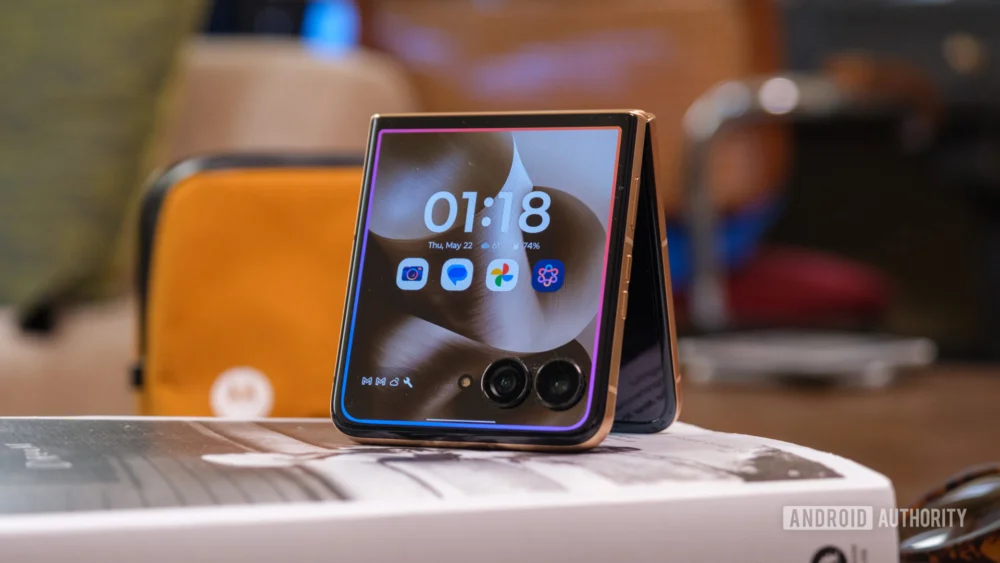
The protracted wait for owners of the Motorola Razr 2025 and the premium Razr Ultra in the United States is officially concluded, as both foldable devices have begun receiving the stable build of Android 16. This deployment marks a significant milestone for Motorola’s flagship clamshell lineup, which has seen considerable market success this generation by offering compelling hardware design coupled with competitive pricing, particularly in the Ultra variant. While the rollout has already commenced in international territories, such as key European markets and India, for approximately a month, the localized, carrier-specific distribution in the highly competitive North American ecosystem has been noticeably delayed. The arrival of this major operating system update, confirmed across devices serviced by Verizon and T-Mobile, signals a crucial step in maintaining the relevance and feature parity of these devices against rivals in the rapidly evolving foldable segment.
The context surrounding this update is vital for understanding its significance. Motorola, under Lenovo’s stewardship, has aggressively positioned the Razr series as a serious contender against established giants like Samsung’s Galaxy Z Flip series. The 2025 iterations, encompassing the standard Razr and the higher-spec Ultra, introduced refined hinge mechanisms, improved external display functionality, and often, a more aggressive price point for the base model. However, the success of any modern smartphone, especially a high-end foldable where software optimization is paramount to managing the dual-screen experience, hinges on timely operating system support. Delays in major OS updates can breed user frustration and negatively impact the perception of long-term device viability, irrespective of the initial hardware quality.
Initial confirmation of the rollout arrived through official channels and community reports. For the standard Razr 2025 on Verizon, the update changelog explicitly details the transition to Android 16, cataloged under the software version identifier W1UC36H.96-35-1. While the OS upgrade itself is the centerpiece, an analytical observation of the accompanying security patch level reveals a point of contention: the update bundles the December 2025 security patch. In the current technological climate, where monthly or near-monthly security updates are the norm, shipping a major OS upgrade with a security baseline that is several months old presents a slight incongruity. This suggests that the final testing and certification process with US carriers prioritized the core OS transition over integrating the absolute latest security baseline available at the time of deployment.
Simultaneously, reports surfaced regarding the Razr Ultra’s update trajectory on T-Mobile. A user submission documented the stable Android 16 installation, bearing the version number W1VL36H.59-55-5. This specific deployment for the Ultra model required a substantial download, measured at approximately 3.95GB, which is characteristic of a major version migration involving core system changes, new framework implementations, and potentially carrier-specific customizations being integrated into the new OS foundation. The fact that both primary models are receiving the update concurrently, albeit across different carriers, suggests a coordinated final push from Motorola’s software engineering teams to clear carrier certification hurdles across the board.
The implications of Android 16 for foldable devices cannot be overstated. While core features like improved privacy controls, enhanced notification management, and updated visual aesthetics are standard for any device receiving the upgrade, Android 16 brings specific refinements crucial for the foldable form factor. These include deeper optimization for continuous app state transitions across the main and cover displays, more robust APIs for managing the unique aspect ratios and hinge states (like tent mode or laptop mode), and potentially more sophisticated multi-tasking controls that leverage the increased screen real estate when unfolded. For the Razr Ultra, which often emphasizes productivity alongside style, these software enhancements directly impact the user experience fidelity.
From an industry perspective, this delayed US rollout for Motorola raises questions about its software support cadence compared to its chief competitors. Samsung, generally recognized as the benchmark for Android OEMs in terms of update speed and longevity, often aims for a much tighter window between Google’s AOSP release and carrier deployment in the US. Motorola’s performance in this area has historically been a weak point, often leading to a perception that while their hardware excels in design innovation, their commitment to immediate, high-frequency software support lags. Successfully deploying Android 16 now is a necessary corrective measure, aiming to reassure potential buyers that the Razr platform is supported for the long haul, aligning with the multi-year update promises often associated with premium smartphones.
Analyzing the security patch lag further illuminates the complexity of the US carrier deployment model. In many regions, the OEM pushes the update directly after Google finalizes the release. In the United States, however, each major carrier (Verizon, T-Mobile, AT&T) must conduct its own extensive testing to ensure compatibility with their network provisioning, VoLTE standards, and proprietary features. This testing phase often introduces weeks or even months of delay. For Motorola, managing these disparate certification pipelines simultaneously across multiple hardware SKUs (Razr 2025 vs. Ultra) and multiple carriers, while also incorporating the latest security patches, presents a logistical challenge that is evidently time-consuming.
Looking ahead, the successful adoption of Android 16 on the Razr 2025 series sets a baseline expectation for the 2026 models and future software support commitments. Users investing in foldable technology, which inherently carries a higher price premium than traditional slate phones, demand assurances that their investment will remain secure and feature-rich for at least three to four years. If Motorola can streamline this update process, reducing the lag between global availability and US carrier deployment to mere weeks, it will significantly strengthen its value proposition in the premium Android space.
Furthermore, the evolution of the Android platform itself suggests future updates will become even more critical for foldable longevity. As Google continues to integrate advanced AI capabilities directly into the OS—capabilities that often benefit from larger screen real estate or specialized hardware states—the responsiveness of the OEM in delivering these foundational OS changes becomes paramount. The features introduced in Android 16 will likely serve as the bedrock for Motorola’s own proprietary software additions and feature drops over the next 12 to 18 months.
The user experience upon receiving the update will be the ultimate litmus test. Early adopters will be scrutinizing performance metrics, hinge-related software bugs, and the seamlessness of the cover screen interaction post-update. Anecdotal evidence regarding battery efficiency under the new OS build, especially considering the power demands of flexible displays and external screens, will be closely watched by the broader consumer base waiting for the rollout to hit their specific carrier or unlocked models. The sheer size of the download (nearly 4GB) implies significant architectural changes rather than minor feature additions, reinforcing the importance of a clean, successful installation.
The situation also offers a case study in carrier dependency within the smartphone market. While the core experience is dictated by Google and executed by Motorola, the final gatekeepers in the US remain the carriers. This dynamic places a constraint on Motorola’s autonomy, forcing them to adhere to rigorous, sometimes slow, carrier-specific compliance schedules. For users on carriers not yet confirmed (such as AT&T, which has not yet been publicly documented as rolling out the update), patience remains necessary, though the confirmation from Verizon and T-Mobile suggests the process is now in motion and nearing completion across the board.
In summation, the Android 16 rollout for the Motorola Razr 2025 and Razr Ultra in the US is a necessary, if belated, step toward solidifying the platform’s standing in the premium foldable market. It validates the hardware investment for current owners and signals to future customers that Motorola is committed to the software lifecycle of its most ambitious current devices. The focus now shifts from the when of the update to the quality of the execution and how quickly subsequent security patches will align with industry standards. This transition confirms that the Razr series is now operating on the latest available stable software base, ready to leverage the platform’s newest features designed to enhance the foldable experience. Motorola must leverage this momentum to close the gap in software support timelines moving forward, as consumers increasingly value timely updates as much as cutting-edge design. The coming weeks will see the rest of the US ecosystem receive this crucial upgrade, normalizing the software experience across the entire installed base of these popular clamshell devices. This ongoing software management is the silent, yet most critical, battleground in the high-stakes foldable phone arena.