

The contrast within India’s financial ecosystem has never been more jarring than it is today. On one hand, the nation boasts the Unified Payments Interface (UPI), a domestic real-time payment system that has become a global benchmark for speed and accessibility, allowing a street vendor in Bengaluru to settle a transaction in milliseconds via a QR code. On the other hand, an Indian software-as-a-service (SaaS) company or a textile exporter looking to receive a $50,000 payment from a client in New York or London often finds itself transported back to the late 20th century. This international journey involves a labyrinth of correspondent banks, opaque fee structures, manual reconciliation, and a waiting period that can stretch into several days.
It is within this friction-filled gap that Xflow, a Bengaluru-based fintech startup, has positioned itself. The company’s mission to digitize and streamline the "plumbing" of international B2B commerce recently received a significant vote of confidence from the giants of the global payments industry. Xflow has successfully closed a $16.6 million Series A funding round, a move that notably brings together two of the world’s most influential payment platforms: Stripe and PayPal Ventures.
Led by General Catalyst, the all-equity round also saw participation from a powerhouse roster of existing investors, including Lightspeed, Square Peg, and Moore Capital. This latest infusion of capital values the three-year-old startup at approximately $85 million post-investment, bringing its total war chest to over $32 million. More than just a financial milestone, the dual backing of Stripe and PayPal—direct competitors in many arenas—underscores the critical importance of solving the cross-border B2B puzzle in one of the world’s fastest-growing economies.
The Architecting of a New Financial Rail
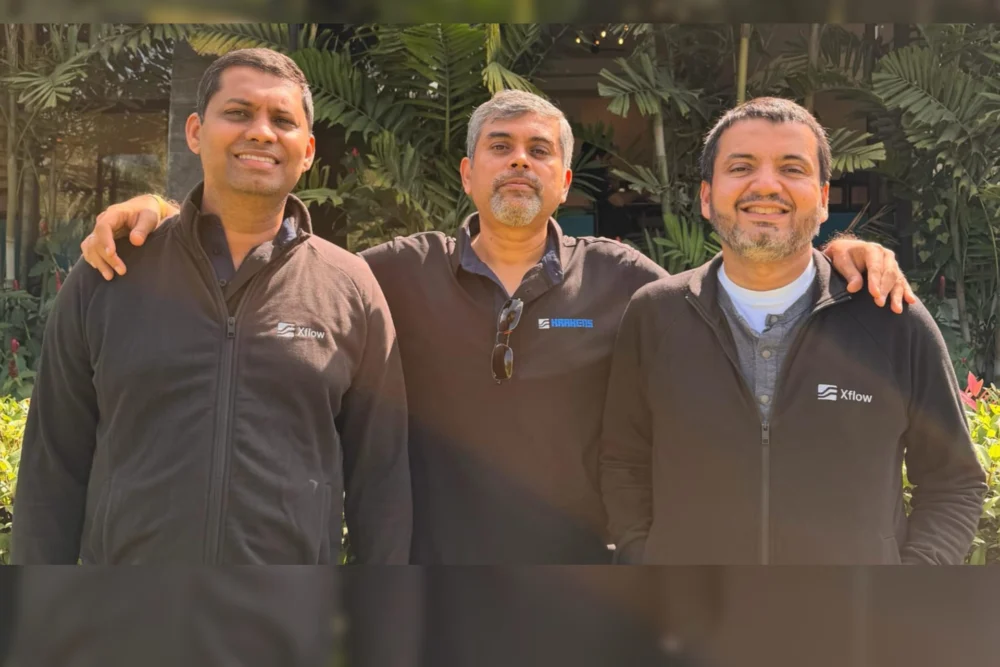
The genesis of Xflow is deeply rooted in the operational philosophy of Stripe. The startup was founded in 2021 by Anand Balaji, Ashwin Bhatnagar, and Abhijit Chandrasekaran, all of whom were instrumental in building out Stripe’s footprint in the Indian market. Their experience at the forefront of global payment infrastructure revealed a systemic weakness: while consumer remittances and domestic payments were being disrupted at a rapid pace, the high-value B2B corridor remained neglected.
For an Indian business, the traditional method of receiving international funds is fraught with "hidden" costs. When a foreign client initiates a wire transfer, the money often passes through multiple intermediary banks before reaching India. Each "hop" in this chain can incur a fee, and by the time the funds are converted into Indian Rupees (INR), the recipient often finds that the final amount is significantly less than expected, with no clear breakdown of the foreign exchange (FX) spreads applied.
Xflow’s approach is not to build a simple "wrapper" around existing bank portals, but to create a robust API-first infrastructure. This allows businesses to integrate international money movement directly into their existing workflows. By functioning as a layer of infrastructure rather than just a standalone application, Xflow enables its clients to automate the collection of payments from over 100 countries in 25 different currencies, providing a level of transparency and predictability that was previously the sole province of multinational corporations with dedicated treasury departments.
Targeting the High-Value Segments
While many fintechs in the cross-border space have focused on the "long tail" of small individual remittances or low-value freelance gigs, Xflow has strategically aimed at higher-value segments where the pain of manual processing is most acute. The company’s client base, which has swelled to approximately 15,000 businesses, is a microcosm of the modern Indian economy.
A significant portion of Xflow’s volume is driven by Global Capability Centers (GCCs). These are offshore units operated by multinational corporations in India to handle high-end R&D, IT, and back-office functions. For a GCC, a single transaction might range between $1 million and $2 million, intended to cover monthly payroll for thousands of employees or local operational overheads. When transactions of this magnitude are delayed or obscured by opaque banking processes, the ripple effects on corporate liquidity can be severe.
Beyond GCCs, Xflow serves traditional goods exporters, who typically deal with transaction sizes between $30,000 and $40,000, and SaaS firms that require a reliable way to collect recurring subscription revenue from global clients. Even at the lower end of the spectrum, such as freelancers averaging $3,000 per transfer, the demand for a "UPI-like" experience in terms of tracking and settlement is becoming the new standard.
The growth figures are a testament to this demand. Xflow reported that it processed close to $1 billion in annualized cross-border payment volume over the last year. This represents a staggering ten-fold increase compared to the previous year, signaling a rapid migration of business volume away from traditional banking channels toward specialized fintech infrastructure.
The AI Advantage and the "Limit Order" for FX
One of the most innovative aspects of Xflow’s evolution is its foray into data-driven treasury management. Foreign exchange volatility is a constant shadow over international trade; a 1% swing in the USD-INR rate can mean the difference between profit and loss for a high-volume exporter.
To address this, Xflow has introduced an AI-powered foreign exchange tool designed to help finance teams optimize the timing of their currency conversions. Rather than being forced to accept whatever rate a bank offers at the moment of settlement, Xflow’s platform allows businesses to set "limit orders." Much like a trader on a stock exchange, a business can specify a target conversion rate. If the market hits that rate within a certain window, the conversion is executed automatically.
According to Balaji, the startup’s predictive model currently offers a three-day forecast with a 92% confidence level. While such figures are subject to market turbulence, the shift from reactive to proactive FX management represents a fundamental upgrade for Indian CFOs. It provides them with a level of control that was historically unavailable without expensive, specialized banking terminals.
Regulatory Moats and the "Powering the Next Thousand Wises" Strategy
In the highly regulated world of Indian finance, technology is only half the battle; the other half is compliance. The Reserve Bank of India (RBI) has recently tightened its oversight of cross-border payment players, introducing the Payment Aggregator–Cross Border (PA-CB) license. Xflow has secured final authorization for this license, covering both export and import transactions. This regulatory approval acts as a significant moat, providing the necessary legal framework to operate at scale and build trust with institutional partners.
Xflow’s business model is also distinct in its "B2B2B" approach. Rather than competing directly with every payment app on the market, Xflow positions itself as the engine under the hood. By offering APIs that can be embedded into other platforms, it has signed partnerships with players like Easebuzz and Drip Capital.
Balaji’s philosophy is clear: "We didn’t want to build the next Wise—we want to power the next thousand Wises." This infrastructure-first strategy mirrors the early days of Stripe, focusing on providing the tools that allow other developers and businesses to build complex financial products without having to worry about the underlying regulatory and technical complexities of moving money across borders.
The Broader Industry Implications
The investment from Stripe and PayPal Ventures is more than a success story for one startup; it is a signal of the shifting tectonic plates in global trade. India is no longer just a source of low-cost labor; it is a global hub for high-value services and specialized manufacturing. As the volume of these exports grows, the world’s financial giants recognize that the "last mile" of international payments into India is a strategic prize.
For Stripe, backing Xflow allows it to deepen its influence in the Indian ecosystem through a team that already understands its DNA. For PayPal, it provides a stake in the next generation of B2B infrastructure in a market where traditional consumer-facing models face stiff competition from domestic incumbents.
Looking ahead, Xflow plans to use its new capital to expand its product suite and its geographical footprint. While India remains the primary focus, the company is already eyeing Singapore for future expansion and currently holds a payments license in Canada. The upcoming rollout of import capabilities will also allow Xflow to close the loop, helping Indian businesses not just receive money from abroad, but also pay global vendors with the same level of ease.
Conclusion: Toward a Borderless B2B Future
The era of B2B payments being "stuck in a different age" is rapidly coming to an end. As Xflow scales its team of 65 employees and integrates more deeply with India’s export economy, the goal is to make the physical location of a business partner irrelevant to the speed and cost of a transaction.
If Xflow succeeds, the "India Stack"—the digital infrastructure that has already transformed domestic life—will finally have a reliable bridge to the rest of the global economy. In this future, moving $1 million from a corporate headquarters in San Francisco to a development center in Bengaluru will be as transparent, predictable, and seamless as a consumer buying a cup of coffee with a smartphone. The backing of the world’s payment leaders suggests that this future is not just a possibility, but an impending reality.