


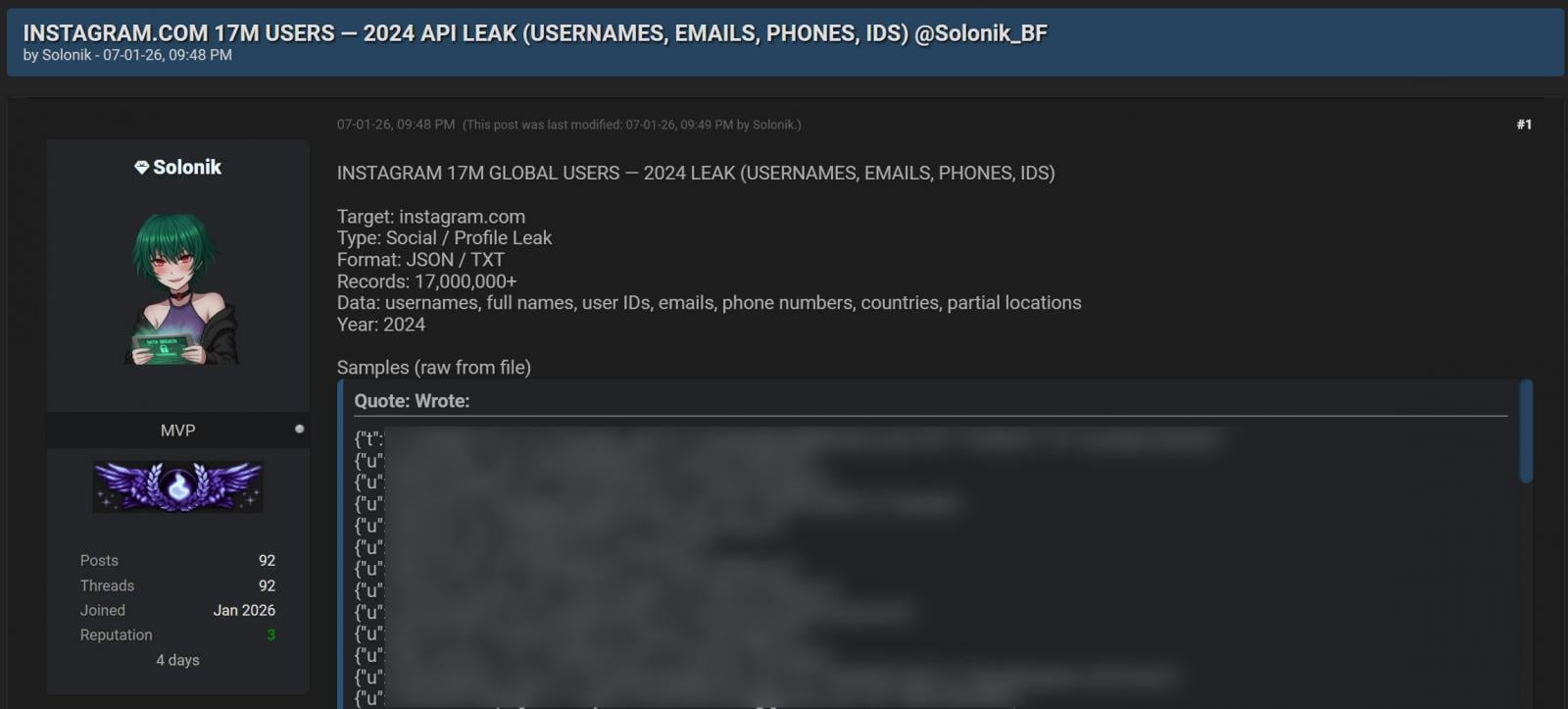
The digital security landscape was recently rattled by circulating claims of a substantial data leak involving an estimated 17.5 million Instagram accounts. This purported trove of personal information, which surfaced on various clandestine online forums, prompted immediate scrutiny from cybersecurity observers and consumer protection entities, notably including a warning issued by Malwarebytes to its user base. The data, reportedly offered freely, was attributed by its leaker to an unverified exploit allegedly exploiting an Instagram Application Programming Interface (API) vulnerability occurring sometime in 2024. However, Meta, the parent company of Instagram, has staunchly denied any systemic breach, characterizing the incident as a separate, now-resolved technical anomaly rather than a full-scale compromise of user data integrity.
The specifics of the leaked dataset, as analyzed by various security researchers monitoring dark web activity, detail records containing up to 17,017,213 unique Instagram profiles. The granularity of the exposed information varies significantly across these records. While some entries are relatively sparse, containing merely an Instagram User ID and username, others are considerably richer, allegedly including associated phone numbers, full names, email addresses, physical residential addresses, and unique Instagram account identifiers. This mix of personally identifiable information (PII) presents a tangible risk for targeted adversarial activities, even if the core authentication credentials remain protected.
In response to the escalating concern, a spokesperson for Meta provided a clear delineation between the exposed data and a true security breach. They confirmed that the company successfully patched a specific issue that had permitted an "external party to request password reset emails for some Instagram users." Crucially, Meta’s official stance is unequivocal: "We want to reassure everyone there was no breach of our systems and people’s Instagram accounts remain secure." They advised users who may have received unsolicited password reset notifications to disregard them, apologizing for the resultant alarm.
This incident underscores a persistent tension in the social media ecosystem: the difference between data scraping facilitated by platform vulnerabilities and a direct, unauthorized breach of core database infrastructure. The data circulating online appears to align more closely with the former. Researchers tracking the provenance of this specific dataset have suggested on social media platforms that the information may not originate from a novel 2024 exploit, as claimed, but rather is a compilation or residual output from an older API scraping incident, potentially dating back to 2022. This ambiguity in the data’s origin complicates remediation efforts and necessitates a thorough forensic understanding of the underlying mechanisms.

Meta, in its communications, stated it has no record of API compromises occurring in either 2022 or 2024 that would account for this specific volume of data exfiltration. This assertion further leans the narrative away from a major system intrusion and toward the exploitation of publicly accessible endpoints—a known, persistent challenge for large-scale platforms like Instagram.
Historical Context and the Scrape-vs-Breach Dichotomy
To appreciate the gravity of the current situation, it is essential to recall Instagram’s history with data harvesting. The platform has been the subject of significant scraping incidents before. A notable event in 2017 involved a flaw that was exploited to harvest and subsequently sell personal details, including phone numbers and email addresses, belonging to an estimated six million user accounts, many of whom were high-profile individuals. The current leaked batch may, therefore, represent an aggregation of that older material combined with more recent scraping yields, rather than a single, monolithic data dump from a current exploit.
The key differentiator for security professionals lies in the integrity of the access controls. A system breach implies unauthorized access to the platform’s internal servers or databases, usually resulting in the theft of hashed passwords, internal keys, or proprietary infrastructure data. Data scraping, conversely, leverages flaws in the API or front-end interface that allow automated bots to query public or semi-public profile information at scale, often by mimicking legitimate user behavior until rate limits or security checks intervene. The current situation, based on Meta’s denial of a breach and the nature of the exposed PII (which is often visible on profiles or accessible via enumeration attacks), strongly suggests a sophisticated scraping operation rather than a database penetration.
Industry Implications: The Cost of Public Data
Even if passwords are not compromised, the leakage of comprehensive PII carries significant ramifications for the digital identity ecosystem. The exposure of phone numbers and email addresses—especially when correlated with physical addresses—significantly lowers the barrier for sophisticated social engineering attacks. Threat actors can leverage this curated data for highly effective phishing campaigns (spear-phishing) or smishing attacks, masquerading as legitimate service providers or even Instagram support staff.
For enterprises, this ongoing data volatility necessitates a robust security posture focused on identity verification beyond the basic username/password combination. The prevalence of scraped data fuels the market for account takeover (ATO) attempts. When an actor possesses an email and phone number, they can more easily bypass basic security questions or trick customer service agents into initiating unauthorized account recovery processes, particularly if the user has not enabled multi-factor authentication (MFA).

This incident serves as a crucial reminder that data visibility is not synonymous with data security. If an element of data is accessible through the API, regardless of the intent of the platform’s design, a determined attacker will find a way to automate its collection. This places an increasing burden on platforms to aggressively monitor API traffic for anomalous request patterns indicative of bulk data extraction.
Expert Analysis: API Hardening and Rate Limiting
From a technical standpoint, the reported flaw—the ability to mass-request password reset emails—points toward inadequate server-side validation or weak rate-limiting on sensitive account management endpoints. When a system allows an unauthenticated or low-privilege actor to trigger actions meant only for the legitimate account holder (like initiating a password reset sequence), it represents a critical logic flaw.
Security architects often emphasize the principle of "defense in depth," and this incident highlights a failure in the perimeter defenses specific to account lifecycle management. Effective remediation involves:
- Strict Rate Limiting: Implementing granular, per-IP and per-session rate limits on functions like password reset requests, sign-up attempts, and contact information lookups. These limits must be dynamic and adaptive, flagging suspicious bursts immediately.
- CAPTCHA Integration: Utilizing advanced, invisible challenges (like modern CAPTCHAs or behavioral analysis) for high-risk actions, ensuring that automated scripts are effectively blocked from executing bulk requests.
- Input Validation Parity: Ensuring that the backend systems validating requests are as strict as the front-end interfaces, preventing attackers from bypassing client-side controls to target internal APIs directly.
The fact that Meta was able to "fix" this issue suggests it was a configuration or coding oversight rather than an inherent architectural vulnerability in the platform’s core encryption or database structure. However, the scale at which the exploit was allegedly utilized—impacting potentially millions of users via unsolicited emails—indicates that the rate limiting was either entirely absent or set too high for this particular function.
Future Impact and Proactive Security Postures
The continued circulation of large, aged datasets like this one shifts the focus from data prevention to data mitigation. Users whose data is already public cannot retrieve it from the forums. Therefore, the industry trend moves toward mandating stronger user controls.
The most significant future trend arising from these recurrent scraping incidents is the mandatory adoption of robust, phishing-resistant Multi-Factor Authentication (MFA). While Meta continues to recommend MFA, high-profile data exposure events often correlate with immediate spikes in users enabling this protection. Security experts strongly advocate for hardware security keys or authenticator apps (TOTP) over SMS-based verification, as SMS codes can sometimes be compromised through SIM-swapping attacks, an attack vector made easier when an attacker already possesses a user’s phone number from a scraped list.
Furthermore, this event will likely fuel regulatory scrutiny regarding the transparency of API access controls. Regulators are increasingly interested not just in what data is held, but how easily external entities can systematically harvest it. Platforms may face greater pressure to demonstrate proactive monitoring for bulk data retrieval patterns, moving beyond reactive patching after the data is already publicly traded.
In conclusion, while Instagram and Meta maintain that no fundamental security breach occurred—meaning core account credentials remain safe—the exposure of extensive PII for over 17 million profiles presents a tangible threat landscape for targeted fraud and social engineering. Users must remain hyper-vigilant, treat all unsolicited communication regarding their accounts with extreme suspicion, and prioritize enabling the strongest available forms of two-factor authentication to safeguard against follow-on attacks capitalizing on this publicly available intelligence. The cycle of scraping, leaking, and subsequent user panic remains a defining characteristic of operating at the scale of modern social networking platforms.