

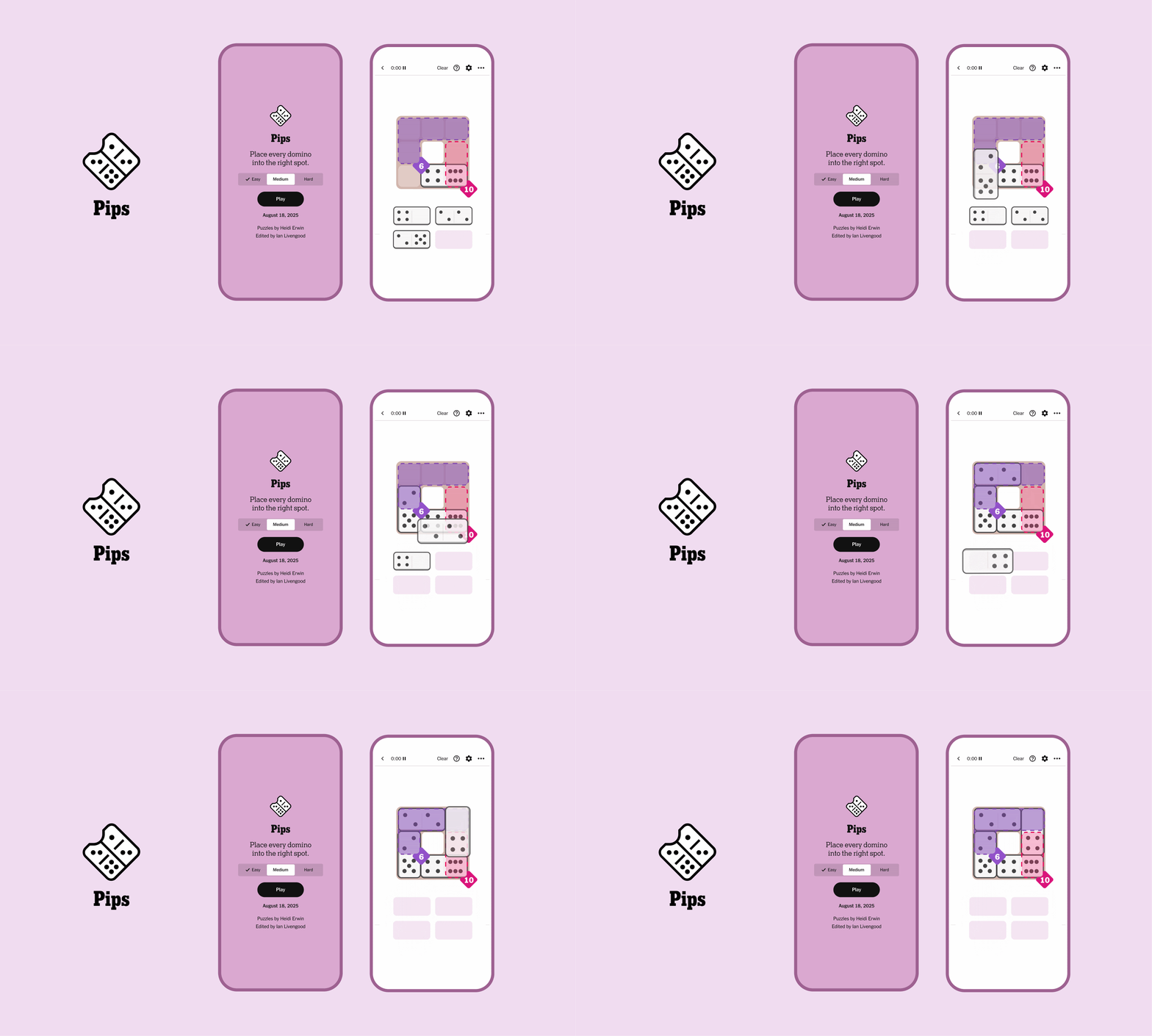
The digital landscape of daily gaming has undergone a radical transformation over the past decade, shifting from simple time-wasters to sophisticated cognitive exercises that challenge the boundaries of spatial reasoning and mathematical logic. Among the most intriguing additions to this genre is the game of Pips, a logic-based puzzle that utilizes the familiar mechanics of dominoes but strips away the luck of the draw, replacing it with a rigid framework of constraints and requirements. For the session dated Friday, February 6, players encountered a set of puzzles that demanded more than just a passing glance. While the Easy tier remained accessible, the Medium and Hard tiers presented a significant spike in complexity, requiring a systematic approach to deduce the only viable placement for each numerical tile.

To understand the appeal and the inherent difficulty of the February 6 challenge, one must first analyze the fundamental mechanics of Pips. The game presents a grid of multicolored boxes, where each color corresponds to a specific logical "condition." These conditions act as mathematical or relational hurdles. For example, a set of squares may be required to sum up to a specific number, such as 10, or they may be governed by inequalities, where the total value must be "greater than" or "less than" a designated figure. Other regions might demand equality, where all pips within a specific color group must be identical, or non-equality, represented by a crossed-out equal sign, indicating that no two squares in that zone can share the same value. The player is provided with a finite set of dominoes—rectangular tiles consisting of two square halves, each containing a number of "pips" ranging from zero to six. Winning requires the player to use every single domino in the provided set, filling every square on the grid while satisfying every constraint simultaneously.
The industry implications of such games are profound. Major media organizations have increasingly pivoted toward gaming as a primary driver of subscription retention and daily active user (DAU) metrics. In an era of fragmented attention, "sticky" content that encourages a daily habit is invaluable. Pips represents a evolution of the traditional crossword or Sudoku, blending the tactile satisfaction of dominoes with the computational rigor of modern logic puzzles. This trend reflects a broader cultural shift toward "gamified cognition," where audiences seek out mental stimulation that feels productive yet entertaining. As newsrooms continue to integrate gaming into their digital portfolios, the complexity of these puzzles often scales with the day of the week, culminating in challenges like those seen this Friday, which test the player’s ability to manage multiple overlapping variables.

The February 6 puzzle set was characterized by a distinct lack of obvious entry points, particularly in the Hard tier. In easier iterations, a single "1" or "0" condition often dictates the first move with absolute certainty. However, today’s grid required a more heuristic approach, forcing players to look for "bottleneck" tiles—areas where the available domino set is most restricted.
Analysis of the February 6 Hard Puzzle Walkthrough
For the Hard tier of the February 6 puzzle, the complexity was centered on the distribution of high-value pips. With multiple zones requiring a total sum of 10, players had to be cautious not to exhaust their 5s and 6s too early in the wrong locations. The grid featured several critical zones: a "Blue 1" tile, a "Pink 10" sum, a "Purple 10" sum, and a "Green 4" requirement.

The most logical starting point for the Hard puzzle was the Blue 1 tile located in the top right quadrant. Deducing the identity of this tile is a masterclass in elimination. The player is typically given a 1/1 domino and a 1/5 domino. Through trial and error—or better yet, through forward-looking logic—one can determine that the 1/1 domino is incompatible with the surrounding Pink 10 and Purple 10 zones. Therefore, the Blue 1 tile must be the "1" half of the 1/5 domino. The placement of the "5" then becomes the first major decision.
In Step 1 of the solution, the 1/5 domino is oriented so that the 5 pips fall into the Pink 10 zone. This move immediately narrows the possibilities for the remainder of that sum. To complete the Pink 10, another 5 is required, leading the player to select the 5/4 domino. This domino is placed such that the 5 completes the Pink 10, while the 4 pips extend down into the Green 4 tile. Simultaneously, the Purple 10 zone must be addressed. By placing the 4/3 domino from the Purple 10 zone down into the Pink equality (=) zone, and the 6/6 domino from the Purple 10 into the Blue "greater than 9" (> 9) group, the player begins to anchor the upper half of the board.

Step 2 involves a transition from sums to equalities. Moving clockwise around the square, the player must utilize the 6/0 domino, extending from the Blue > 9 group into the Orange equality (=) group. To complement this, the 3/0 domino is moved from the Pink = zone down into the same Orange = group. This creates a cascade effect: with the 0s now accounted for in the orange zone, the player can place the 3/3 domino in the remaining Pink = tiles and the 1/1 domino in the two Purple = tiles at the bottom left. At this stage, the grid begins to look cohesive, but the final few dominoes are often the most treacherous.
The final solution requires a precise balance of the remaining tiles. The 4/0 domino must be placed to bridge the Purple 8 sum and the Orange = group. This allows the 0/5 domino to move from the Orange = zone down into the Green 10 sum. To wrap up the puzzle, the 4/2 domino is placed between the Purple 8 and the Dark Blue 4 zones, while the 2/5 domino is slotted into the remaining spaces of the Dark Blue 4 and Green 10 areas. This intricate dance of numbers ensures that the Purple 8, Green 10, and Orange = conditions are all met with the exact remaining pips.

Expert-Level Analysis of Puzzle Design
From a design perspective, the February 6 Hard Pips puzzle is an example of "interlocking constraints." In simpler puzzles, zones are often isolated, meaning a mistake in one corner doesn’t necessarily ruin the logic of another. However, in today’s Hard grid, the Pink = and Orange = zones acted as a central hub. A single incorrect domino choice here would ripple outward, making the Green 10 or Purple 8 sums impossible to achieve. This design philosophy forces the player to engage in "backtracking"—a common technique in computer science and AI where an algorithm tries a path, hits a dead end, and returns to the last known valid state to try a different branch.
The cognitive benefits of solving such puzzles are well-documented in neuropsychology. Engaging with Pips requires the use of the prefrontal cortex for executive function and the parietal lobe for spatial processing. By forcing the brain to rotate dominoes mentally and calculate sums simultaneously, the game serves as a form of "mental calisthenics" that can improve fluid intelligence and working memory.

Future Impact and Trends in Digital Logic Gaming
Looking forward, we can expect the complexity of games like Pips to increase as developers integrate procedural generation. Currently, most daily puzzles are hand-crafted by designers to ensure a single, elegant solution. However, AI-driven puzzle generation is on the horizon, which could allow for personalized difficulty levels based on a player’s historical performance. We may also see the introduction of "timed" competitive modes or "infinite" modes where the grid expands as the player solves sections, similar to a digital version of an ever-growing jigsaw puzzle.
Furthermore, the social aspect of these games is likely to grow. Just as Wordle created a universal language of green and yellow squares, Pips has the potential to foster communities that share "walkthrough logic" and "efficiency scores." The Friday, February 6 puzzle, with its trickier-than-usual Medium and Hard tiers, serves as a prime example of how these games can spark conversation and collective problem-solving among enthusiasts.

In conclusion, the February 6 Pips challenge was a sophisticated test of deductive reasoning. By moving beyond simple arithmetic and into the realm of spatial-logical constraints, it offered a rewarding experience for those willing to engage in the "trial and error" necessary to master the grid. As digital puzzles continue to evolve, they will undoubtedly remain a cornerstone of the modern media experience, providing a daily dose of intellectual rigor in an increasingly automated world. Whether you are a casual "Pipsqueak" or a logic veteran, the satisfaction of seeing that final domino click into place remains a unique and compelling digital triumph.