

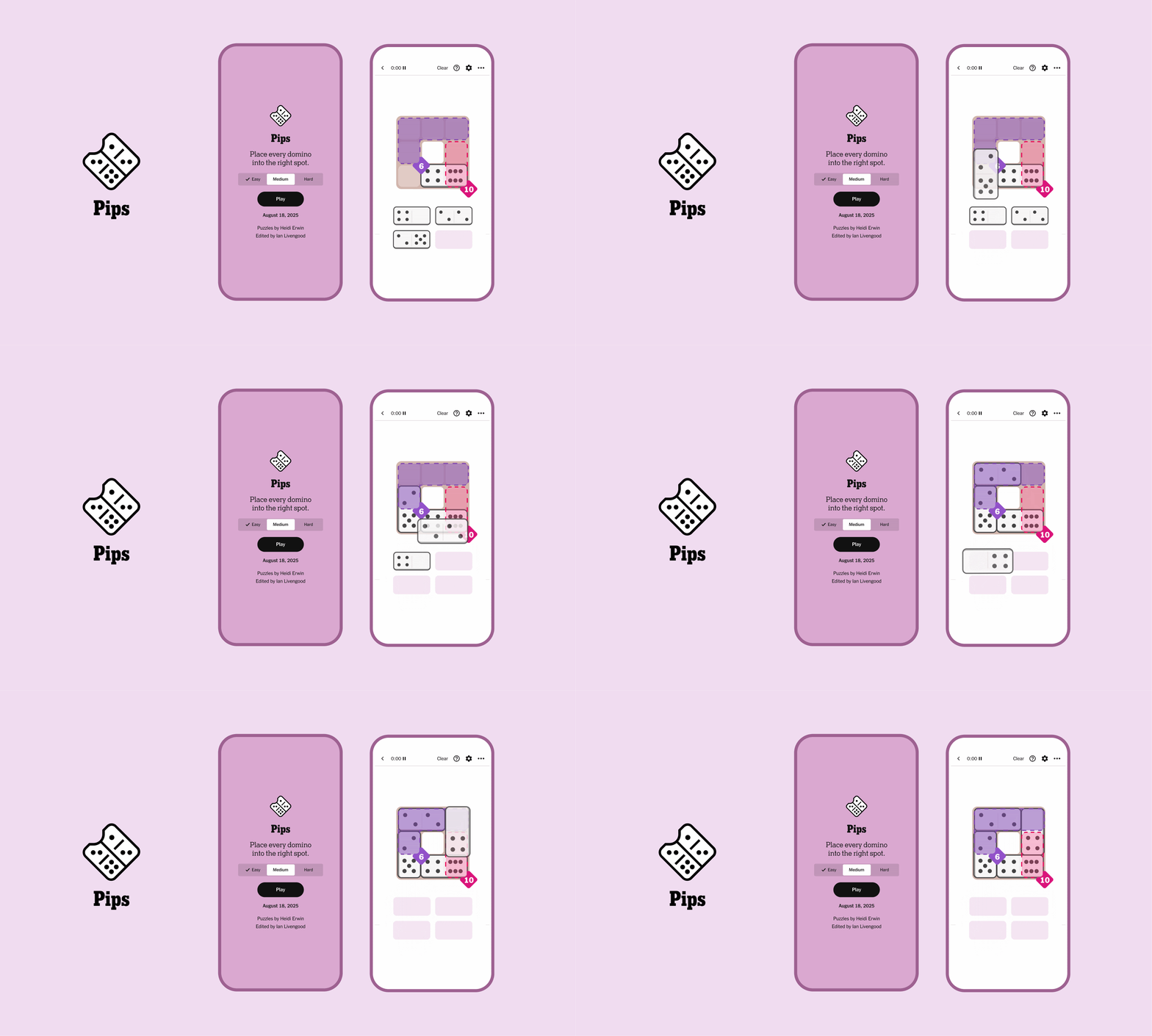
The digital puzzle landscape has undergone a radical transformation over the past decade, evolving from simple newspaper crosswords into a sophisticated ecosystem of daily cognitive exercises. Among the most intriguing additions to this genre is the spatial reasoning game known as Pips, which challenges players to navigate a complex interplay of mathematical constraints and geometric arrangements. As we reach the midpoint of the week, typically referred to in the puzzle community as the "hump day" of difficulty, the latest iteration of Pips presents a fascinating case study in game design, balancing accessibility with high-level logical requirements.
At its core, Pips is a game of constrained optimization. Players are presented with a grid of multicolored boxes, each governed by specific "conditions" that must be satisfied using a finite set of dominoes. These conditions range from simple arithmetic sums to complex inequalities and non-equivalence requirements. The elegance of the game lies in its dual-layered challenge: one must not only solve the mathematical riddle within each colored zone but also manage the physical orientation of the dominoes to ensure every square is filled. This requires a high degree of mental rotation and forward-thinking, as a single misplaced tile in an early stage can lead to an unsolvable configuration in the final squares.

In the broader context of educational technology and cognitive psychology, games like Pips serve as vital tools for maintaining neuroplasticity. By forcing the brain to toggle between numerical logic and spatial orientation, the game engages both the left and right hemispheres. This "midweek stretch" is particularly important for regular players, as it reinforces the mental frameworks established during the simpler puzzles of Monday and Tuesday while preparing the mind for the typically more grueling challenges found toward the weekend.
Today’s puzzle set features three distinct tiers: Easy, Medium, and Hard. However, an expert analysis of the grid layouts suggests a curious deviation from the standard difficulty curve. While the Medium tier offers a robust challenge that requires careful planning, the Hard tier today presents a unique geometric structure that, paradoxically, may feel more intuitive to seasoned players than its predecessor.
The Mechanics of the Grid
Before diving into the specific solutions for February 4, it is essential to understand the "syntax" of the Pips grid. Each color-coded region represents a rule set. For instance, a purple zone might feature an "equal sign with a slash," indicating that the numbers within those squares must not be identical. Conversely, a blue zone might require all included tiles to match perfectly.

The most demanding conditions involve inequalities. When a grid displays a ">" or "<" symbol followed by a number, the player must calculate the sum of all pips within that specific colored boundary to ensure they exceed or fall below the target value. The "blank" tiles, which appear frequently in today’s Hard puzzle, represent the "wild cards" of the game—they can accommodate any value, provided they are part of a domino that satisfies adjacent conditions.
Deciphering the Midweek Tiers
The Easy tier today serves as a foundational exercise in tile orientation. The solution hinges on the placement of the 1/4 and 3/6 dominoes, which act as the anchors for the rest of the grid. In this configuration, the primary goal is to satisfy the basic equality constraints without overcomplicating the spatial layout. Most players will find that the tiles fall into place naturally once the central axis is established.
The Medium tier, however, represents a significant step up in complexity. Today’s Medium puzzle focuses heavily on the "7 and 8" groups—regions where the total pip count must hit these specific numbers. This requires a more nuanced understanding of domino combinations. Unlike the Easy tier, where the orientation is often dictated by the shape of the zone, the Medium grid forces players to consider multiple rotations of the same tile to see how they impact neighboring zones. It is a test of patience and iterative testing.

Expert Walkthrough: The Hard Tier "Trident"
Today’s Hard Pips puzzle is visually striking, resembling a trident or a candelabra. This geometric arrangement is more than just an aesthetic choice; it dictates the flow of logic. The puzzle consists primarily of groups requiring a sum of 7, distributed across seven dominoes. Despite its "Hard" classification, the solution is remarkably streamlined if one approaches it with a "pathfinding" mindset.
To solve the Hard Pips for Wednesday, one must first identify the bottleneck. In this instance, the bottleneck is the Purple "> 0" tile.
Step 1: The Left Flank
Begin by placing the 1/4 domino so that it spans from the Purple "> 0" tile up into the Dark Blue 7 region. This immediately satisfies the purple condition (as 1 is greater than 0) and contributes 4 pips to the blue zone. To complete the Dark Blue 7, we must look at the adjacent tiles. Position the 3/6 domino vertically above the previous tile, extending into the Pink 7 zone. This provides the necessary pips to satisfy the lower regions while setting up the upper "prongs" of the trident. Finally, place the 1/0 domino leading from the Pink 7 into the first available free tile.

Step 2: The Right Flank and Completion
With the left side stabilized, the focus shifts to the Blue 7 zone on the right. Insert the 5/1 domino here, followed by the 1/2 domino, which should bridge the gap between the Blue 7 and the Green "> 1" tile. This ensures that the green condition is met (2 is greater than 1) while balancing the blue sum.
The final sequence involves the 4/2 domino, which should be placed from the Purple "> 2" tile down into the Orange 7 region. To finish the puzzle, the 4/0 domino is placed from the Orange 7 into the final free tile. The speed with which this "Hard" puzzle can be solved suggests a design philosophy that favors "flow" over "friction" for this specific midweek entry.
Critical Analysis of Game Design
From a professional game design perspective, today’s Hard Pips raises interesting questions about how difficulty is perceived versus how it is constructed. Typically, a "Hard" puzzle involves high interdependency, where a choice in one corner of the grid limits options in the opposite corner through a chain of constraints.

In today’s trident-shaped layout, the lanes are relatively isolated. This "lane-based" logic actually simplifies the cognitive load because the player can solve one "prong" of the trident without worrying about it breaking the logic of the others. While the shape is complex, the lack of intersecting bottlenecks makes it feel more like three small, easy puzzles joined at the base rather than one large, difficult one. For future iterations, the developers might consider adding "bridge conditions" that link the prongs of the trident, forcing players to account for the entire grid simultaneously.
Industry Implications and Future Trends
The success of daily logic puzzles like Pips reflects a broader trend in the digital media industry: the "gamification of the morning routine." For publishers, these games are not merely entertainment; they are high-value retention tools. A user who visits a site daily to solve a puzzle is significantly more likely to maintain a long-term subscription than one who only visits for breaking news.
Looking forward, we can expect to see several trends emerge in this space:

- AI-Generated Constraints: While today’s puzzles are likely hand-curated to ensure a specific "feel," the use of procedural generation assisted by AI will allow for infinite variations of games like Pips, potentially offering personalized difficulty levels based on a player’s past performance.
- Competitive Social Integration: We are already seeing the "share square" phenomenon (popularized by Wordle). Future versions of spatial puzzles will likely include "speed-run" modes or "minimum move" challenges that can be compared across social networks.
- Cross-Platform Spatial Play: As augmented reality (AR) technology matures, spatial logic games could move off the 2D screen and into 3D space, requiring players to physically move around a virtual grid to place dominoes.
Conclusion
Today’s Pips collection offers a satisfying, if somewhat unconventional, progression. The Medium tier provides the day’s most rigorous mental workout, while the Hard tier offers a rewarding, visually interesting conclusion that emphasizes the elegance of spatial symmetry. Whether you are a casual player looking to sharpen your focus before work or a logic enthusiast analyzing the nuances of grid construction, the midweek Pips remains a standout example of the enduring appeal of the daily digital puzzle. As we move toward the latter half of the week, players should remain vigilant; if today’s Hard puzzle was a "breather," tomorrow’s grid is likely to be a far more demanding test of logic.