

The arrival of January 1, 2026, marks more than just the beginning of a new calendar year; it signifies a milestone in the evolution of digital logic gaming. Since its debut, Pips has transformed from a niche experimental feature into a cornerstone of the daily digital routine for millions. As we navigate the first full year of this game’s presence on the premier mobile gaming platforms, it is clear that the transition from vocabulary-based challenges to spatial and arithmetic logic has struck a chord with a global audience. Today’s puzzle, strategically designed to mirror the "26" of the new year, offers a fascinating case study in how developers balance thematic celebration with the rigorous demands of logic-based gameplay.
The Rise of the Logic-Based Daily Ritual
The digital puzzle landscape has undergone a seismic shift over the last five years. Following the explosion of word-based games in the early 2020s, audiences began seeking out challenges that utilized different cognitive pathways. While crosswords and word-association games rely heavily on linguistic memory and lateral thinking, Pips taps into spatial reasoning and mathematical constraints. This shift reflects a broader trend in "brain training" apps, where users prioritize diverse mental exercises to start their day.

Pips, as a mechanic, is deceptively simple but mathematically complex. By utilizing domino-style tiles within a constrained grid, the game forces players to manage multiple variables simultaneously. Each colored zone represents a logic gate or an arithmetic requirement—ranging from simple equality to complex "greater than" or "non-equal" parameters. As we analyze today’s New Year’s Day puzzles, we see the culmination of these design philosophies: a blend of visual storytelling and high-level problem solving.
Understanding the Mechanics: The Pips Framework
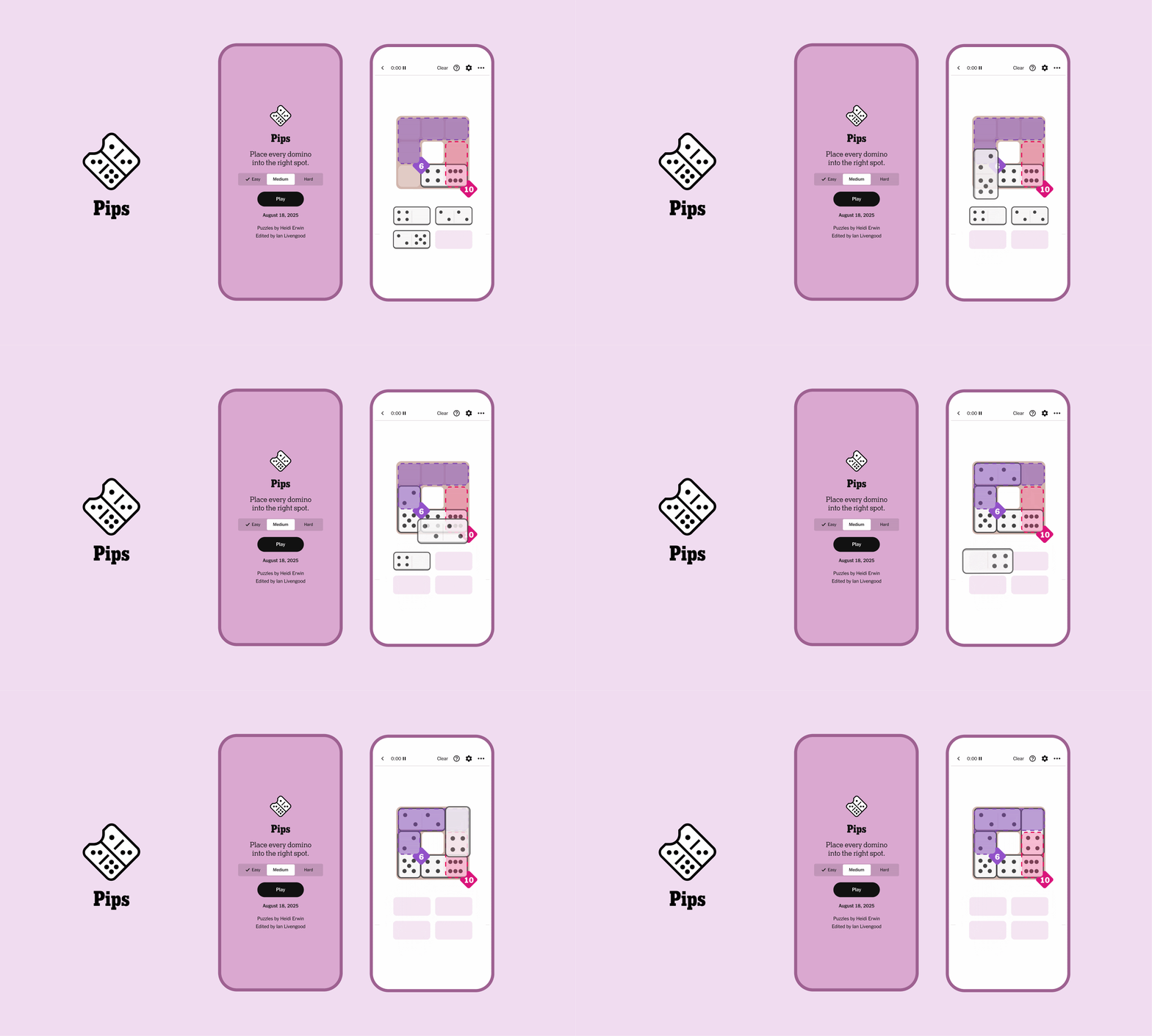
To appreciate the complexity of today’s solutions, one must first understand the underlying architecture of Pips. The game operates on a grid system where multicolored boxes dictate specific "conditions." Players are provided with a finite set of dominoes—tiles consisting of two halves, each containing a number of "pips" (dots).
The core challenge lies in the "conditions" assigned to various colored regions:

- The Equality Constraint (=): All tiles within this colored zone must have the same number of pips.
- The Summation Constraint: Often indicated by a number within a colored zone, the total pips of all tiles in that area must equal the specified sum.
- The Inequality Constraint (≠): Tiles within this zone must not share the same pip count.
- The Comparison Constraints (> or <): The total pip count in one area must be strictly greater than or less than a specified value or another zone’s total.
Winning requires the player to use every provided domino, filling every square on the grid while satisfying every condition simultaneously. Unlike traditional puzzles where a player might solve one section independently, Pips is a closed system; a single tile placement in the "Easy" corner of the grid can create a ripple effect that makes the "Hard" section impossible to solve.
Industry Implications: The Gamification of Retention
The success of Pips is a masterclass in digital retention strategy. For major media conglomerates, the goal is no longer just providing news, but providing a "sticky" ecosystem. Logic puzzles are uniquely suited for this because they create a "flow state"—a psychological phenomenon where the user is fully immersed in a task that is challenging but achievable.
From an industry perspective, Pips represents the "math-ification" of the casual gaming market. By moving away from the "Search" and "Find" mechanics of earlier mobile games and toward "Analyze" and "Execute" mechanics, developers are capturing a demographic that includes engineers, students, and professionals who use these puzzles as a morning cognitive "warm-up." The data suggests that games like Pips have a higher daily-active-user (DAU) consistency than traditional news articles, making them invaluable for subscription-based business models.

Today’s Walkthrough: Thursday, January 1, 2026
The New Year’s Day puzzles are traditionally designed to be accessible yet rewarding. Today’s set provides a smooth ramp-up in difficulty, concluding with a Hard puzzle that is more about the visual "payoff" than extreme difficulty.
The Easy Tier: Setting the Foundation
The Easy puzzle today focuses on simple equality. Players are tasked with matching pip counts across three distinct zones. The key to the Easy grid is identifying the "anchor" tile—the one domino that can only fit in one specific orientation due to the surrounding boundaries. Once the first domino is placed in the central Blue zone, the remaining tiles fall into place like a standard jigsaw.
The Medium Tier: The Arithmetic Pivot
The Medium puzzle introduces the first real challenge of the year. It utilizes the "Summation" condition, requiring players to do quick mental math while managing tile rotation. The difficulty here lies in the overlap; one half of a domino might satisfy a Blue equality condition, while the other half must contribute to a Pink summation condition. Today’s Medium puzzle required a 3/4 domino to be placed vertically to bridge the gap between the two zones, a move that many players found counterintuitive at first glance.

The Hard Tier: The "26" Celebration
The Hard Pips puzzle for January 1 is a thematic masterpiece, shaped like the number 26 to celebrate the year 2026. Despite its "Hard" classification, the design is surprisingly logical, provided you start from the extremities.
Step-by-Step Solution for the Hard Puzzle:
- The Initial Anchor: Begin at the top left. Place the 1/2 domino so that the 1 sits in the Purple zone and the 2 transitions into the Pink zone. This sets the numerical sequence for the entire upper curve of the "2" shape.
- The Horizontal Bridge: Follow this by placing the 6/2 domino. The 6 satisfies the Blue requirement, while the 2 moves into the Orange "Equal" zone.
- The Mid-Section: Use the 2/2 domino to fill the core of the Orange zone. Because the condition is equality, this "double-two" is the only logical fit that preserves the chain.
- The Transition to the "6": Place the 2/5 domino at the base of the "2" shape, leading into the first free tile.
- The Circular Loop: For the "6" portion of the grid, place the 5/5 domino in the Pink equality zone. Follow this with the 5/0 domino.
- The Final Sequence: The Green 1 tile acts as the gateway to the Dark Blue equality zone. Place the 1/0 domino there, followed by the 0/0 "double-blank" to fill the remainder of that zone.
- Closing the Puzzle: The 0/4 domino moves from Dark Blue into the final Blue zone. Slot the 4/4 domino next to it. Finally, use the 4/6 domino to move into the Purple zone, and finish the entire grid with the 6/1 domino in the final free tile.
Expert Analysis: The "Softball" Strategy
Veteran puzzle analysts note that today’s Hard puzzle is significantly more lenient than the "Difficult" tiers seen in late 2025. This is a deliberate editorial choice. On major holidays like New Year’s Day, puzzle editors often employ a "softball" strategy—designing puzzles that are visually impressive and satisfying to solve without causing undue frustration. The goal is to celebrate the holiday with the community, ensuring that players start their year with a "Win" rather than a "Dnf" (Did Not Finish).

The use of the "26" shape is a form of environmental storytelling within the game. It acknowledges the passage of time and rewards the player’s loyalty. However, experts warn that this leniency is usually short-lived. Historically, the first week of January sees a "difficulty spike" around January 4th or 5th, as the "holiday grace period" ends and the puzzles return to their most grueling forms.
Future Trends: Where Pips Goes From Here
As we look forward into 2026, the trajectory for Pips and similar logic games involves deeper integration with emerging technologies. We are already seeing rumors of "Spatial Pips," an augmented reality (AR) version of the game where players can project the grid onto their physical environment and move dominoes with hand gestures.
Furthermore, the integration of procedural generation assisted by AI is expected to allow for "Infinite Pips" modes. While the daily puzzles remain hand-curated by expert designers to ensure a logical "pathway," AI can now generate millions of valid grids for practice modes. This ensures that the skill ceiling for the game continues to rise, as players can practice specific logic gates (like the dreaded "Triple-Inequality Overlap") outside of the daily ranked challenge.

Conclusion
Today’s Pips puzzles offered a perfect blend of festive design and logical satisfaction. By guiding players through the symbolic "26" grid, the developers have successfully kicked off a new year of cognitive engagement. Whether you are a casual player solving the Easy grid over coffee or a "Pipsqueak" veteran dissecting the Hard walkthrough, the game continues to prove that logic is a universal language. As the winter months continue, players should prepare for the complexity to ramp up, but for today, the victory is a well-deserved start to 2026. Stay focused, keep rotating those tiles, and may your pip counts always satisfy their conditions.