

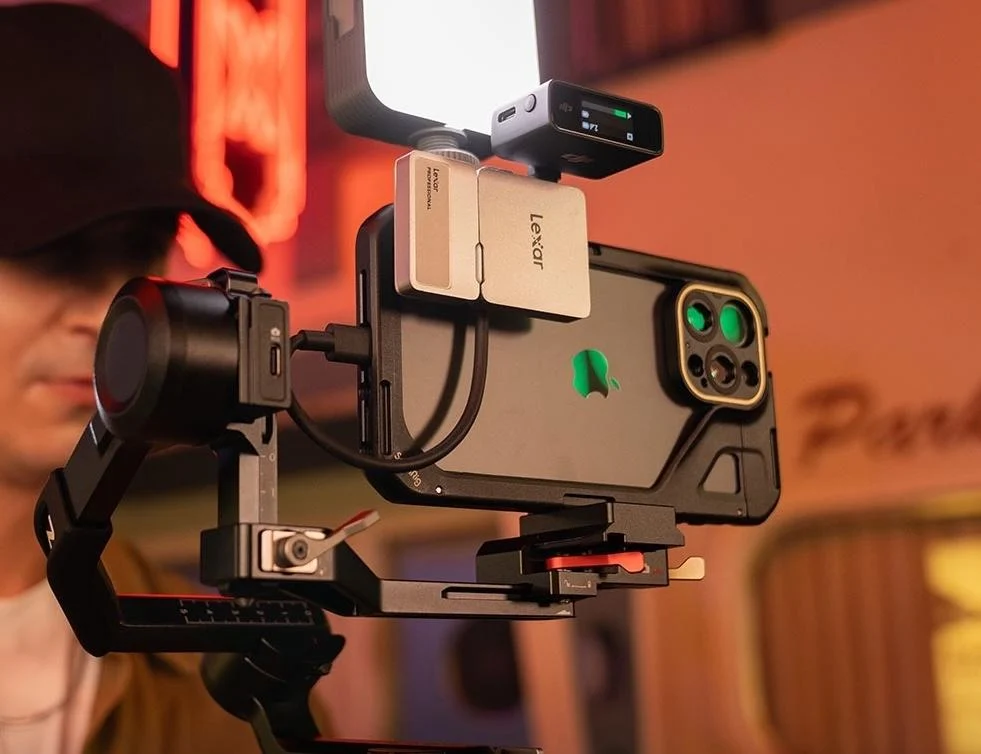
The landscape of professional content creation is undergoing a radical shift toward mobility, and at CES 2026, Lexar has positioned itself at the vanguard of this movement. As smartphones and drones evolve into primary tools for high-end cinematography, the demand for storage that is both high-performance and physically unobtrusive has reached a fever pitch. Lexar’s latest unveiling of the GO Portable SL400 and the Air SL260 SSDs represents more than just a hardware refresh; it is a calculated response to the technical bottlenecks currently facing creators who work in the field. By prioritizing weight reduction and modular connectivity, Lexar is addressing the specific ergonomic and data-rate requirements of the modern "iPhone filmmaker" and drone enthusiast.
The headline act of Lexar’s showcase is undoubtedly the GO Portable SL400 SSD. In an industry where "portable" often still means a bulky brick tethered by a dangling cable, the SL400 is a marvel of miniaturization. Weighing a staggering 12 grams, the device is essentially a featherweight component that can be integrated into a mobile rig without altering the center of gravity. This is a critical factor for creators utilizing motorized gimbals. Traditional external SSDs often require counterweights or specialized mounting hardware that can strain gimbal motors or limit the range of motion. At 12g, the SL400 bypasses these issues entirely, allowing for seamless stabilization on everything from a handheld smartphone stabilizer to a professional-grade DJI drone.
Under the hood, the GO Portable SL400 utilizes a USB 3.2 Gen 2 interface to deliver read speeds of up to 1,050MB/s and write speeds of 1,000MB/s. To put these figures into a real-world context, these speeds are specifically optimized for the high-bitrate demands of Apple’s ProRes 4K video recording. With the iPhone 17 Pro pushing the boundaries of mobile video, the internal storage of even the highest-capacity handsets can be depleted in minutes when shooting in professional formats. The SL400 offers a 1TB or 2TB safety net, enabling creators to record directly to the external drive without the risk of dropped frames or the "storage full" warnings that frequently plague high-resolution shoots.
However, the true innovation of the SL400 lies in its modular docking station. Lexar has recognized that storage is rarely used in isolation on a professional set. The docking station acts as a hub for the mobile creator, featuring a pass-through USB-C port that allows for simultaneous charging of the host device. This solves one of the most persistent problems in mobile videography: the single-port limitation. By providing extra ports for a wireless microphone receiver or a compact LED light, the SL400 dock transforms a smartphone into a fully realized production rig. This modularity is a direct nod to the "run-and-gun" nature of modern journalism and social media content creation, where speed and simplicity are paramount.
Durability has also been a focus for the SL400, which carries an IP65 rating for dust and water resistance. For creators shooting in unpredictable outdoor environments—be it a dusty desert or a misty coastline—this level of protection is non-negotiable. The inclusion of a silicone protective case and a one-meter drop resistance rating further reinforces the device’s "field-ready" credentials. Lexar has even included a low-tech but highly practical feature: sticky labels for the SSD body. In a professional environment where multiple drives are often used for different projects or "reels," the ability to physically label a drive is a simple yet effective way to manage data on the fly.
Parallel to the SL400, Lexar introduced the Air SL260, a device that emphasizes sheer portability and aesthetic versatility. While it lacks the extreme throughput of its sibling, the Air SL260 is a masterclass in compact design, measuring just 5 x 7cm—roughly the size of a matchbox. At 19 grams, it remains one of the lightest drives on the market, even lighter than the USB-C cable it comes with. This drive is aimed at the broader creator market—those who need to offload thousands of high-resolution RAW photos, 4K b-roll, or project documents while traveling light.

The Air SL260 utilizes a USB 3.2 Gen 1 interface, providing read and write speeds in the neighborhood of 390MB/s to 400MB/s. While this may not be the choice for direct-to-drive 4K ProRes recording, it is more than sufficient for rapid file transfers, allowing a gigabyte of data to be moved in approximately one second. Its versatility is bolstered by a clever USB-C cable that features a clip-on USB-A adapter, ensuring compatibility with legacy laptops and desktop systems that haven’t yet fully transitioned to the USB-C standard. Available in capacities ranging from 512GB to 2TB and finished in sleek Black or vibrant Aqua Blue, the Air SL260 is clearly designed to be the "everywhere" drive for the modern digital nomad.
The launch of these two devices comes at a time when the "Creator Economy" is shifting from a hobbyist niche to a multi-billion-dollar professional industry. Analysts suggest that by 2026, the demand for high-speed, ultra-portable storage will grow exponentially as 8K video recording becomes more common in consumer-grade hardware. Lexar’s decision to focus on the 1TB and 2TB sweet spots reflects the current data requirements of professional workflows, where a single day of shooting can easily generate hundreds of gigabytes of raw data.
Furthermore, the industry is seeing a trend toward the "democratization of cinema." Tools that were once reserved for high-budget film sets are now available to anyone with a high-end smartphone. However, the hardware ecosystem must keep pace. The introduction of the SL400’s docking station is a prime example of this ecosystem maturation. It acknowledges that the smartphone is no longer just a communication device; it is a camera body that requires an "outboard" of accessories to perform at its peak.
Looking toward the future, the implications of Lexar’s CES 2026 announcements extend into the realm of data security and reliability. Both the GO and Air series come equipped with Lexar’s proprietary data recovery tools. In an era where a corrupted drive can mean the loss of thousands of dollars in production time, these software fail-safes are as important as the physical hardware. The provision of a three-year warranty suggests a high level of confidence in the longevity of the NAND flash memory used in these ultra-compact enclosures, which often struggle with heat dissipation.
The competitive landscape for external SSDs is fierce, with giants like Samsung, SanDisk, and Crucial constantly vying for dominance. Lexar’s strategy appears to be one of specialization. Rather than competing solely on raw speed—where Thunderbolt 4 and 5 drives are pushing into the 3,000MB/s+ range—Lexar is focusing on the specific ergonomic needs of the mobile creator. For a drone pilot, the difference between a 100g drive and a 12g drive is the difference between five minutes of extra flight time or a more stable shot in high winds. For a TikTok or YouTube creator, the ability to plug in a microphone and a light while recording to an SSD is a significant quality-of-life improvement.
As we move further into 2026, the GO Portable SL400 is priced competitively at $189.99 for the 1TB model and $349.99 for the 2TB variant, positioning it as a premium but accessible tool for professionals. The Air SL260, while pricing is yet to be fully detailed for all regions, is expected to follow a more aggressive pricing structure to appeal to the mass market.
In conclusion, Lexar’s presence at CES 2026 has sent a clear message to the technology world: the future of storage is not just about how much data you can hold, but how easily you can carry it into the most remote and demanding environments on Earth. By shedding every unnecessary gram and rethinking the connectivity of the external drive, Lexar has provided content creators with the freedom to focus on their art rather than their equipment. Whether it is the high-speed, hub-centric workflow of the SL400 or the pocket-sized convenience of the Air SL260, these devices are set to become staples in the kits of photographers, videographers, and storytellers worldwide.