

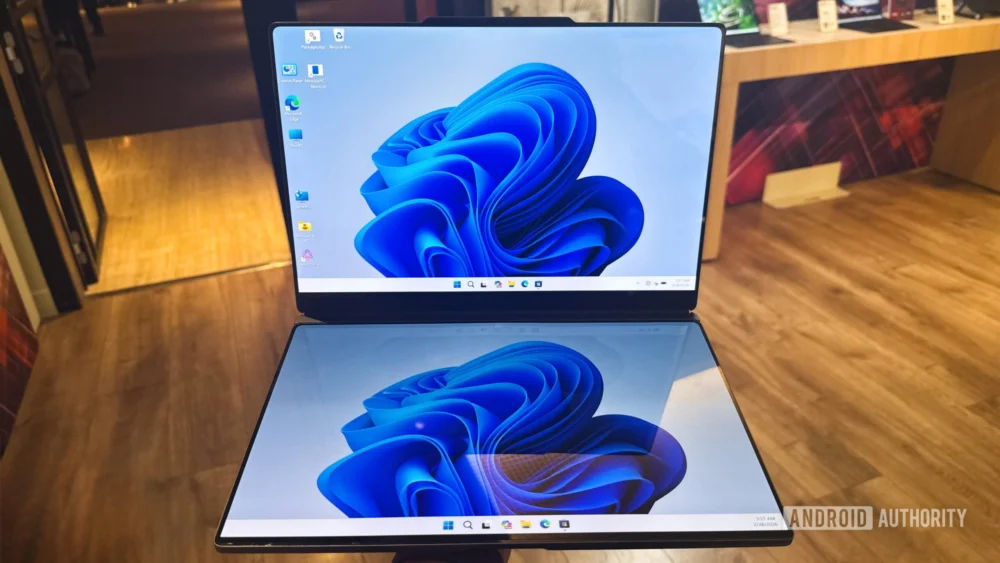
Lenovo has consistently utilized major industry showcases, particularly Mobile World Congress (MWC), as a platform to debut audacious hardware concepts. For years, these presentations have served as fascinating, if somewhat distant, glimpses into potential futures—devices so technologically ambitious they seemed destined to remain behind protective barriers, appreciated only for their sheer engineering novelty. The 2024 reveal of the Transparent Display Laptop, for instance, was a prime example of futuristic spectacle. However, the unveiling at MWC 2026, centered around the ThinkBook Modular AI PC concept, represents a significant departure from mere exhibitionism; this concept possesses a tangible practicality that immediately recontextualizes the current state of personal computing hardware.
The immediate impression upon encountering the ThinkBook Modular AI PC is one of deceptive normalcy. From the primary user-facing aspect, it presents as a sleek, contemporary 14-inch touchscreen business notebook—unassuming, professional, and adhering to established design language. There are no overt visual cues suggesting radical innovation. It is only upon scrutinizing the peripheral architecture and interacting with the device that the true depth of its modular philosophy becomes apparent. This design choice is deliberate and consequential: it suggests a market readiness, or at least a near-term viability, that transcends purely theoretical exploration. This is not a device to be admired from afar; it is a blueprint for how professionals might genuinely interact with their tools tomorrow.
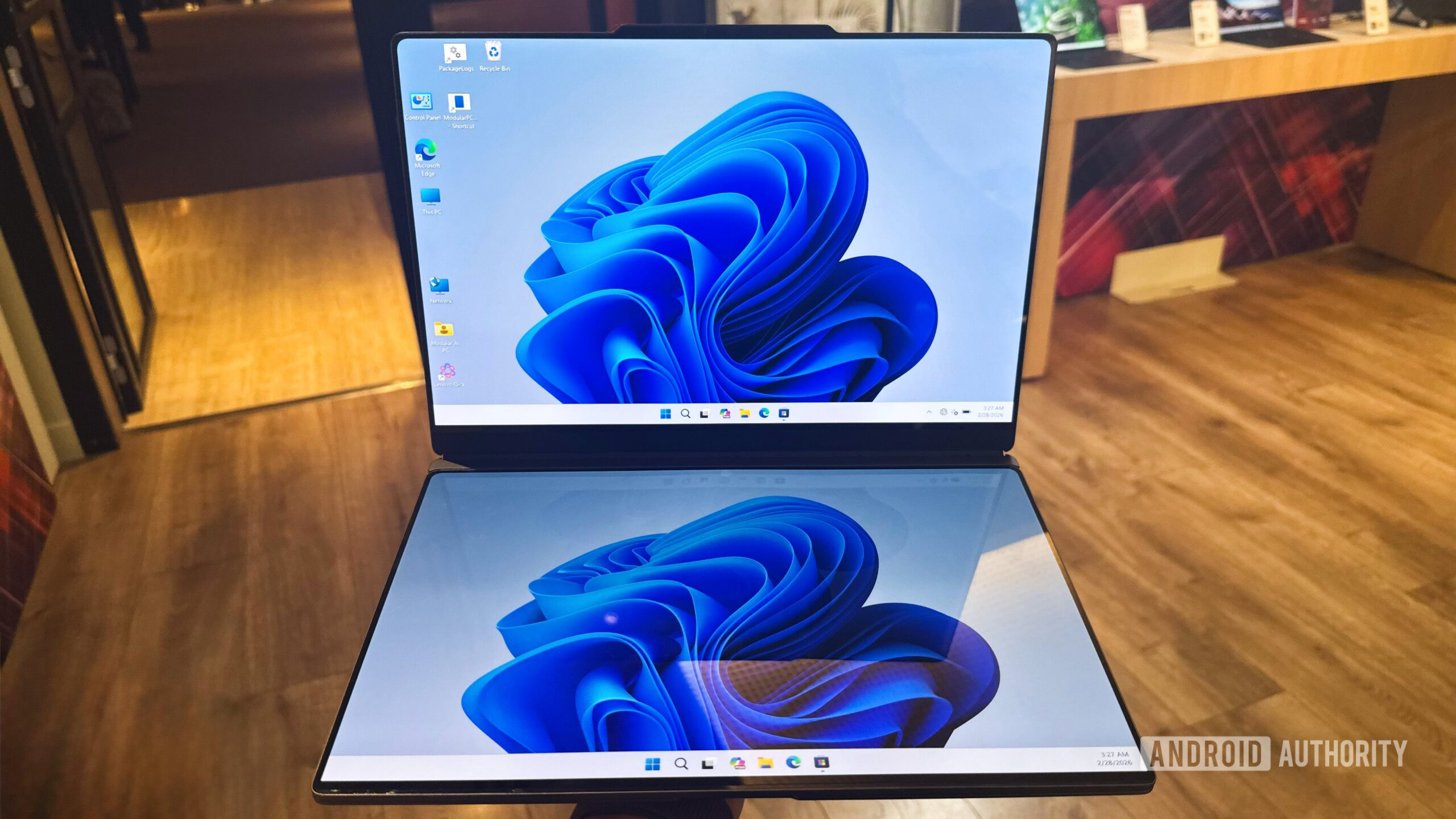
The core innovation resides in the integration of a secondary, full-sized 14-inch display attached magnetically and secured via pogo pins to the rear chassis lid. When docked, this secondary screen is flush, presenting a near-seamless aesthetic. The immediate application for this feature is evident in collaborative scenarios: facilitating immediate screen sharing without the physical awkwardness of repositioning the entire unit or requiring attendees to crane their necks. One user faces the primary display while the second screen directly addresses an adjacent party—a seemingly small UX improvement that streamlines meeting dynamics considerably.
However, the genius of this design lies in its deliberate unfixing. This secondary panel is not merely a static auxiliary screen; it is fully detachable. When separated from the main chassis, it transforms into a highly versatile, standalone portable monitor. Equipped with its own integrated kickstand mechanism, it supports both portrait and landscape orientations, offering expanded utility for data visualization, coding, or document review away from the primary workstation. While this standalone functionality necessitates an external power source supplied via a dedicated pogo pin adapter, the flexibility it introduces fundamentally alters the definition of a "single-unit" productivity device.
The modularity extends deeper into the fundamental interface components. The traditional keyboard assembly is itself designed for detachment. This allows for a compelling configuration shift: the keyboard can be wirelessly operated, permitting the main computational unit (the screen and core internals) to be used as a primary display, while the keyboard rests in a more ergonomic position or is used remotely. This flexibility effectively transforms the system into a dual-screen workstation setup without the cumbersome requirement of docking stations or proprietary external peripherals. The physical interaction feels remarkably fluid, lending credence to the notion that this is less a distant concept and more a proof-of-concept for imminent product lines.
Perhaps the most pragmatic element of this modular architecture targets the perennial frustration of connectivity standardization: the I/O ports. Lenovo has engineered the input/output clusters as physically swappable modules. Users are no longer locked into predetermined port layouts on the left or right edges. USB-A, USB-C, and HDMI connectors can be physically relocated between defined bays on the chassis edges based on the user’s workspace configuration, cable management preferences, or the specific peripherals required for a given task. Furthermore, the inclusion of a dedicated storage case for these detached modules addresses the crucial logistical challenge inherent in modularity—preventing the loss of essential components when they are removed.
This level of user-configurable hardware customization moves beyond mere aesthetic differentiation; it speaks to a growing professional demand for personalized computing environments that are adaptable across diverse physical locations, from hot-desking offices to remote fieldwork.
From a technical standpoint, the underlying specifications position the ThinkBook Modular AI PC firmly within the current high-end business segment. It is powered by an Intel Core Ultra 7 255H processor, complemented by 32GB of system memory and a substantial 1TB M.2 PCIe SSD. These components ensure robust performance capable of handling modern, AI-accelerated workloads—a nod to the "AI PC" designation. However, the inclusion of a relatively small 33Wh battery highlights the reality of concept engineering: power consumption across multiple screens and modular connections remains a significant engineering hurdle. In this context, the specifications serve primarily as a baseline for current capability, allowing the focus to remain squarely on the groundbreaking form factor and functional adaptability.
Industry Implications: Challenging the Monolithic Paradigm
Lenovo’s strategy with the ThinkBook Modular AI PC appears calculated to disrupt the increasingly stagnant laptop design landscape. For the past decade, innovation in mainstream laptops has largely focused on incremental refinements: thinner bezels, marginally faster processors, and improved battery chemistry. True paradigm shifts—like the dual-screen revolution spearheaded by concepts like the Yoga Book or, more recently, the rise of foldables—have often been niche or short-lived due to cost or usability concerns.
The ThinkBook Modular AI PC attempts to bridge this gap by offering tangible, discrete modularity that addresses specific productivity pain points rather than aiming for a single, all-encompassing futuristic form factor. This approach carries significant implications for the broader PC industry:
1. Decoupling Hardware Lifecycles: True modularity, if adopted widely, could fundamentally alter the replacement cycle for personal computers. Instead of retiring an entire machine due to an outdated port selection (e.g., needing more USB-C or requiring an older standard for legacy hardware), users could potentially upgrade only the necessary I/O module. Similarly, if a user’s workflow shifts to require a higher-resolution secondary display, the external module could be swapped without replacing the core processing unit. This aligns with growing consumer and enterprise desires for greater sustainability and reduced electronic waste.
2. The Rise of Contextual Computing: The dual-screen attachment and swappable keyboard signify a shift toward contextual computing. The device adapts its physical manifestation to the immediate task. In a presentation setting, it becomes a dual-viewer. In a focused writing session, it becomes a low-profile tablet paired with a wireless keyboard. This contrasts sharply with the current standard where users must carry multiple devices (laptop, tablet, second monitor) to achieve similar flexibility.
3. Redefining the "AI PC": While the concept integrates current-generation AI-capable silicon (Intel Core Ultra), the modularity itself can enhance AI workflows. The extra screen space is invaluable for monitoring AI process outputs, managing complex data sets used for local model inference, or providing dedicated real-time translation or transcription services without encroaching on the primary workspace. The concept demonstrates that the "AI PC" moniker needs to encompass not just processing power but also the physical interface that enables these new computational tasks.
Expert Analysis: Overcoming the Modular Hurdles
Historically, modular computing initiatives—from Project Ara in the mobile space to various attempts at modular desktop PCs—have faltered due to three primary challenges: connectivity standardization, power delivery efficiency, and thermal management. Lenovo’s approach, while promising, must successfully navigate these hurdles for commercial viability.
The reliance on pogo pins for the secondary display and I/O modules is an established, though limited, solution. Pogo pins offer robust, high-speed connection when precisely aligned, but they introduce potential points of failure through wear and tear or misalignment. The critical engineering challenge lies in ensuring that the data transfer rates (especially for a high-resolution, high-refresh-rate external display) remain unimpeded and that the mechanical connection can withstand the repeated physical stress of detachment and reattachment over several years.
Power delivery is equally complex. The 33Wh battery noted in the specifications suggests that the primary unit is designed for a relatively short operational window when powering two displays, one of which requires an auxiliary connection. For the modular concept to be truly portable, Lenovo must either dramatically increase the capacity of the main unit’s battery or develop a method for the detachable modules to serve as supplementary power banks for the main unit when docked, creating a synergistic power ecosystem rather than a parasitic one.
Furthermore, the thermal implications of housing a powerful Core Ultra processor in a chassis designed to accommodate modular components cannot be understated. Any significant thermal throttling stemming from reduced cooling efficiency due to modular design constraints will undermine the performance benefits of the high-end CPU. The fact that the keyboard can be detached and used wirelessly suggests a design that prioritizes thinness in the main display unit, which inherently compresses thermal headroom.
Future Trajectory: From Concept to Commodity
Lenovo’s history suggests that these MWC concepts are less about immediate retail sales and more about establishing technological beachheads. The Transparent Display Laptop, while not mass-marketed, likely informed refinements in display technology and protective coatings for future products. Similarly, the ThinkBook Modular AI PC feels less like a singular product pitch and more like a strategic exploration of future workflow necessities.
The most probable future impact is not the release of this exact configuration but the gradual integration of its successful elements into mainstream ThinkBook and perhaps even Yoga lines. The modular I/O system, in particular, seems poised for rapid adoption. Enterprises value standardized, easily replaceable components, and the ability to physically customize port locations without sacrificing chassis integrity is a compelling value proposition for fleet management.
The detachable secondary screen could evolve into a premium accessory offering for high-end ThinkPad or ThinkBook models, marketed as a "Productivity Extension Pack." If the magnetic connection and power delivery issues can be ironed out, a version of this might appear as a premium add-on within the next two to three product cycles.
Ultimately, the ThinkBook Modular AI PC challenges the industry’s conventional wisdom that a laptop must be a singular, immutable slab of metal and silicon. By embracing true, user-defined hardware flexibility, Lenovo is not just showcasing technology; it is prototyping the next generation of adaptable personal workstations, forcing competitors to confront the inevitability of hardware that serves the task, rather than the task conforming to the hardware. The experience leaves the observer with a distinct sense of technological displacement—current fixed-form-factor machines, even those with top-tier specifications, suddenly appear rigid and fundamentally less capable of adapting to the complex demands of the modern hybrid professional.