

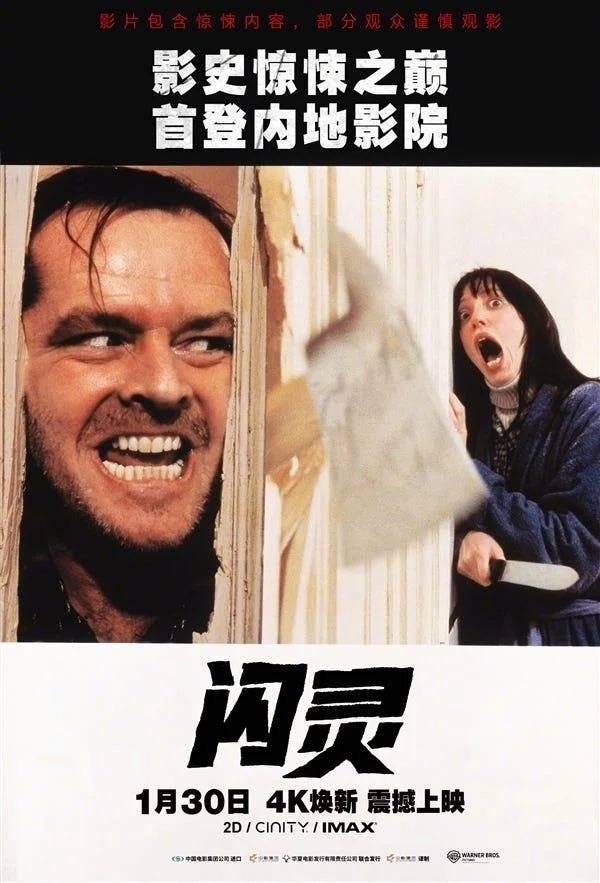
For over four decades, Stanley Kubrick’s psychological masterpiece, The Shining, has stood as a cornerstone of global cinema, influencing everything from the horror genre’s visual language to the technical evolution of cinematography. Yet, despite its status as a permanent fixture in the Western cultural canon, the 1980 adaptation of Stephen King’s novel has never been granted a formal theatrical release in mainland China. That historical absence is finally coming to an end. In a move that signals both a shift in the Chinese market’s appetite for classic international cinema and the aggressive expansion of high-end exhibition technology, The Shining is making its debut on Chinese screens. This release is not merely a standard 2D affair; it is being positioned as a showcase for the most advanced theatrical formats available today, including IMAX and the homegrown Chinese premium large format, Cinity.
The arrival of the Torrance family at the Overlook Hotel in 4K resolution across China represents a significant milestone for film preservation and international distribution. While the film has been available via grey-market media and streaming in various capacities over the years, the opportunity to witness Kubrick’s meticulous framing and the groundbreaking Steadicam work of Garrett Brown on a massive scale is a first for the region. The release leverages the recent 4K restoration, which was supervised with an eye toward modern high-dynamic-range (HDR) standards, making it the perfect candidate for the high-contrast environments provided by modern laser projection systems.
To understand the weight of this release, one must consider the sheer scale of the Chinese theatrical landscape, which has rapidly become the most sophisticated in the world regarding Premium Large Format (PLF) technology. IMAX, the Canadian-born giant that remains the gold standard for immersive cinema in the West, has found its most fertile ground in China. Of the roughly 1,700 IMAX screens worldwide, over 800 are located within the People’s Republic. This represents nearly 45% of the brand’s global footprint. For IMAX, China is no longer just a secondary market; it is a primary driver of research, development, and revenue.
However, the Chinese market is no longer content to simply host Western technology. The rise of Cinity, a premium format developed by the state-owned China Film Group (CFG), has introduced a formidable competitor to the likes of IMAX and Dolby Cinema. Cinity was designed specifically to push the boundaries of theatrical exhibition, focusing on what industry experts call the "seven pillars" of cinematic quality: high frame rate (HFR), high resolution (4K), high dynamic range (HDR), wide color gamut (WCG), high brightness, immersive sound, and 3D integration.
The technical specifications of Cinity are particularly impressive to those in the tech-journalism and film-production spheres. Utilizing dual Christie laser projectors, Cinity systems are capable of delivering brightness levels that far exceed standard xenon-bulb projectors, which is crucial for maintaining the integrity of the image in both 2D and 3D. While The Shining was shot in a traditional 24-frames-per-second (fps) format, the Cinity system’s ability to handle high-bitrate 4K content with superior contrast ensures that the deep shadows of the Overlook’s corridors and the vivid, blood-red hues of the iconic elevator scene are rendered with a fidelity never before seen in a public theater.
Beyond projection, the Cinity brand has pushed into the realm of Direct View LED technology with its "Cinity LED" offering. Much like Samsung’s Onyx or Sony’s Crystal LED, Cinity LED replaces the traditional projector and screen with a massive wall of self-emissive pixels. This technology eliminates the inherent limitations of reflected light, offering "perfect blacks" and a contrast ratio that is effectively infinite. In a film like The Shining, where Kubrick uses light and shadow to build a sense of architectural dread, the transition to an LED display can be transformative. The nuances of the film’s grain structure and the subtle gradations in the dark corners of the screen become visible in ways that traditional projection often obscures.

The legitimacy of Cinity on the global stage was cemented by the endorsement of James Cameron, perhaps the industry’s most demanding technical perfectionist. During the production and post-production of Avatar: The Way of Water and the upcoming Avatar: Fire and Ash, Cameron praised Cinity as a "superior format." The director was so impressed by the system’s performance that a Cinity LED screen was transported to his Lightstorm Entertainment facility in New Zealand to serve as a reference mastering monitor. This is a staggering vote of confidence; a director of Cameron’s stature using a commercial exhibition screen as a mastering tool suggests that the gap between professional grading monitors and consumer-facing theater screens is closing.
The decision to bring The Shining to China in these premium formats also highlights a broader trend in the "experience economy." As home theater technology—driven by OLED panels and high-end soundbars—continues to improve, the theatrical industry has been forced to offer something that cannot be replicated in a living room. This has led to a bifurcation of the market: standard screens are struggling, while PLF screens are thriving. For a classic film like The Shining, the draw is no longer the plot, which is well-known, but the "event" of seeing it in a state-of-the-art environment.
The geopolitical and cultural implications of this release are equally noteworthy. China has historically maintained strict regulations regarding the depiction of the supernatural and "ghosts" in cinema, often citing a desire to discourage superstition. However, in recent years, the China Film Administration has shown a greater willingness to allow the screening of classic Western films that are deemed to have significant artistic or historical value. By framing The Shining as a technical showcase for IMAX and Cinity, the release circumvents some of the traditional hurdles associated with the horror genre. It is being presented not just as a ghost story, but as a masterpiece of direction and a benchmark for visual technology.
For audiences outside of China, the proliferation of Cinity remains a somewhat distant phenomenon, though it is beginning to creep into Western markets. Currently, European cinephiles can find Cinity screens in select locations in Germany, Switzerland, and Spain. In the United States, the footprint is even smaller, with a notable installation at the Marcus Majestic Cinema in Waukesha, Wisconsin, where it is marketed under the "Ultrascreen DLX" branding. The fact that a 44-year-old American film is receiving its most technologically advanced release in China, rather than in its home country, is a testament to where the center of gravity for theatrical innovation currently lies.
Looking toward the future, the success of The Shining in China could pave the way for a steady stream of "prestige re-releases." As the Chinese middle class continues to grow and its audience becomes more cinephilic, there is a burgeoning market for the works of Kubrick, Hitchcock, Spielberg, and Coppola. If these films can be leveraged to sell tickets for high-margin PLF screens, it creates a win-win scenario for both the studios (who can monetize their back catalogs) and the theater owners (who need high-quality content to justify their investment in expensive laser and LED hardware).
Furthermore, the competition between IMAX and Cinity is likely to drive further innovation. IMAX has already responded to the threat of LED screens by refining its "IMAX with Laser" systems and expanding its "Filmed for IMAX" program, which encourages directors to use IMAX-certified cameras. Meanwhile, the China Film Group is looking to export Cinity more aggressively, positioning it as a more flexible and cost-effective alternative for exhibitors who want premium performance without the restrictive licensing terms often associated with Western brands.
In the end, the Chinese release of The Shining is more than a footnote in film history; it is a convergence of past and future. It brings one of the 20th century’s greatest artistic achievements into the 21st century’s most advanced viewing environments. As Jack Nicholson’s Jack Torrance descends into madness, he will do so with a clarity, brightness, and color depth that Stanley Kubrick could have only dreamed of when he was meticulously composing those shots in 1979. For the Chinese audience, the wait has been long, but the technical payoff promises to be spectacular. The Overlook Hotel has finally opened its doors in the East, and it has never looked more terrifyingly beautiful.