

The landscape of global licensing has witnessed a tectonic shift with the formal unveiling of the inaugural LEGO Pokémon collection. Following ten months of intense speculation and a partnership announcement that sent ripples through both the toy and gaming industries, The LEGO Group and The Pokémon Company International have finally pulled back the curtain on a debut range that spans the spectrum from accessible desk companions to monolithic engineering feats. Launching officially on February 27—coinciding with the annual "Pokémon Day" celebrations—this collaboration represents one of the most significant brand mergers in recent memory, bridging the gap between the world’s most successful multimedia franchise and the undisputed leader in construction toys.
For decades, the Pokémon license was held by competitors, most notably Mattel’s Mega brand, leaving a "Pikachu-shaped hole" in the LEGO portfolio. The resolution of this long-standing absence marks a new chapter for the Danish toy giant as it continues to consolidate its grip on Nintendo-adjacent intellectual properties. The initial wave focuses heavily on the "Generation I" nostalgia that fueled the franchise’s global explosion in the late 1990s, centering on five iconic creatures: Pikachu, Eevee, and the final evolutions of the original Kanto starters—Venusaur, Charizard, and Blastoise.

The Entry Point: Eevee and the ‘Build Together’ Strategy
The most accessible entry in the new lineup is LEGO Pokémon Eevee (Set 72151). Comprising 587 pieces and retailing at $59.99, this set is positioned as a gateway product for both younger fans and casual collectors. From a design perspective, Eevee presents a unique challenge: translating an "Evolution Pokémon" known for its soft, organic curves into a medium defined by hard angles and studs. The designers have opted for a "gawping," friendly expression that mirrors the creature’s aesthetic in the recent Let’s Go, Eevee! titles.
Beyond the physical bricks, this set serves as a primary vehicle for the LEGO "Build Together" app. This digital integration allows multiple users to work on different segments of the build simultaneously, reflecting a broader industry trend toward social and familial play. While Eevee is currently only available in its standard Normal-type form, the modular nature of LEGO suggests a clear path for future "Eeveelutions." Industry analysts expect that if sales for Set 72151 meet projections, we will likely see Jolteon, Vaporeon, and Flareon follow as mid-range expansions, utilizing similar internal skeletons to minimize production costs.
The Mascot Challenge: Pikachu and the Art of Articulation
The face of the franchise receives a substantial tribute in the form of LEGO Pokémon Pikachu and Poké Ball (Set 72152). At 2,050 pieces and a $199.99 price point, this is a "Large Scale" model intended for the growing "Kidult" demographic—adult fans who view LEGO as a sophisticated display medium rather than a temporary toy.

The design of the Pikachu set highlights the inherent tension between accuracy and articulation. Recreating Pikachu’s rotund, yellow silhouette requires a complex internal structure of SNOT (Studs Not On Top) bricks to achieve a smooth finish. Early impressions suggest the likeness is most effective when the model is placed in its signature pouncing pose on the included lightning-bolt-themed base. The inclusion of a brick-built, functional Poké Ball adds a layer of interactivity that collectors have long requested. This set exemplifies LEGO’s recent pivot toward "Display and Play" models, which are engineered to look like high-end statues while maintaining the tactile satisfaction of a buildable object.
The 6,800-Piece Beast: A New Heavyweight in the LEGO Pantheon
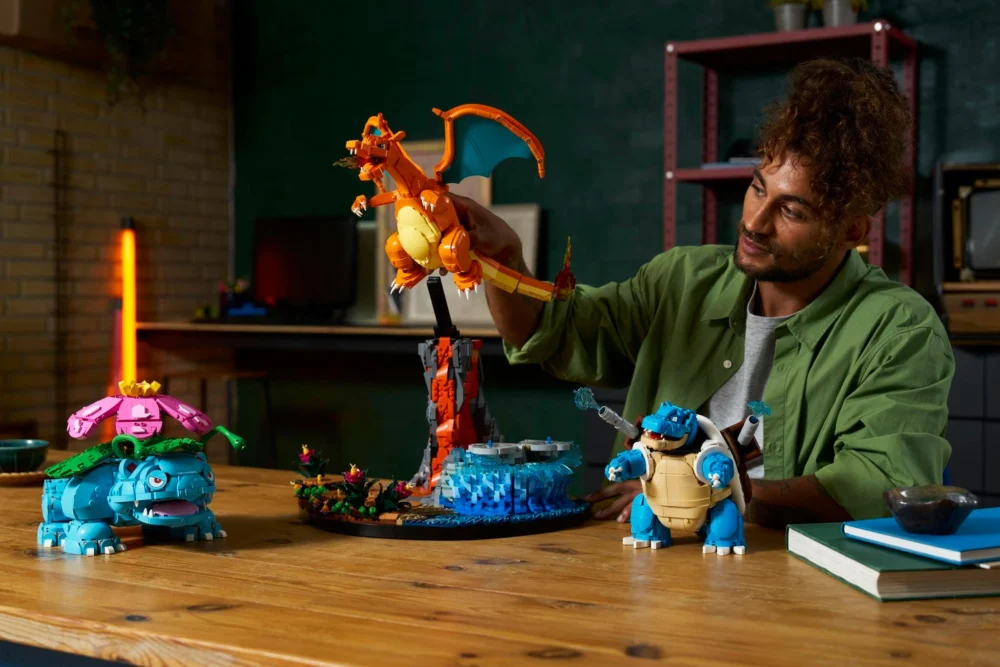
The undisputed crown jewel of the reveal is the LEGO Pokémon Venusaur, Charizard, and Blastoise (Set 72153). This "monstrous masterpiece" is a statement of intent from both companies. With a staggering brick count of 6,838 pieces, it immediately enters the record books as the seventh-largest LEGO set ever produced. It trails only the most legendary builds in the company’s history, such as the Star Wars Millennium Falcon, the Titanic, and the Eiffel Tower.
Retailing for $649.99, this set is a high-end diorama that places the three final-stage starters in their respective elemental biomes. Charizard is suspended in mid-air, Blastoise is positioned amidst crashing waves, and Venusaur is anchored in a lush, floral landscape. The level of detail here is unprecedented for a licensed character set, featuring complex Technic mechanisms to support the weight of the builds.

However, the set has already sparked debate among purists regarding the use of black Technic liftarms to suspend Charizard. While necessary for structural integrity, some critics argue that at this price point, LEGO should have utilized transparent polycarbonate elements to maintain the illusion of flight. Despite these minor design critiques, the set’s sheer scale and the inclusion of numerous "Easter eggs"—references to the original Pokémon Red and Blue games hidden within the internal structure—ensure it will become a "holy grail" for serious collectors.
The Economics of Nostalgia: Pricing and Incentives
One of the most surprising aspects of this announcement is the pricing structure. Historically, high-profile licensed sets carry a premium that can push the cost well beyond the traditional "10 cents per brick" benchmark. However, the Pokémon range appears to be bucking this trend, with all three sets landing remarkably close to that sweet spot. This aggressive pricing suggests that LEGO is aiming for volume, attempting to convert as many of Pokémon’s 440 million global fans into LEGO enthusiasts as possible.
To further incentivize early adoption, LEGO is introducing a highly coveted Gift With Purchase (GWP): the Kanto Region Badge Collection (Set 40892). This 312-piece display box features all eight gym badges from the original games, secured behind a clear front with a Poké Ball clasp. Crucially, this GWP is tied exclusively to the $650 "Beast" set. This strategy is a masterclass in psychological marketing, targeting the completionist nature of Pokémon fans who are conditioned by the franchise’s "Gotta Catch ‘Em All" mantra. On the secondary market, these badge sets are expected to appreciate in value rapidly, potentially offsetting the high entry cost for savvy investors.

Industry Implications and the ‘Kidult’ Revolution
The timing of this collaboration is no accident. The toy industry has seen a decline in traditional play among children, offset by a massive surge in adult collectors. Pokémon is uniquely positioned to capitalize on this trend, as the children who first played the games in 1996 are now adults with significant disposable income. By releasing a 6,800-piece set alongside a $60 Eevee, LEGO is effectively capturing the entire household.
Furthermore, this partnership places significant pressure on competitors. Mattel’s Mega brand has done an admirable job with the Pokémon license for years, but they lack the global distribution network and the cultural prestige associated with the LEGO brick. For many fans, a character doesn’t truly "arrive" in the toy world until it has been immortalized in LEGO. This move likely signals the beginning of a multi-year roadmap that will eventually encompass newer generations of Pokémon, possibly integrating the electronic "Smart Brick" technology seen in the LEGO Super Mario line.
Future Outlook: Where Do We Go From Here?
The current reveal, while massive, is likely only the tip of the iceberg. Conspicuous by their absence are LEGO minifigures. While the current sets are scale models of the creatures themselves, the potential for a "Minifigure-scale" world is immense. Fans are already clamoring for a Pallet Town set, a Pokémon Center, or even a brick-built version of the iconic S.S. Anne.

There is also the question of future generations. While the Kanto starters are the safest bet for a debut, the Johto and Hoenn regions offer equally iconic designs like Lugia or Rayquaza that would translate beautifully into the LEGO "Icons" or "Ultimate Collector Series" format. The possibility of an 8-bit Pallet Town frame—similar to the LEGO Super Mario World set—remains a high probability for a 2026 release.
In conclusion, the LEGO Pokémon range is a landmark achievement in product design and brand synergy. By balancing high-end engineering with nostalgic charm, the two companies have created a product line that feels both inevitable and fresh. As the February 27 launch date approaches, the "Pokémon Day" celebrations are set to reach a fever pitch. Whether you are a casual fan looking for a cute Eevee or a hardcore collector ready to tackle a 6,000-piece Charizard, the message is clear: the world of Pokémon has finally found its home in the world of the brick, and the possibilities for expansion are as vast as the Pokédex itself.