

The landscape of digital communication is undergoing a profound transformation as Google formally integrates its powerful Gemini large language model (LLM) directly into the core experience of Gmail. This development, centered around the newly introduced "AI Inbox" and "AI Overviews," signals a decisive shift away from the traditional, chronologically sorted email interface that has remained largely unchanged since the mid-2000s. Google frames this overhaul as a necessary response to the sheer volume of digital correspondence overwhelming modern users, noting that the decades-old paradigm established around 2004 is no longer sustainable in an environment where individuals regularly contend with hundreds of emails weekly, a torrent that only seems to intensify.
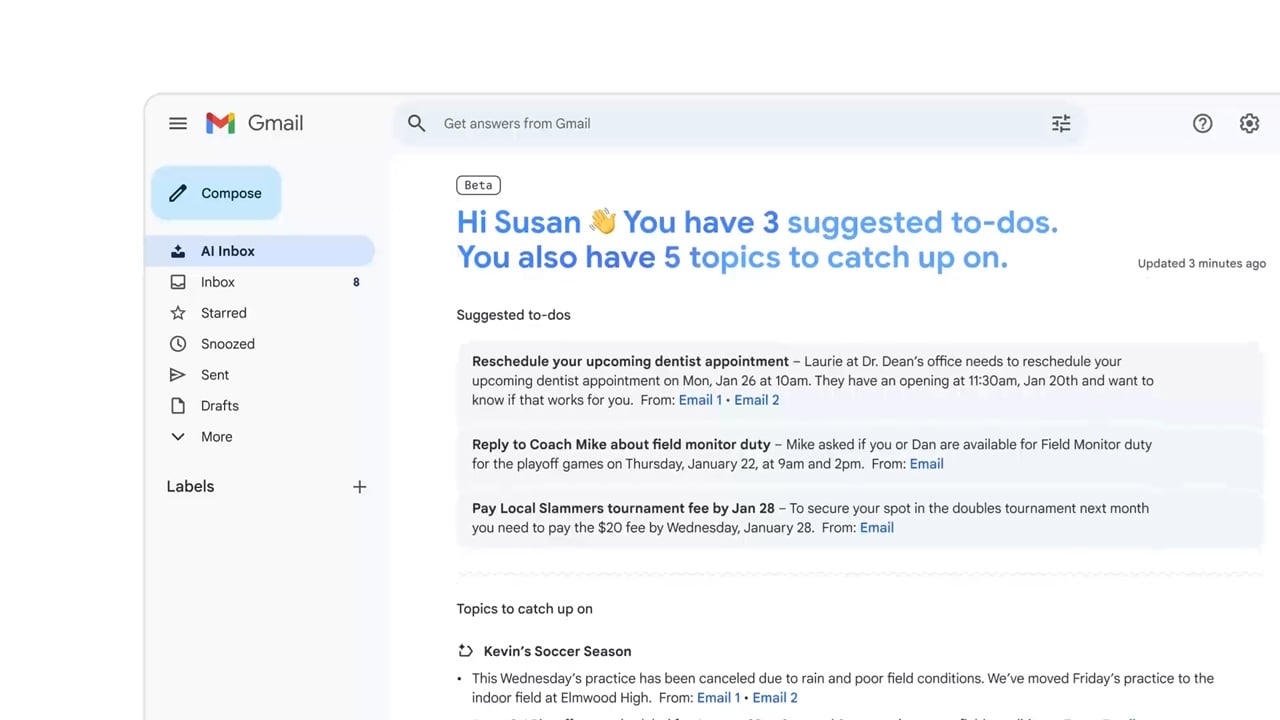
The cornerstone of this evolution is the AI Inbox, designed to function as a dynamic, personalized briefing system nestled prominently in the left-hand navigation pane, positioned above the standard folder structure. According to Google’s official documentation, this feature aims to emulate a personal executive assistant, distilling actionable items and highlighting critical updates. Crucially, the system employs sophisticated inference capabilities, leveraging signals such as communication frequency, established contacts, and inferred relational context within message threads to dynamically identify and elevate "VIPs"—the senders or topics that demand immediate attention. This moves beyond simple spam filtering or priority marking; it is an attempt at preemptive triage based on user behavior patterns.
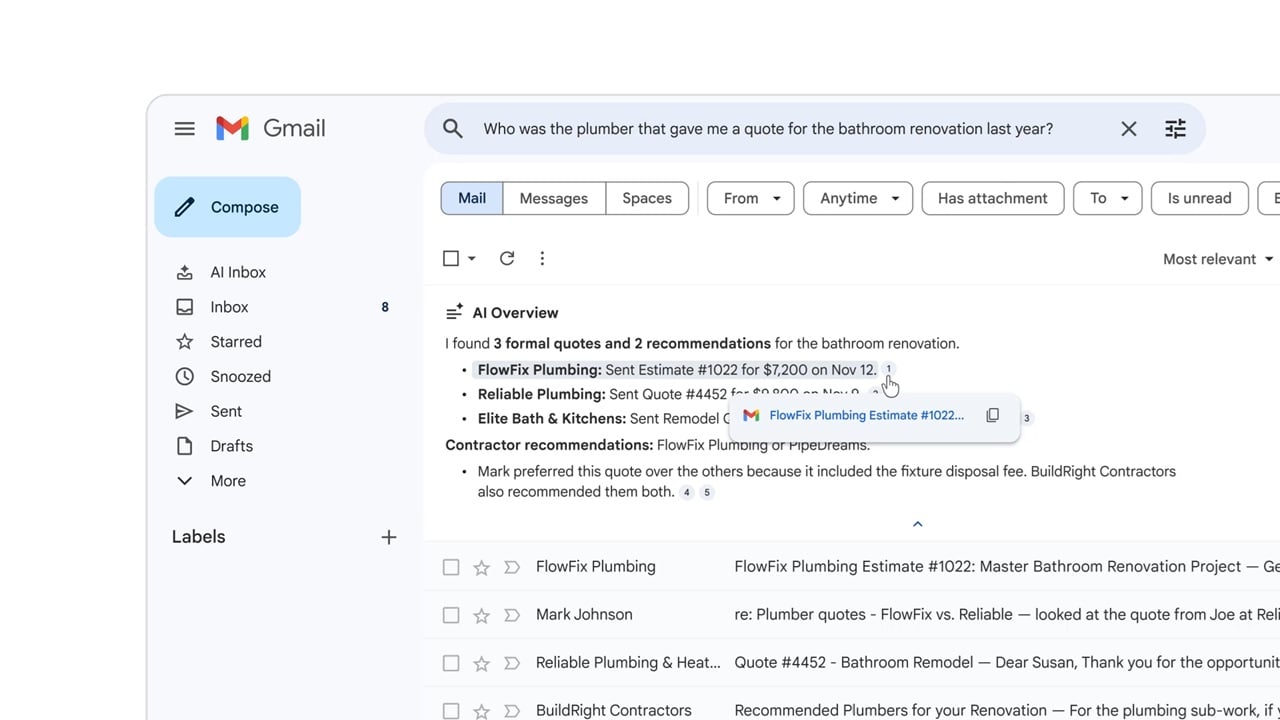
Complementing the AI Inbox are the "AI Overviews," which are functionally analogous to the summarization tools now common in Google Search, but applied contextually to email threads. In corporate or complex environments, where essential decisions or project updates can be buried deep within lengthy reply-all chains spanning days or weeks, sifting through every message becomes a significant drain on productivity. AI Overviews promise to synthesize these sprawling conversations into concise, digestible summaries, allowing users to grasp the current state of play without undertaking the laborious process of manual thread reconstruction. This capability, which is being rolled out initially at no additional cost to all users, represents a direct application of generative AI to solve a pervasive pain point in professional workflows.
The underlying technology driving these features is, unequivocally, Gemini. The deployment signifies a significant step in Google’s broader strategy to embed its most advanced generative AI across its entire suite of productivity tools. While the AI Overview conversation summaries are slated for broad, immediate availability, the more advanced AI Inbox functionality appears initially targeted towards subscribers of the premium Google AI Pro and Ultra tiers, with a phased rollout commencing within the United States.
However, this aggressive integration of sophisticated AI into the most private digital domain—personal and professional correspondence—inevitably raises significant security and privacy concerns among the user base. In response to this anticipated apprehension, Google has issued explicit and robust assurances: the data derived from user emails will not be utilized in the foundational training of their public AI models. This commitment is paramount. The company has stated clearly that users retain agency, possessing the ability to deactivate these AI functionalities entirely should they prefer the traditional Gmail experience or remain uncomfortable with the level of processing occurring within their accounts, even under these strict data governance parameters.
The Context of Trust in the Age of Pervasive AI
To fully appreciate the weight of Google’s privacy pledge, one must consider the industry-wide context. Since the initial proliferation of powerful LLMs, data ingestion—the process of feeding vast troves of text, code, and conversation into training sets—has been the primary engine driving model improvement. For consumer-facing applications like Gmail, which handles everything from sensitive financial communications to proprietary business strategy, the source material is uniquely valuable and highly sensitive.
Historically, Google’s monetization model for its core services has relied on anonymized data analysis for targeted advertising. While Gmail itself has long been insulated from direct ad insertion within the inbox interface, the data within it remains a rich dataset. The introduction of Gemini necessitates a different calculus. If users believe their intimate correspondence is being used to refine models that might later be deployed in ways that could inadvertently leak context or structure, adoption will stall, regardless of the utility offered.
Google’s strategy here mirrors commitments made in other enterprise-focused AI deployments, where data isolation and non-training clauses are table stakes for securing large corporate contracts. By applying this same rigor—or at least the same explicit promise—to the consumer and free-tier user base, Google is attempting to preempt a major regulatory or public relations hurdle. The distinction between using data in transit or at rest for processing (which is necessary for summarization) versus using it for model refinement (which is external training) is the critical legal and technical line they are attempting to draw in the sand.
Industry Implications: Redefining Productivity Software
The introduction of the AI Inbox has significant ramifications extending beyond Google’s direct competitors like Microsoft Outlook and Apple Mail. It signals a maturation point for AI in productivity suites: the technology is moving from being a bolted-on feature (like simple auto-complete) to becoming the primary interface layer.

For competitors, the pressure is immediate. Outlook is already heavily invested in Copilot, which offers similar capabilities within the Microsoft 365 ecosystem. The race is now about speed of deployment, accuracy of summarization, and, critically, the strength of the accompanying privacy guarantees. If Google manages to deliver genuinely superior contextual awareness in the AI Inbox—for instance, by better understanding complex organizational hierarchies implied in email signatures and thread history—it could create a significant competitive advantage, pulling users deeper into the Google ecosystem.
Furthermore, this move impacts the broader enterprise software market. If users become accustomed to having their communication streams intelligently curated by Gemini, they will begin to expect similar levels of cognitive offloading in their CRM systems, project management tools, and internal knowledge bases. The expectation is shifting from software that stores information to software that interprets and prioritizes it proactively.
Expert Analysis: The Technical Hurdles of Contextual Trust
From a technical standpoint, fulfilling the "no training on user data" promise requires robust architectural separation. This typically means that data processed for individual user summaries must be handled by specialized, ephemeral instances of the Gemini model, or securely partitioned environments that are strictly ring-fenced from the large, general-purpose models that are continuously being updated with public data.
Experts in machine learning operations (MLOps) emphasize that ensuring this separation is not trivial. It requires rigorous auditing of data pipelines, stringent access controls, and perhaps utilizing techniques like federated learning or differential privacy, even if the company stops short of publicizing these exact methods. Any future security incident or data breach that suggests leakage of private email content into the general model weights would immediately invalidate Google’s core promise, leading to catastrophic user confidence erosion.
The effectiveness of the AI Inbox also hinges on its ability to accurately infer intent and urgency. In technical environments, jargon and acronyms proliferate. A system that misinterprets a critical bug report as low-priority correspondence, or conversely, elevates a routine internal announcement due to high volume, undermines the entire value proposition. The system must learn the specific vocabulary and established communication norms of each individual user and their professional circle, a task that requires intense, personalized processing—but processing that Google insists remains local to the user’s secure tenancy.
Future Impact and Emerging Trends
The trajectory set by the AI Inbox suggests several clear future trends for digital productivity:
1. The Death of the Default Chronological View: The primary view in email clients will increasingly become an AI-curated digest. The traditional inbox will likely become an archive or a secondary view for users who prefer manual review. This fundamentally alters how users interact with incoming information, prioritizing relevance over mere temporal arrival.
2. Deep Integration with Cross-Product AI: The AI Inbox will likely serve as a gateway to deeper functionality. For example, if the AI Inbox highlights a to-do item extracted from an email, the next logical step is for the user to confirm that item and have it automatically populate Google Tasks or Calendar, all orchestrated by Gemini across the Workspace suite. This creates a sticky, interconnected environment where AI acts as the central operating system for daily tasks.
3. The Rise of AI Governance and Auditing Tools: As more critical business logic is processed by these AI layers, there will be a corresponding demand for transparent governance tools. Users, especially in regulated industries, will require dashboards or reports detailing why the AI prioritized certain items, what inference rules were applied, and definitive proof that their data was isolated from model training. This will likely spur a new category of compliance software focused on auditing internal LLM usage.
4. Subscription Tier Differentiation: The initial rollout strategy clearly signals that the most advanced, proactive features (AI Inbox) will remain tethered to premium subscriptions (AI Pro/Ultra), while basic summarization (AI Overviews) is used as a broad adoption incentive. This establishes a clear monetization path for generative AI within the productivity space, where the "intelligence layer" itself becomes a key differentiator justifying higher monthly fees.
In conclusion, Google’s deployment of Gemini within Gmail marks a pivotal moment, tackling the overwhelming reality of modern digital communication head-on. While the utility promised—the personalized briefing and the thread summarization—is substantial, the success of this new AI era hinges entirely on Google’s ability to maintain the rigorous data isolation it has publicly guaranteed. In the post-privacy-breach digital economy, technical capability must be perfectly mirrored by demonstrable, uncompromised trust.