

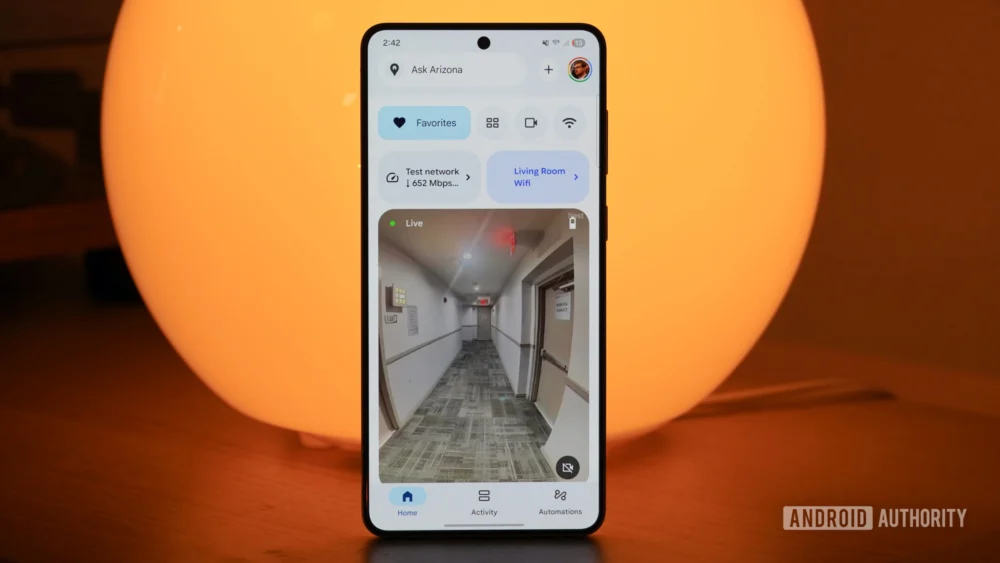
The ongoing evolution of the Google Home platform, the central nervous system for millions of interconnected smart devices, often finds itself balancing the demand for groundbreaking innovation against the persistent user need for rock-solid fundamental stability. In the latest iteration of the Google Home application suite, the focus appears to be a strategic blend of both: addressing long-standing quality-of-life issues while simultaneously deepening the logic available to advanced automation creators. This recent rollout, detailed in accompanying platform release notes, signals a methodical commitment to enhancing usability, particularly for users invested in complex, multi-layered routines and real-time security monitoring.
For the average consumer navigating the smart home landscape, the initial allure of connected devices—voice commands, remote control—quickly yields to the desire for true, autonomous operation. This is where the power of "automations" or "routines" becomes paramount. If a system requires constant manual intervention or troubleshooting, its ‘smart’ designation quickly dissolves into mere remote control. Google’s latest updates directly target this friction point by expanding the available "starters" and "conditions" that can initiate these automated sequences, while also addressing a critical pain point for security camera users: latency.
Addressing the Latency Dilemma: The Camera Experience
One of the most significant quality-of-life improvements detailed in the release is the enhancement of "close-to-live playback" for Nest and other compatible cameras integrated into the Home app. For years, a common frustration across major smart home ecosystems, but particularly noticeable in Google Home, has been the delay between an event occurring and the recorded clip being accessible or viewable. Users would often receive a motion alert, tap it immediately, only to be met with an infuriating "Video not available" placeholder or a feed that lagged several seconds behind reality.
Google’s stated improvement aims to significantly reduce this latency. From a technical standpoint, this suggests optimizations in how the application communicates with cloud storage and local edge processing (if applicable) to prioritize the retrieval and rendering of the most recent footage. In a security context, milliseconds matter. If a package is dropped off, or a potential intruder is sighted, the ability to view footage from thirty seconds ago versus two minutes ago fundamentally changes the utility of the monitoring system. This move away from frustrating delays towards near-instantaneous event review demonstrates Google’s recognition that for security features, speed is not a luxury, but a core requirement.
This optimization subtly reasserts Google’s competitive stance against rivals like Amazon Alexa and Apple HomeKit. While all platforms struggle with the inherent challenges of cloud processing and variable network conditions, platform providers who can consistently deliver the lowest perceived latency gain a distinct advantage in consumer trust, especially concerning security monitoring where users expect immediate situational awareness.
The Deepening of Automation Logic: Granularity is Power
Beyond the immediate fix for camera users, the update delivers substantial utility to the power users—those who have moved beyond simple "Turn on lights at sunset" commands into sophisticated conditional logic. The expansion of available triggers and conditions is where the platform’s intelligence truly deepens.
Previously, many automations were binary: if X happens, do Y. The new additions allow for much more nuanced environmental and device-state awareness. Specifically cited additions include:
- Environmental Sensing: The ability to trigger actions based on specific humidity thresholds. This is crucial for climate control routines, especially in basements prone to dampness or bathrooms where rapid dehumidification is necessary post-shower. Instead of relying solely on temperature or time, humidity offers a finer control over environmental quality and appliance longevity.
- Device State Awareness: Triggers based on a robot vacuum’s operational status, such as when it successfully docks itself. This allows for follow-up actions, perhaps triggering a specific lighting scene in the cleaning area or sending a final "Cleaning Complete" notification only upon successful completion of its cycle. Similarly, triggers related to battery status—such as a device’s battery level dropping below a certain percentage or, conversely, reaching a full charge—enable proactive power management routines.
This shift towards monitoring device states rather than just device actions is a significant step in platform maturity. It moves the system from reacting to external events to managing the internal health and status of its own components.
Fine-Grained Input Control for Physical Interfaces
Perhaps one of the most architecturally interesting additions is the introduction of more granular control over physical button and switch interactions. Modern smart switches and dimmers often support multiple input methods beyond a simple on/off toggle: single-press, double-press, and long-press. The new update integrates these distinct physical gestures directly into the automation engine as valid starting points.
This is a key development for user interface design within the smart home. A single physical switch, traditionally limited to controlling one light fixture, can now become a multi-functional control hub without adding new hardware. For example:
- Single Press: Toggles the primary overhead light.
- Double Press: Activates the "Movie Mode" scene (dims lights, closes shades).
- Long Press: Initiates a "Goodnight" routine (locks doors, turns off all non-essential power).
This level of input granularity dramatically increases the functionality density of existing infrastructure, reducing clutter and improving the tactile experience for occupants who prefer physical controls over voice or app interaction.
Expanding Action Sets: Color and Scene Precision
The evolution is not limited to triggers; the available actions have also been enriched. A notable addition is the ability to set smart lighting devices to precise color or color temperature specifications within an automation. While basic on/off or dimming routines have long been standard, the ability to invoke specific HSL (Hue, Saturation, Luminosity) values or Kelvin temperatures programmatically opens the door for highly contextualized ambient control.
This enables sophisticated routines tied to circadian rhythms or specific activities:
- A "Waking Up" routine could transition lights from a very warm, low-intensity amber (mimicking sunrise) to a brighter, cooler white (optimal for focus) over a thirty-minute period.
- An "Evening Wind Down" automation could shift all lights in the living area to a consistent, warm 2200K color temperature, explicitly avoiding cooler, blue-rich light wavelengths known to suppress melatonin production.
This moves Google Home beyond simple utility and into the realm of environmental psychology supported by hardware control.
Industry Implications and Contextual Analysis
These incremental updates, while perhaps not headline-grabbing revolutions, hold significant weight in the context of the broader smart home industry. The current market is defined by a tug-of-war between platform consolidation (driven partly by standards like Matter) and feature parity.
Google’s strategy appears to be twofold: first, shoring up the foundational experience (camera speed) to rebuild user confidence eroded by past instabilities. Second, leveraging its deeply integrated software ecosystem to offer logical depth that hardware-centric rivals might struggle to match without significant backend investment.
The introduction of humidity triggers, for instance, positions Google Home as a more holistic home management platform, not just an entertainment and lighting controller. As consumers become more educated about home health—air quality, energy efficiency, and thermal comfort—the platform that best translates environmental sensor data into actionable, automated responses will capture market share.
Furthermore, the focus on granular input (press vs. long-press) suggests an acknowledgment of the diverse ways users interact with their homes. Voice assistants are excellent for quick, context-specific commands, but physical switches remain the most reliable interface during emergencies, power outages (for local controls), or when voice commands are inconvenient (e.g., during a loud movie or when others are sleeping). By empowering these physical inputs within the automation logic, Google enhances accessibility and robustness.
Future Trajectory and Expert Outlook
The trajectory suggested by this update points toward an increasing reliance on contextual awareness as the primary differentiator in the smart home race. Future iterations will likely see these new triggers become vectors for integrating more complex third-party data: perhaps triggering routines based on local pollen counts, utility pricing signals, or even integration with wearable health data to adjust ambient conditions proactively.
Expert analysis suggests that the next major hurdle for Google Home—and the industry at large—will be making these complex, multi-conditional automations easily discoverable and editable for the average user. While the capability to create a routine based on humidity, battery level, and a long-press action is now present, presenting this level of complexity in a clean, intuitive user interface remains a monumental design challenge. The current update solidifies the engine’s capabilities; the next phase must focus on simplifying the dashboard.
Ultimately, these updates serve as proof points that the Google Home development team is actively iterating based on real-world usage patterns. While the user community often expresses desire for a complete architectural overhaul, the steady stream of feature expansions that solve tangible, daily frustrations—like slow camera feeds and limited trigger options—is crucial for maintaining a loyal and engaged user base, even amidst the inevitable complexities of large-scale software deployment. This measured approach to feature enhancement suggests a mature understanding of the consumer electronics lifecycle, prioritizing reliable functionality over splashy, under-baked announcements.