


The landscape of web browser development is undergoing a significant evolution as Google Chrome, the dominant player in the market, formally transitions its stable release schedule from a four-week cycle to a compressed two-week cadence. This strategic shift, slated to commence with the rollout of Chrome 153 on September 8th, represents more than just a minor scheduling adjustment; it signals a profound maturation in Google’s internal development, testing, and deployment infrastructure. By halving the time between major stable versions, Google aims to enhance feature velocity, improve responsiveness to emerging web standards, and, perhaps most critically, streamline the process of mitigating emerging vulnerabilities.
For nearly three years, since 2021, the four-week cycle had become the predictable rhythm for developers, IT departments, and web content creators relying on Chrome’s predictable update window. This new bi-weekly model, however, applies across the board for Stable and Beta channels spanning Desktop (Windows, macOS, Linux), Android, and iOS platforms. This synchronization across disparate operating systems under a tighter timeline suggests Google has successfully industrialized its Continuous Integration/Continuous Deployment (CI/CD) pipelines to handle smaller, more frequent integration points without sacrificing the rigorous quality assurance historically associated with slower releases.
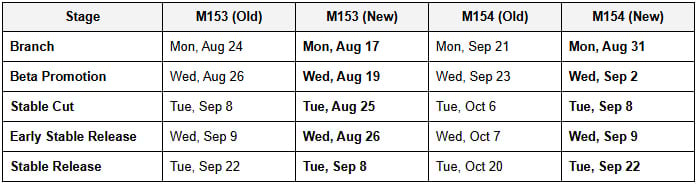
The shift is visualized by an updated development roadmap, which now mandates two major stable releases per calendar month. This acceleration places significant pressure on downstream consumers of the browser, but Google’s rationale hinges on the concept of "minimal viable change." As articulated by the company, this strategy is designed to "minimize disruption and simplify post-release debugging." When a release package is smaller—containing fewer new features, fixes, and performance tweaks—the potential surface area for introducing regressions or critical bugs shrinks proportionately. Furthermore, if an issue does surface post-launch, tracing its origin back through a two-week changeset is considerably faster and less resource-intensive than sifting through four weeks’ worth of committed code.
Crucially, this acceleration is not universal across all Chrome branches. The most bleeding-edge channels—Dev and Canary—which serve as the proving grounds for developers and early adopters, will maintain their existing, faster schedules. This preserves the necessary buffer for high-frequency testing and experimentation before code is deemed ready for mass consumption. More significantly, the Extended Stable channel, a vital lifeline for large enterprise deployments, regulatory environments, and organizations requiring extensive internal validation periods, remains untouched on its existing eight-week cycle. This tiered approach acknowledges the vastly different risk tolerances and deployment realities between the general public and highly regulated corporate environments, ensuring that stability-conscious sectors are not forced into uncomfortable update speeds.
The Architectural Underpinnings: Stability Through Velocity
The industry-wide adoption of faster release cycles in software development is not new, but achieving this velocity in a product as ubiquitous and complex as Chrome is a monumental technical achievement. Google explicitly attributes its confidence in maintaining high stability standards to "recent process enhancements." This points toward ongoing, deep investment in automated testing frameworks, sophisticated canary testing infrastructure, and potentially machine learning-assisted quality checks.
In the era of monolithic, infrequent updates, minor bugs often compounded, leading to larger, more complex patches that occasionally introduced cascading failures. The two-week model forces developers to adopt a more disciplined, atomic approach to feature development. If a new feature or optimization cannot be adequately tested and stabilized within a fourteen-day window, it suggests the scope of that feature is too large for the current release velocity, necessitating further refinement or postponement. This iterative pressure inherently promotes better engineering practices.

This move directly correlates with broader industry trends pushing toward DevOps maturity. Companies that can deploy smaller, validated changes rapidly gain competitive advantages in responsiveness and reliability. By enforcing this cadence on its flagship browser, Google is effectively setting a new baseline expectation for the entire ecosystem dependent on Chrome—from web application developers to enterprise IT managers.
Industry Implications: Web Standards and Ecosystem Pressure
The impact of this change reverberates beyond the end-user experience. For web developers, the faster introduction of new browser features means that experimental APIs, performance enhancements, and updated web standards will move from proposal to stable deployment much quicker. This is a double-edged sword. On one hand, it accelerates innovation, allowing developers to utilize cutting-edge browser capabilities sooner. On the other hand, it demands greater agility in testing legacy codebases against newer browser behaviors.
Previously, a developer might have a full month to observe Beta channel behavior before a feature landed in Stable. Now, that window shrinks to two weeks. While the Beta channel remains a crucial testing ground, the margin for error in reacting to final stable releases is tighter. This reinforces the industry movement toward adopting automated end-to-end testing suites that can quickly validate compatibility across multiple stable builds, rather than relying on manual checks against quarterly or monthly builds.
Furthermore, the push for rapid feature delivery often complements efforts to standardize emerging technologies. When Google can deploy a new standard feature quickly, it pressures other browser vendors (like Mozilla with Firefox and Apple with Safari) to adopt or iterate upon that standard more rapidly, ultimately benefiting the open web by reducing fragmentation caused by proprietary implementations.
The Security Imperative: Building on Weekly Fortifications
This new feature release cadence must be understood in the context of Chrome’s already aggressive security posture. Since August 2023, Chrome has operated on a framework that decouples feature updates from critical security patches, delivering dedicated, out-of-band security fixes on a weekly basis. This proactive measure is specifically designed to shrink the "patch gap"—the window of opportunity exploited by malicious actors between a vulnerability disclosure and widespread user remediation.
The bi-weekly feature release structure complements this weekly security model perfectly. Security fixes address immediate threats, while the bi-weekly milestone releases handle ongoing functional improvements, performance optimizations, and non-critical bug resolutions. By separating these concerns, Google ensures that critical vulnerabilities are addressed with maximum speed, without being bottlenecked by the feature testing required for a larger, combined monthly release.
The context of recent security challenges underscores the necessity of this pace. The article notes that Chrome experienced an uptick in actively exploited zero-day vulnerabilities in the preceding year, with numerous CVEs being leveraged in the wild. In a high-stakes environment where browser exploitation remains a primary vector for corporate espionage and broad cyberattacks, reducing deployment latency by 50% is a tangible security advantage. A faster release cycle means that even if a zero-day is discovered, the time until a patch reaches the majority of users is significantly reduced, diminishing the exploit’s shelf life.
Expert Analysis: The Future of Browser Development
From a software engineering perspective, this transition signifies that Google has successfully managed the complexity inherent in scaling rapid iteration. Historically, browser development was slow due to the intertwined nature of rendering engines (like Chromium/Blink), JavaScript execution environments (V8), and platform integration layers across operating systems.
Senior software architects often view frequent, small releases as the hallmark of a mature microservices-oriented approach, even when applied to a monolithic application like a web browser. The goal is to create internal boundaries that allow teams to develop, test, and merge changes independently and frequently. The two-week cycle suggests that these internal boundaries are robust enough to prevent the integration of these smaller components from destabilizing the entire product.
One potential challenge lies in the cognitive load placed upon enterprise administrators who manage large fleets of workstations. While the Extended Stable channel caters to the most risk-averse, organizations on the standard Stable track must now prepare for significant functional changes twice a month instead of once. IT departments must adjust deployment testing schedules, bandwidth allocation for downloads, and user communication protocols to accommodate the increased frequency of mandatory restarts. This adjustment is a necessary tax for leveraging the benefits of faster innovation.
Looking Ahead: Trends in Digital Delivery
The adoption of the bi-weekly release schedule is likely to be viewed retrospectively as a key inflection point in browser maintenance strategy. It positions Chrome ahead of the curve in balancing feature delivery with stability assurance. As the web continues to evolve—incorporating more complex, resource-intensive applications directly into the browser (e.g., advanced gaming, AI interfaces, high-fidelity media streaming)—the need for rapid iteration to support these demands becomes paramount.
We can anticipate that this accelerated cadence will fuel further experimentation in areas like WebAssembly performance, advanced WebGL/WebGPU capabilities, and privacy-preserving technologies (like Privacy Sandbox initiatives). Features that once required lengthy incubation periods can now be tested in the hands of millions of users within a month, providing high-fidelity feedback loops to engineers.
Ultimately, this shift is a calculated maneuver by Google to cement Chrome’s dominance by offering a product that feels perpetually modern, secure, and incrementally improved. By making instability smaller and more manageable, they aim to make the entire update experience virtually invisible to the average user, while simultaneously increasing the operational overhead for threat actors seeking easy targets. The age of the slow, predictable browser update is officially fading, replaced by a dynamic rhythm tuned to the unrelenting speed of modern software development.