

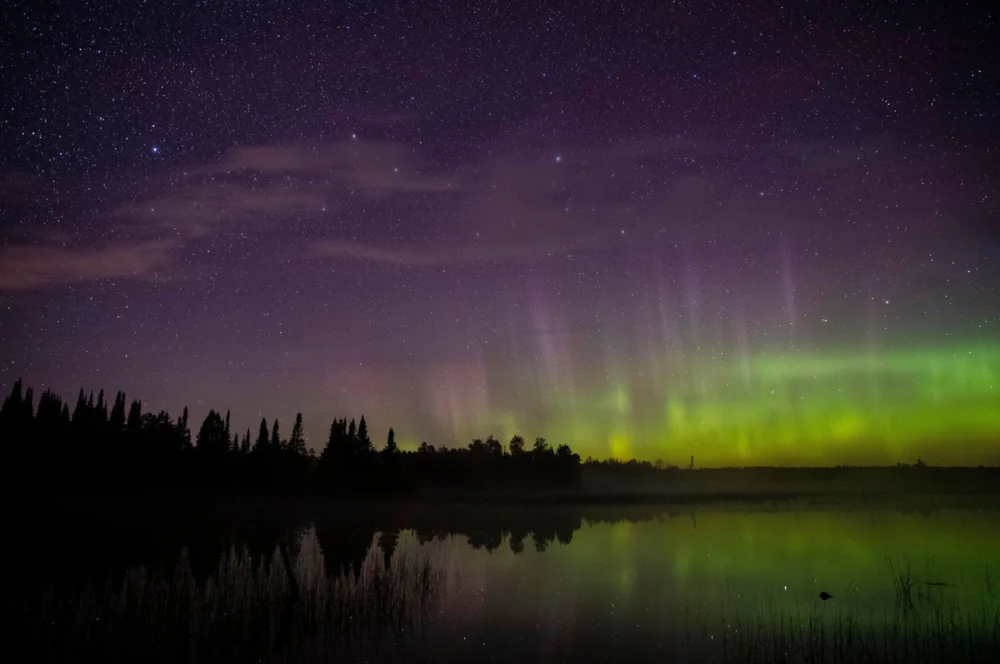
The celestial stage is set for a weekend of atmospheric brilliance as a surge of solar activity threatens to push the Aurora Borealis deep into the northern tier of the United States. Following a series of high-intensity eruptions from the sun’s surface, the National Oceanic and Atmospheric Administration (NOAA) has issued a formal geomagnetic storm watch for Saturday, February 7, through Sunday, February 8. According to space weather forecasters, a G1-class (minor) geomagnetic storm is highly likely as a coronal mass ejection (CME) makes a grazing impact with Earth’s magnetic field. While "minor" in the lexicon of heliophysics, such a storm can create spectacular visual displays for skywatchers located far from the traditional auroral oval.
The catalyst for this weekend’s anticipated light show is sunspot AR4366, a massive and magnetically complex region on the solar surface that has recently become the most volatile area of the current solar cycle. On February 4, this sunspot unleashed a powerful X4.2-class solar flare. X-class flares represent the most intense category of solar eruptions, capable of triggering planet-wide radio blackouts and long-lasting radiation storms in the upper atmosphere. The plasma cloud launched by this specific flare—the CME—is currently traversing the 93-million-mile void between the sun and Earth, carrying with it a billion tons of charged particles and an embedded magnetic field.
For residents in at least 10 U.S. states, this solar "graze" offers a rare opportunity to witness the northern lights from their own backyards. The states positioned in the primary "viewline" include Alaska, Washington, Idaho, Montana, Wyoming, North Dakota, South Dakota, Minnesota, Wisconsin, Michigan, and Maine. While those in the southernmost portions of these states may only see a faint green or reddish glow low on the northern horizon, those closer to the Canadian border could experience the more traditional curtains of light and dancing pillars that characterize a true auroral display.
The Science of the Solar Maximum
The current uptick in activity is no coincidence. Our sun operates on a roughly 11-year cycle, transitioning from solar minimum to solar maximum. We are currently navigating the peak of Solar Cycle 25, a period characterized by a high frequency of sunspots, flares, and CMEs. This particular cycle has significantly outperformed initial scientific predictions, showing levels of activity not seen in nearly 23 years. This heightened state of "solar max" means that the Earth’s magnetosphere is being bombarded more frequently by solar wind, making the aurora a common visitor to latitudes that rarely see it during quieter years.
Sunspot AR4366 is a prime example of this peak activity. As the sun rotates, this "active region" has moved into the "Earth strike zone," a position where any eruption is aimed directly or nearly directly at our planet. Because AR4366 continues to grow in size and complexity, space weather experts warn that this weekend’s G1 storm could be just the beginning of a multi-day period of geomagnetic instability.

Ideal Viewing Conditions and the "Planet Parade"
Astrophotographers and amateur stargazers have an additional reason for optimism this weekend. A bright moon can often wash out the subtle colors of the aurora, but the lunar cycle is working in favor of observers this time. Across North America, the moon will not rise until approximately 2:00 a.m. local time on Sunday, February 8. This provides a generous window of "true dark" during the peak evening hours when geomagnetic activity often intensifies.
The weekend also coincides with a rare "planet parade," a celestial alignment where six planets—Mercury, Venus, Mars, Jupiter, Saturn, and Uranus—are becoming visible in various parts of the night sky. The prospect of seeing the northern lights shimmering above a planetary alignment is a rare "double feature" for the astronomical community.
However, the success of any aurora hunt depends on two factors: clear skies and the orientation of the interplanetary magnetic field (IMF). While meteorologists can predict cloud cover, space weather forecasters look at a metric known as the "Bz component." The Earth’s magnetic field acts as a shield, but it has a "door" that can be opened. When the Bz component of the incoming solar wind points North, our shield is reinforced. However, when the Bz swings South, it aligns with Earth’s magnetic lines in a way that allows solar plasma to stream into the upper atmosphere. This process, known as magnetic reconnection, is the engine that drives the aurora. Observers are encouraged to watch for a sustained southward Bz of -5 nT or stronger to know when a display is imminent.
Industry Implications of Solar Storms
While the public views geomagnetic storms as a visual spectacle, the technology sector views them with a degree of caution. Even a G1-class storm can have measurable impacts on modern infrastructure. Satellite operators, including those managing low-Earth orbit (LEO) constellations like SpaceX’s Starlink, must monitor these events closely. Increased solar activity heats the Earth’s upper atmosphere, causing it to expand. This increases atmospheric drag on satellites, which can cause them to lose altitude or, in extreme cases, drop out of orbit entirely.
The aviation industry also pays close attention to X-class flares and CMEs. During geomagnetic storms, radio communication at high latitudes can be disrupted, and polar flight routes may be diverted to avoid increased radiation exposure for crew and passengers. Furthermore, power grid operators must manage geomagnetically induced currents (GICs) that can flow through long-distance transmission lines, potentially damaging transformers if the storm intensity unexpectedly spikes.
How to Maximize Your Viewing Potential
For those hoping to catch a glimpse of the aurora this Saturday night, location is everything. Light pollution is the primary enemy of the aurora hunter. Experts recommend using tools like the Dark Sky Place Finder or light pollution maps to identify areas away from the "glow" of major cities. A location with an unobstructed view of the northern horizon is essential, as a G1 storm rarely pushes the aurora directly overhead in the lower 48 states; instead, it appears as a "glow" or "arc" in the north.

Modern technology has also made aurora hunting more accessible. Apps such as "My Aurora Forecast" and "SpaceWeatherLive" provide real-time data from the Deep Space Climate Observatory (DSCOVR) satellite, which sits about a million miles toward the sun. This satellite provides a 15-to-60-minute "early warning" of the solar wind’s speed and magnetic orientation before it hits Earth.
If you are using a camera, even a smartphone, the results may surprise you. Modern sensors are much more sensitive to the wavelengths of light emitted by oxygen and nitrogen atoms in the atmosphere than the human eye is. A three-to-ten-second exposure on a tripod can often reveal vibrant greens and reds that appear only as a greyish mist to the naked eye.
Looking Ahead: The 2026 Outlook
The current flurry of activity is a harbinger of what is to come throughout 2025 and 2026. As the sun remains in its solar maximum phase, the frequency of X-class flares and subsequent geomagnetic storms is expected to remain high. This period represents a "golden age" for aurora viewing in the continental United States, as the auroral oval—the ring of light typically confined to the Arctic—will continue to expand southward during these solar outbursts.
The scientific community is using this period to refine predictive models. Understanding how CMEs interact with the Earth’s magnetosphere is critical not just for aesthetic reasons, but for protecting the global "technosphere." As we become increasingly dependent on satellite-based GPS, high-frequency communications, and a delicate global power grid, the ability to forecast these "space hurricanes" becomes a matter of national security.
As Saturday night approaches, the combination of a powerful X-class flare, a well-positioned sunspot, and a favorable moon phase creates a perfect storm for skywatchers. Whether you are a professional photographer or a curious resident of the northern states, the message is clear: keep your eyes on the northern sky. The universe is about to put on a show, reminding us of the profound and dynamic connection between our planet and the star that sustains it. Clear skies and wide eyes will be the order of the night as the solar wind brings the magic of the North to the doorsteps of millions.