

For decades, the skateboarding genre in interactive media has been defined by a rigid adherence to the "extreme sports" archetype. From the pixelated foundations of the late 1980s to the cultural phenomenon of the Tony Hawk’s Pro Skater series and the physics-driven realism of EA’s Skate, the focus has almost exclusively remained on the mastery of the board. These titles prioritized the accumulation of points, the perfection of a line, and the expansion of a digital skatepark. However, a new wave of independent development is beginning to dismantle these conventions, treating the skateboard not as a tool for sports simulation, but as a vehicle for existential exploration. At the forefront of this movement is Skate Story, a title that eschews the concrete jungles of Southern California for a psychedelic, iridescent descent into the depths of a vaporwave Hell.
Developed by Sam Eng and published by the avant-garde curators at Devolver Digital, Skate Story represents a radical departure from genre norms. It does not ask the player to become a world-class athlete; it asks them to become a fragile, crystalline demon seeking liberation through the most unlikely of means. This shift in perspective—moving from the literal to the metaphorical—marks a significant milestone in how sports mechanics can be utilized to tell complex, atmospheric stories.
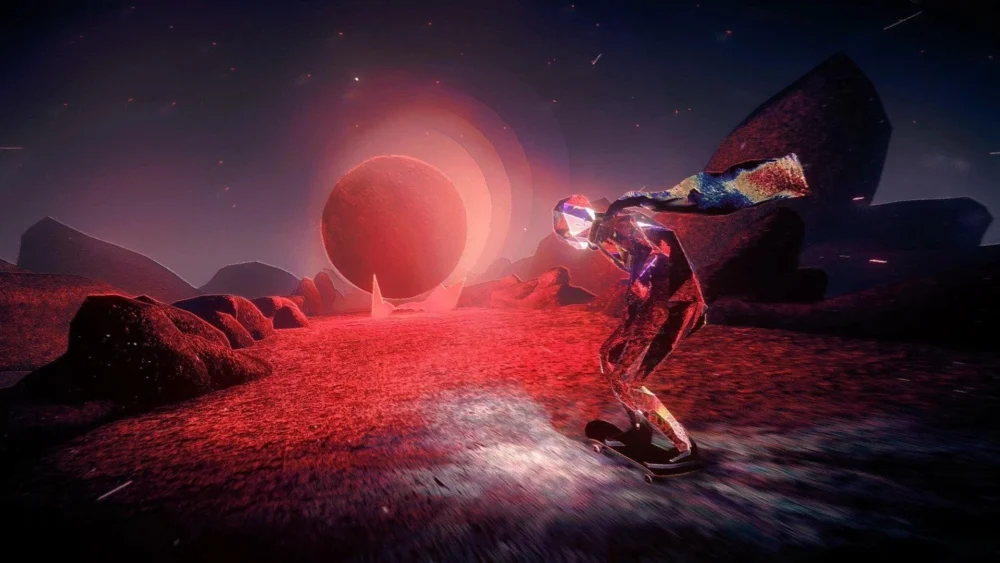
The premise of Skate Story is as enigmatic as its visual style. Players inhabit the form of a demon made of glass and light, trapped within the confines of the Underworld. To escape this eternal confinement, the protagonist enters into a Faustian bargain with the Devil: if the demon can skate to the ends of Hell and "eat the moon," its freedom will be granted. On the surface, the narrative sounds like a fever dream, yet within the context of the game’s internal logic, it feels remarkably cohesive. The moon serves as a celestial carrot on a stick, a symbol of the impossible task that mirrors the real-world frustration of learning a difficult skate trick.
Visually, Skate Story is nothing short of a triumph of art direction. While traditional depictions of Hell rely on a palette of scorched ochres and deep reds, Sam Eng opts for an iridescent, vaporwave aesthetic. The world is a kaleidoscope of neon purples, translucent teals, and glitch-art distortions. This choice is not merely cosmetic; it informs the emotional temperature of the journey. The Underworld here feels less like a pit of suffering and more like a melancholic, liminal space—a dreamscape where the laws of physics are secondary to the laws of style. The shimmering, glass-like textures of the protagonist and the environment create a sense of constant, beautiful peril.

This fragility is the game’s most compelling mechanical hook. Because the protagonist is made of glass, every collision carries the threat of total annihilation. In most skateboarding games, a "bail" is a minor setback, often accompanied by a ragdoll animation and a score penalty. In Skate Story, a failed landing or a collision with an obstacle results in the character shattering into a thousand shimmering shards. This "glass cannon" approach to movement fundamentally changes the player’s relationship with the environment. You are not an invincible god of the halfpipe; you are a vulnerable entity navigating a world that is fundamentally hostile to your existence.
Despite this high stakes fragility, the game remains surprisingly accessible. The control scheme avoids the daunting complexity of "sim-style" skaters like Session or Skater XL. Instead, it focuses on a rhythmic, fluid approach to tricks. Basic maneuvers like ollies, kickflips, and grinds are executed with a grace that emphasizes flow over technical perfection. The goal is rarely to hit a specific score threshold, but rather to maintain momentum through increasingly surreal landscapes. This design philosophy ensures that the "vibes" remain immaculate, allowing the player to enter a flow state that is more meditative than competitive.
The boss encounters in Skate Story further distinguish it from its predecessors. These are not mere skill checks, but encounters with "manmade horrors beyond comprehension"—entities that possess a biblically sinister aura. These fights transform the act of skateboarding into a form of ritualistic combat. Players must navigate treacherous terrain, avoiding laser beams and skating across surfaces of water, all while performing specific trick combinations to deplete the health bars of these celestial gatekeepers. It is a brilliant fusion of action-adventure tropes and sports mechanics, proving that the vocabulary of skateboarding is versatile enough to support traditional boss-battle structures.
From a technical standpoint, the experience is bolstered by a haunting, lo-fi experimental soundtrack that perfectly complements the visual journey. The absence of traditional voice acting is a deliberate choice that pays dividends in atmosphere. While some might argue that a narrated guide would provide more narrative weight, the silence of the Underworld—punctuated only by the rhythmic clack of the board and the ethereal score—allows the player to project their own emotions onto the journey. When higher powers speak down to your glass form through text, the lack of a voice actually enhances the sense of cosmic scale and your own relative insignificance.
The industry implications of Skate Story are profound. For years, the "skateboarding game" was considered a dead or niche genre, sustained only by a handful of dedicated fans. However, the success of titles like OlliOlli World and now Skate Story suggests a growing appetite for "skate-adjacent" experiences—games that use the aesthetics and movement of skating to explore different genres. We are seeing the birth of the "skate-adventure" or "skate-RPG," where the board is as central to the identity of the game as a sword is to a fantasy epic.

This trend reflects a broader shift in the gaming industry toward "vibe-centric" design. As graphical fidelity reaches a plateau, developers are increasingly turning toward unique art styles and atmospheric storytelling to differentiate their work. Skate Story is a masterclass in this approach. It understands that the feeling of skating—the defiance of gravity, the subversion of public space, the solitary pursuit of a goal—is more important than the literal simulation of the sport.
Expert analysis of the game’s impact must also acknowledge its role as a piece of counter-culture media. Historically, skateboarding has always been an act of defiance, a way for youth to reclaim urban environments and push back against societal expectations of "proper" behavior. Skate Story captures this meta-context perfectly. By placing a skateboarder in the middle of a cosmic struggle against the Devil and celestial entities, it elevates the act of skating to a form of spiritual rebellion. It is the ultimate "stick it to the man" narrative, where "the man" is the architect of the universe itself.
For players on mobile or handheld platforms, such as the Steam Deck or the newly launched Nintendo Switch 2, Skate Story offers a particularly compelling experience. The game’s structure—divided into distinct, brisk segments—is ideally suited for portable play. While the intensity of some boss fights can lead to the occasional hand cramp during extended sessions, the forgiving checkpoint system ensures that the experience never becomes frustrating. The ability to dive into a 6-to-8-hour psychedelic odyssey while on the go is a testament to the game’s tight pacing and focused vision.
Looking toward the future, Skate Story sets a high bar for how developers can iterate on established genres. It invites us to imagine what other "sports" could be reimagined through a surrealist lens. Could we see a survival-horror game built around the mechanics of mountain climbing? An existential drama centered on long-distance running? Skate Story proves that when you strip away the scoreboards and the sponsors, the core mechanics of movement can be used to tell stories that are deeply human, even when the protagonist is a demon made of glass.
In conclusion, Skate Story is far more than a simple alternative to the Tony Hawk franchise. It is a bold, artistic statement that uses the medium of skateboarding to explore themes of fragility, defiance, and the search for freedom. With its breathtaking visuals, hypnotic soundtrack, and accessible yet high-stakes gameplay, it stands as one of the most unique offerings in the modern indie landscape. It does not overstay its welcome, offering a concise and memorable journey that lingers in the mind long after the final moon has been consumed. For those seeking an experience that prioritizes atmosphere and artistic integrity over traditional progression systems, Skate Story is an essential voyage into the heart of a neon-soaked abyss.

Score: 8/10
Skate Story is currently available for PC, PlayStation 5, and Nintendo Switch 2.