

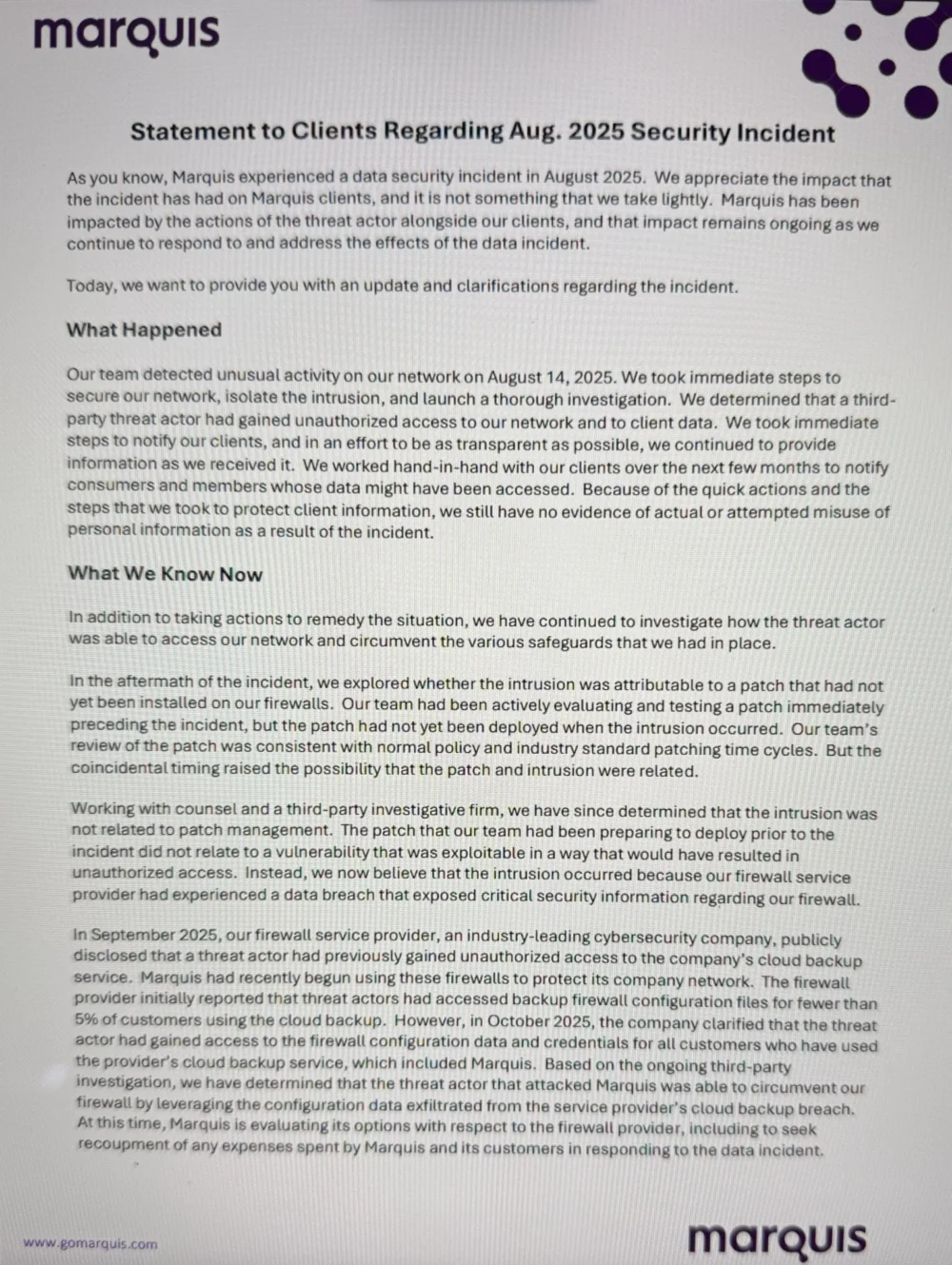
Marquis Software Solutions, a significant player in the U.S. financial technology sector, has publicly revised its narrative concerning the severe ransomware incident that crippled its operations in August 2025, affecting a substantial network of partner banks and credit unions. The Texas-based firm, which services over 700 institutions with essential data analytics, regulatory compliance tools, customer relationship management (CRM), and digital marketing services, is now directly attributing the success of the cyber intrusion to a previously disclosed security vulnerability within SonicWall’s cloud infrastructure. This pivot in attribution shifts the focus from the presumed exploitation of a local firewall vulnerability to the compromise of configuration data hosted by a third-party service provider.
Internal communications, recently made available, reveal that Marquis’s internal investigation, supported by external forensic experts, has concluded that the initial compromise vector was not a failure to patch a perimeter defense system—the initial hypothesis in many sectors following similar attacks. Instead, the threat actors reportedly utilized highly sensitive configuration details exfiltrated from SonicWall’s MySonicWall online portal following a breach of the vendor’s cloud backup service. This specific dataset, which details firewall settings, access controls, and potentially authentication mechanisms, provided the attackers with the necessary intelligence to bypass Marquis’s existing network defenses effectively.
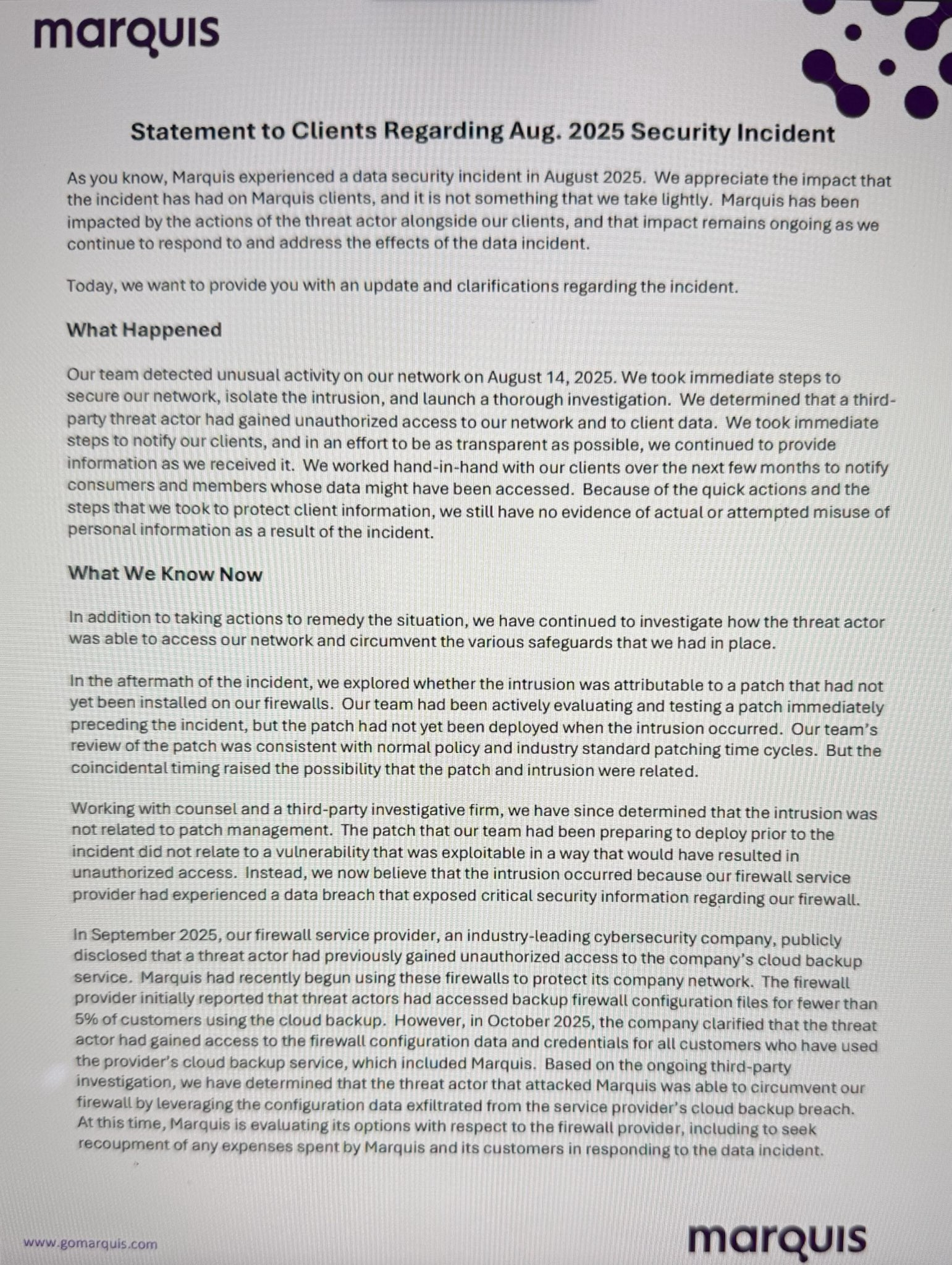
In their formal statement to affected clients, Marquis explicitly noted, "Based on the ongoing third-party investigation, we have determined that the threat actor that attacked Marquis was able to circumvent our firewall by leveraging the configuration data extracted from the service provider’s cloud backup breach." This statement carries significant weight, not only for the immediate fallout for Marquis and its clients but also for the broader ecosystem relying on similar third-party management tools. Furthermore, the firm has signaled its intent to hold the firewall provider accountable, stating that it is currently "evaluating its options with respect to the firewall provider, including to seek recoupment of any expenses spent by Marquis and its customers in responding to the data incident." This suggests a potential legal or contractual challenge regarding product liability and security assurances provided by the hardware vendor.
Contextualizing the SonicWall Cloud Backup Incident
To fully grasp the gravity of Marquis’s findings, one must place them within the timeline of the original SonicWall disclosure. SonicWall first alerted its customer base to the breach in its MySonicWall cloud environment on September 17, 2025. Initially, the vendor downplayed the scope, suggesting the incident impacted only approximately 5% of its firewall customers utilizing the cloud backup feature. The initial advisory mandated immediate credential resets, warning that extracted access tokens and credentials could make subsequent firewall compromises "significantly easier."
However, the scope rapidly expanded. Within three weeks of the initial warning, SonicWall was forced to issue a stark update: forensic analysis confirmed that the breach had, in fact, compromised the configuration data for all customers utilizing the cloud backup service, regardless of the initial estimation. This escalation highlighted a failure in initial detection or scope assessment, eroding user confidence significantly.

The situation grew more complex a month later when a subsequent investigation, conducted by Mandiant, linked the September MySonicWall incident to sophisticated, state-sponsored threat actors. This attribution elevated the incident from a typical criminal ransomware operation to one potentially involving nation-state resources, raising the stakes for every affected customer, particularly those in sensitive sectors like financial services.
It is crucial to differentiate this cloud backup compromise from contemporaneous, yet distinct, attacks targeting SonicWall infrastructure. SonicWall explicitly stated that the state-sponsored activity tied to the backup breach was unrelated to the separate, widespread attacks attributed to the Akira ransomware group, which exploited vulnerabilities in MFA-protected SonicWall SSLVPN accounts in late September. The latter involved credential stuffing or brute-forcing against the VPN endpoints themselves, whereas the Marquis incident appears rooted in stolen administrative metadata.
Further muddying the waters was the independent reporting by cybersecurity firm Huntress on October 13, which documented a massive, large-scale campaign compromising over 100 SonicWall SSLVPN accounts using what appeared to be previously stolen, valid credentials. While this activity demonstrated pervasive targeting of SonicWall devices across the industry, Huntress found no direct forensic link connecting those VPN compromises back to the initial MySonicWall cloud backup data exfiltration. Marquis’s current findings suggest a third, highly effective pathway: using stolen cloud backup metadata to engineer a targeted bypass of the primary network firewall.
Industry Implications: The Supply Chain of Trust
The implications of Marquis’s declaration extend far beyond the two companies involved. This incident serves as a potent case study in the cascading risks inherent in the modern IT supply chain, specifically concerning third-party managed services and configuration backups.
For financial institutions—a sector under intense regulatory scrutiny (e.g., by the OCC, FDIC, and state regulators)—the reliance on security vendors is absolute. When a vendor’s management platform (like MySonicWall) becomes the pivot point for an attack against a critical downstream customer (like Marquis), it fundamentally challenges established vendor risk management protocols.
Expert analysis suggests that security professionals often segment risk based on threat vectors: perimeter attacks (firewalls, VPNs), internal lateral movement, and data exfiltration. The compromise described by Marquis merges these vectors by turning administrative metadata—a seemingly benign asset—into a blueprint for network infiltration. Firewall configurations often contain internal IP schema, security policies, trusted network definitions, and sometimes even encrypted keys or authentication protocols that, when known, allow an attacker to craft attacks that appear to originate from trusted zones or mimic legitimate administrative traffic.

This scenario underscores a critical gap in security due diligence: many organizations rigorously vet the security posture of the hardware they purchase but may not apply the same level of scrutiny to the cloud management services wrapped around that hardware. If a firewall vendor stores configuration backups in a cloud environment that proves insufficiently hardened against state-sponsored actors, the downstream customer inherits that risk, irrespective of their own patch management discipline.
Expert Analysis: Configuration Data as the New Crown Jewel
In cybersecurity circles, the theft of system credentials or zero-day exploits is traditionally viewed as the highest-value data breach. However, sophisticated threat actors are increasingly prioritizing configuration data, especially for network infrastructure like firewalls.
Configuration files are essentially the "source code" for an organization’s network defenses. Knowing the precise ruleset of a SonicWall firewall allows an attacker to:
- Identify Blind Spots: Determine which ports are open, which services are exposed, and which internal segments are considered trusted.
- Mimic Legitimate Traffic: Craft malicious packets that adhere precisely to the established security policies, making them difficult for intrusion detection systems (IDS) or security information and event management (SIEM) platforms to flag.
- Facilitate Lateral Movement: If the configuration includes details about internal segmentation or VPN access profiles, the attacker gains a roadmap for navigating the internal network without triggering perimeter alarms.
Dr. Evelyn Reed, a principal security architect specializing in vendor transparency, noted, "When a vendor centralizes configuration backups, they create a single point of failure that is exponentially more valuable than compromising individual customer firewalls one by one. Marquis’s finding confirms the worst fears: the digital key to the kingdom wasn’t stolen; the vendor handed over the master blueprint."
The fact that the attack successfully bypassed Marquis’s firewall after leveraging this configuration data suggests a sophisticated deployment where the attackers didn’t just gain access; they gained context. They understood the defensive posture intimately enough to navigate it precisely.
Future Impact and Trends in Vendor Risk Management
The consequences of this incident will ripple through the cybersecurity and procurement landscapes for years. For SonicWall, it necessitates a comprehensive overhaul of its cloud backup architecture and transparency regarding its incident response timeline. The initial underestimation of the scope and the later attribution to state actors place immense pressure on the company to regain the trust of its enterprise client base, particularly those in high-security verticals.
For the wider industry, this incident solidifies several emerging trends in risk management:
1. Deep Dive into Service Metadata Security: Procurement teams must now mandate audit rights or verifiable compliance reports specifically detailing the security of cloud-hosted management and backup platforms, irrespective of the underlying hardware vendor. The security of the management plane is now as critical as the security of the data plane.
2. Zero Trust Architecture Validation: Incidents like this accelerate the adoption of Zero Trust Network Access (ZTNA). Even if an attacker possesses seemingly perfect configuration data, a robust Zero Trust framework mandates continuous verification of every user and device attempting to access resources, limiting the damage an attacker can do even after achieving initial network ingress.
3. Scrutiny of Shared Responsibility Models: Financial institutions will increasingly demand clearer delineation of responsibility when a vendor’s cloud service is the vector. Contractual language regarding liability for breaches originating from vendor-managed services—even if those services are used for configuration management—will become a major point of negotiation. Marquis’s stated intent to seek recoupment indicates that the era of passively absorbing vendor-related breach costs may be drawing to a close.
4. The Weaponization of Configuration Data: Security teams must begin treating configuration files, architecture diagrams, and deployment manifests with the same level of protection afforded to source code or classified data. Access to this metadata should be tightly controlled, ideally requiring multifactor authentication separate from standard administrative logins used for daily firewall management.
In summary, the Marquis ransomware incident, recontextualized through the lens of the compromised SonicWall cloud backup service, represents a significant evolution in cyber risk transfer. It is no longer solely about patching the appliance; it is about securing the digital intelligence—the very configuration blueprints—that define the perimeter itself, especially when that intelligence is entrusted to a third-party cloud ecosystem. The financial services sector, constantly balancing innovation with stringent security requirements, will be watching closely to see how vendors respond to this newfound vulnerability in the architecture of trust.