


The United States Cybersecurity and Infrastructure Security Agency (CISA) has issued a binding operational directive compelling federal civilian executive branch (FCEB) agencies to immediately address a zero-day vulnerability within MongoDB Server that is currently being weaponized by threat actors. This critical security bulletin underscores the escalating risk posed by vulnerabilities in widely adopted data infrastructure components, forcing a rapid, mandated response across sensitive government networks.
The vulnerability, formally designated as CVE-2025-14847 and colloquially referred to in the security community as "MongoBleed," represents a significant data exfiltration vector. MongoDB, the globally ubiquitous non-relational database management system (DBMS), powers the data operations for an estimated 62,500 organizations worldwide, including numerous high-profile Fortune 500 entities. The sheer ubiquity of the affected technology elevates the potential systemic risk beyond just the federal landscape.
Technical Underpinnings and Exploitation Vector
The root cause of MongoBleed lies deep within the server’s network packet processing routines, specifically how MongoDB interacts with the widely used zlib data compression library. The flaw allows an attacker to exploit a weakness in this processing chain to achieve remote, unauthenticated data disclosure. Crucially, the exploitation methodology is characterized by its low complexity, requiring no user interaction or elevated privileges to execute successfully. This combination—high impact, low barrier to entry—is the hallmark of vulnerabilities that rapidly transition from theoretical risk to widespread exploitation.
Successful exploitation grants unauthorized actors the capability to siphon off highly sensitive system assets. The disclosed information frequently includes API keys, cloud access credentials, active session tokens, proprietary internal log data, and, most alarmingly, personally identifiable information (PII) pertaining to citizens or government personnel. The loss of authentication material, in particular, opens secondary avenues for deeper lateral movement within compromised environments, transforming a data leak into a potential full-scale breach.

The immediacy of the threat was solidified by the independent discovery and public release of a functional proof-of-concept (PoC) exploit by Elastic security researcher Joe Desimone. This PoC specifically targets unpatched hosts, demonstrating the ability to leak sensitive memory contents, providing threat actors with a reliable blueprint for mass exploitation. The availability of such tooling drastically shortens the window between vulnerability disclosure and mass attacks.
Escalating Visibility and Real-World Impact
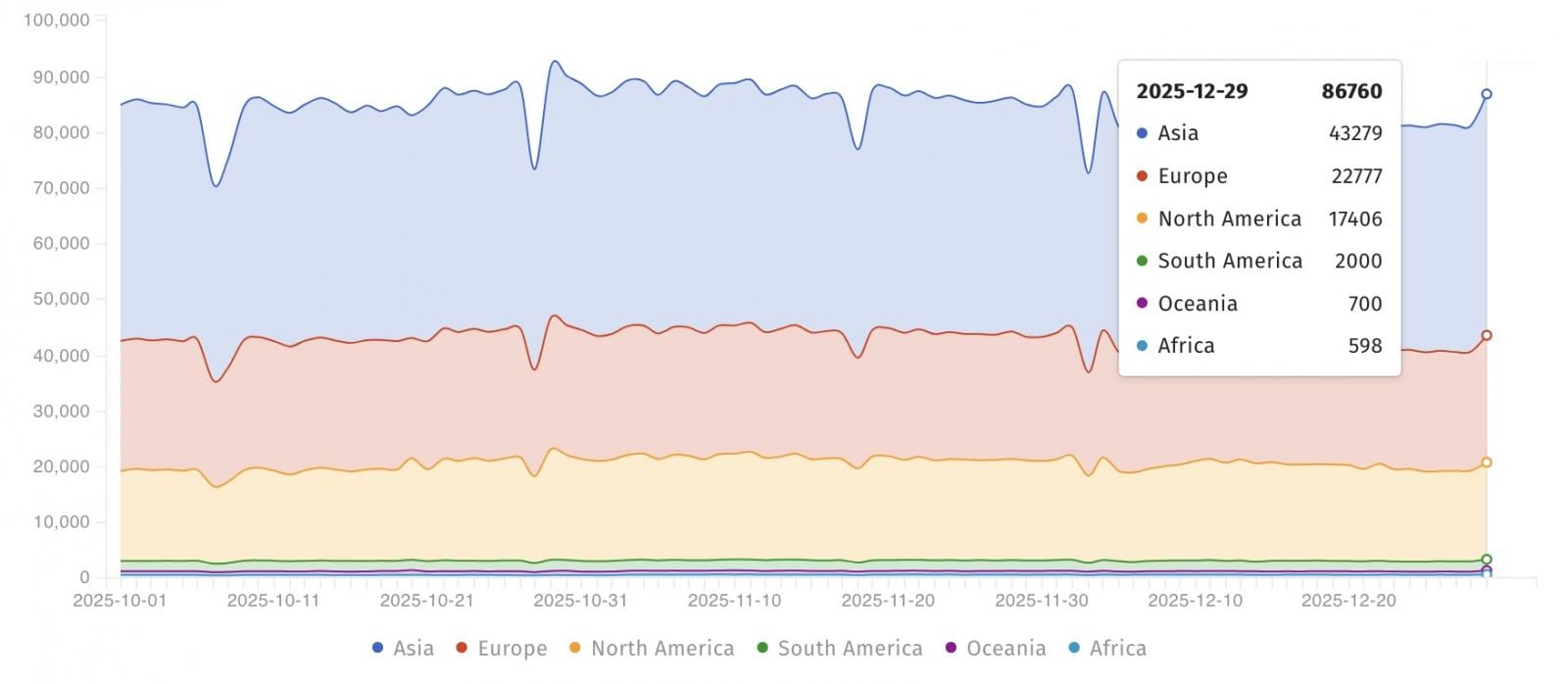
Prior to CISA’s formal directive, evidence of active compromise was already accumulating across internet scanning platforms, signaling widespread exposure. Security reconnaissance efforts conducted by Shadowserver revealed an alarming footprint: over 74,000 MongoDB instances were directly exposed to the public internet and potentially susceptible to the exploit. Further granular scanning by Censys corroborated this finding, fingerprinting more than 87,000 IP addresses running versions of MongoDB vulnerable to CVE-2025-14847.
The most sobering metrics arrived from cloud security intelligence platforms. Wiz, a leading cloud security posture management (CSPM) vendor, confirmed that the vulnerability was actively being exploited "in the wild" over the preceding weekend. Their telemetry indicated a profound impact across cloud deployments, reporting that a substantial 42% of all visible systems utilizing MongoDB in their surveyed cloud environments were running versions susceptible to MongoBleed. This statistic highlights a critical failure point in asset management and patch hygiene within modern, distributed cloud architectures, where databases are often provisioned rapidly and may lack immediate security oversight.
CISA’s decision to add CVE-2025-14847 to its Catalog of Known Exploited Vulnerabilities (KEVs) confirms the intelligence gathered by private sector researchers and elevates the incident to a top-tier federal cybersecurity priority. The directive mandates that all FCEB agencies—encompassing departments such as Homeland Security, Treasury, Energy, and Health and Human Services—must remediate the vulnerability by January 19, 2026. This three-week window is aggressive but standard for actively exploited, high-severity flaws, reflecting the urgency required to neutralize ongoing risk vectors targeting federal assets.
Expert Analysis and Mitigation Strategies
CISA’s accompanying warning emphasized the systemic nature of this threat: "These types of vulnerabilities are frequent attack vectors for malicious cyber actors and pose significant risks to the federal enterprise." The directive reinforces existing policy, referencing Binding Operational Directive (BOD) 22-01, which governs how federal agencies must manage security controls for cloud services, and stresses the need to either apply vendor-supplied mitigations or, failing that, cease product usage immediately.

From a defensive perspective, the patching schedule provided by MongoDB on December 19, 2025, is the definitive solution. However, in large, complex government environments, immediate patching is often hindered by change control processes, dependency mapping, and system stability concerns. For organizations unable to deploy the patch instantaneously, an interim mitigation strategy has been advised: the explicit disabling of zlib compression within the MongoDB server configuration. While this workaround effectively neuters the specific exploitation path of MongoBleed, administrators must recognize that disabling compression may introduce performance overhead or alter data handling characteristics, requiring careful testing.
Furthermore, proactive detection is essential. The availability of specialized tools, such as the MongoBleed Detector hosted on GitHub, allows administrators to parse existing MongoDB logs for indicators of compromise related to CVE-2025-14847 exploitation attempts. This forensic capability is vital for identifying historical intrusions that may have occurred between the patch release and the enforcement of CISA’s mandate.
Industry Implications and Broader Trends
The MongoBleed incident serves as a potent case study illustrating several enduring challenges in modern enterprise security:
1. Supply Chain Risk in Infrastructure Software: MongoDB is foundational. When a core component like zlib, used for standard functions (compression), harbors a critical vulnerability, the blast radius extends across the entire digital ecosystem that relies on that database. This incident underscores the risk embedded within the open-source and third-party libraries that form the backbone of commercial software. Vetting the security posture of underlying dependencies is no longer optional but a prerequisite for secure deployment.
2. The Persistence of Exposure: The fact that tens of thousands of instances remain publicly accessible, despite vendor warnings and security advisories preceding the CISA order, points to systemic deficiencies in network segmentation and asset discovery. In the era of cloud elasticity, many organizations lose sight of services provisioned outside of central IT control—a shadow IT problem amplified by infrastructure-as-code practices. Unsecured database ports, often left open for administrative access or development needs, become irresistible targets for automated scanning bots searching for known vulnerabilities.
3. Automation in Exploitation: The rapid development and release of a PoC, coupled with the immediate detection of widespread scanning activity, demonstrates the speed at which the cybercriminal ecosystem operationalizes new vulnerabilities. The "time to exploit" is now measured in hours or days, not weeks, placing extreme pressure on security teams to compress their incident response timelines significantly.
Future Impact and The Path Forward
The regulatory response from CISA highlights a trajectory toward stricter enforcement regarding known exploited vulnerabilities (KEVs). We can anticipate increased scrutiny, potential audits, and potentially harsher penalties for agencies failing to adhere to mandatory remediation deadlines for KEVs. This shifts vulnerability management from a best-practice recommendation to a compliance mandate with tangible consequences.
For the broader technology sector utilizing MongoDB or similar NoSQL databases, MongoBleed signals a necessary strategic pivot. Organizations must move beyond simple perimeter defense and focus on defense-in-depth strategies tailored for data-centric security. This includes:
- Strict Network Segmentation: Databases should never be directly exposed to the public internet. Access must be funneled through hardened application layers or strictly controlled virtual private cloud (VPC) environments, limiting the attack surface available to automated scanners.
- Continuous Posture Management: Automated tools capable of real-time inventory and vulnerability assessment across multi-cloud environments are essential to detect misconfigurations—like exposed database ports—before threat actors can capitalize on them.
- Dependency Auditing: Deeper integration of Software Composition Analysis (SCA) tools into the development lifecycle to continuously monitor the security status of embedded libraries like zlib, rather than waiting for a critical flaw to emerge in a final product release.
The MongoBleed crisis is more than just a database patch cycle; it is a stark reminder that infrastructure components, once considered stable and secure, can rapidly become vectors for catastrophic data loss if maintenance hygiene lapses. The federal government’s mandated response sets a high bar, one that the private sector must match to ensure the security of sensitive data residing in these ubiquitous database systems. The next wave of security maturity will depend on how quickly organizations can embed automated discovery and remediation processes to counter threats that move at machine speed.