

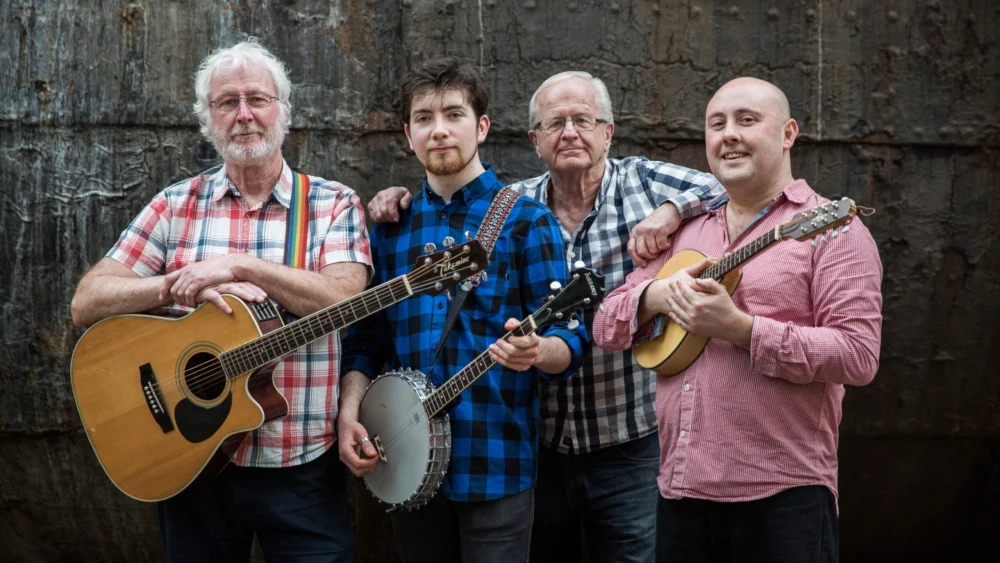
The atmosphere inside the auditorium in London was thick with a heavy, contemplative silence, broken only by the first melodic strains of a folk composition. As the music swelled, tears began to trace paths down the faces of those in the audience. The song was a poignant tribute to a great-grandfather the composer had never met, but the emotional gravity of the moment transcended the lyrics. This was more than a recital; it was a resurrection. On stage sat Patrick Darling, a 32-year-old musician who, for the first time in two years, was "performing" alongside his bandmates. In a world where neurodegenerative disease had stripped him of his physical voice, technology had stepped in to return his song.
Darling’s journey from a multi-instrumentalist to a silent observer of his own life is a narrative familiar to those acquainted with Amyotrophic Lateral Sclerosis (ALS). Diagnosed at the age of 29, Darling faced the brutal progression of a motor neuron disease (MND) that systematically dismantles the body’s ability to communicate with its muscles. ALS is a thief of autonomy; it begins with subtle stumbles and ends by compromising the very mechanics of breathing. For a man whose life was defined by the bass guitar, the piano, the mandolin, and the tenor banjo, the diagnosis was an eviction from his own identity.
The Erosion of an Artist
The decline was documented in the quiet observations of his friends and collaborators. Nick Cocking, a long-time bandmate who met Darling during their university years, recalls the early, baffling signs of the disease. Darling had joined Cocking’s Irish folk ensemble, the Ceili House Band, in 2014, quickly becoming the group’s musical backbone. He was a singer and guitarist who, according to Cocking, "elevated the musicianship" of everyone around him.
The first cracks in the facade appeared during a rainy night in Cardiff. Darling, usually sure-footed, began to trip over paving slabs, slipping repeatedly in the downpour. At the time, it was dismissed as mere clumsiness. However, by August 2023, the reality could no longer be ignored. Darling began performing while seated, his legs no longer able to support the weight of his passion. Soon, his hands—the tools of his trade—began to fail. The guitar and the banjo, once extensions of his soul, became heavy, silent objects.
By the spring of 2024, the disease had reached his lungs and throat. Speaking became an exhaustive labor, a struggle to synchronize breath with sound. In April of that year, in a display of fraternal loyalty, his bandmates carried him onto the stage for what they feared would be his final performance. The following day, Darling called Cocking to deliver the devastating news: he could no longer do it. By June, the silence was absolute. The music had stopped.
The Limitations of Tradition
When the ability to speak begins to wither, patients are often introduced to "voice banking." This traditional process involves recording hours of speech while the patient is still able, creating a library of phonemes that can later be triggered via text-to-speech software. For many, these tools are a lifeline, yet they often suffer from a "robotic" artifice—a flat, mechanical delivery that conveys information but lacks the nuances of personality.
For Darling, there was an additional hurdle: by the time he was introduced to the concept of voice banking, the disease had already altered his vocal cords. The voice he would have "saved" was already a ghost of his true self. "It felt like we were saving the wrong voice," he remarked, using the digital surrogate that eventually replaced his natural speech.
The turning point came through Richard Cave, a speech and language therapist and researcher at University College London. Cave, who also consults for the AI firm ElevenLabs, saw an opportunity to look backward rather than forward. Instead of recording Darling’s current, labored speech, the team turned to the past.

Engineering the Digital Phoenix
The challenge of recreating a singing voice is orders of magnitude more complex than replicating standard speech. While speech requires the reproduction of cadence and tone, singing demands the synthesis of pitch, vibrato, and emotional timbre. Typically, high-fidelity AI voice cloning requires at least ten minutes of pristine, studio-quality audio. Darling had none.
The reconstruction project became a digital archaeological dig. Cave and his team harvested audio from grainy cell phone videos recorded in boisterous, noisy pubs and candid clips of Darling singing in his kitchen. These snippets were fraught with background noise and technical imperfections. Yet, through the application of neural audio synthesis, these fragments were enough to build a "synthetic version" of Darling’s voice.
Crucially, the AI did not produce a sterilized, "perfect" version of the singer. The resulting clone retained a slight rasp and the human fallibility of a live performer. "It doesn’t sound perfect," Cave noted. "It sounds human."
For Darling, the first time he heard the recreation was a moment of profound shock. The digital voice didn’t just mimic him; it was him. In a moment of defiant humor that signaled his spirit remained unbroken, Darling revealed that the first word he programmed his new voice to utter began with "f" and ended with "k." It was a quintessential human reaction to a superhuman technological feat.
Industry Implications: The Democratization of Expression
The technology used to restore Darling’s voice represents a seismic shift in the field of assistive technology. We are moving away from an era of "functional communication"—where the goal is simply to allow a patient to request water or express pain—toward an era of "identity preservation."
Gabi Leibowitz, who leads the impact program at ElevenLabs, emphasizes that while AI cannot yet halt the physical progression of MND or improve the ease of swallowing and breathing, it can preserve the "human" element of the patient. By allowing individuals to retain their unique vocal identity, they can stay in their professions longer and maintain the social connections that define a life.
However, the implications extend far beyond the medical sector. The ability to clone voices with high fidelity from low-quality samples is a dual-use technology that the music industry is still grappling with. While artists like Michael Caine and Liza Minnelli have partnered with firms to license their digital likenesses, the case of Patrick Darling highlights the "AI for Good" narrative that often gets lost in the debate over copyright and "deepfakes." For a disabled artist, generative AI isn’t a threat to their livelihood; it is the only path to a livelihood.
The Compositional Process: Human Intent, Machine Execution
The song performed in London was not a mere playback of an old recording. It was a new work, composed using "Eleven Music," a tool that allows users to generate tracks through text-based prompts. This intersection of human intent and algorithmic execution is where the future of accessible art lies.
While the AI can generate a basic track in sixty seconds, the process of creating "meaningful" music remains an arduous human endeavor. Darling and Cave spent six weeks fine-tuning the composition, adjusting the Irish folk styling to ensure it aligned with Darling’s artistic heritage. This wasn’t "AI music"; it was music by Patrick Darling, facilitated by a digital instrument.

The psychological impact of this cannot be overstated. For a patient with ALS, the world often shrinks until it is the size of a hospital bed. By providing a platform where Darling can still produce, produce, and "thrive," the technology acts as a buffer against the despair that often accompanies terminal illness.
Future Horizons: The Intersection of Brain and Machine
As we look toward the future, the synthesis of voice is likely only the beginning. The next frontier involves the integration of generative AI with Brain-Computer Interfaces (BCIs). Currently, users like Darling might interact with these tools via eye-tracking software or limited manual input. However, companies are already testing implants that can translate neural signals directly into text or synthesized speech.
Imagine a future where a musician like Darling doesn’t need to type a prompt to compose a song, but can simply "think" the melody into existence. The combination of BCI-captured intent and AI-generated high-fidelity audio could effectively bypass the broken physical pathways of the body entirely.
A Bittersweet Symphony
The London performance was a triumph, but it was a triumph tinged with the reality of the condition. As Darling was wheeled onto the stage, the physical toll of his disease was evident, yet the sound that filled the room was that of a man in his prime. Nick Cocking and bandmate Hari Ma provided live accompaniment on the mandolin and fiddle, bridging the gap between the organic and the synthetic.
Cocking admitted that hearing the track for the first time was overwhelming. "I heard the first two or three words he sang, and I had to turn it off," he said. "I was just in bits." It took several attempts before he could listen to the end of the song—a testament to the power of a voice that had been mourned as lost.
As the tech industry continues to push the boundaries of what is possible, the story of Patrick Darling serves as a vital reminder of the stakes. Technology, at its best, is not about the replacement of the human element, but the restoration of it. Darling plans to continue composing, using his digital surrogate to leave behind a legacy that his physical body can no longer sustain.
In the end, the project achieved something that medicine could not: it gave a silent man the last word. And in the world of Patrick Darling, that word is a song.