

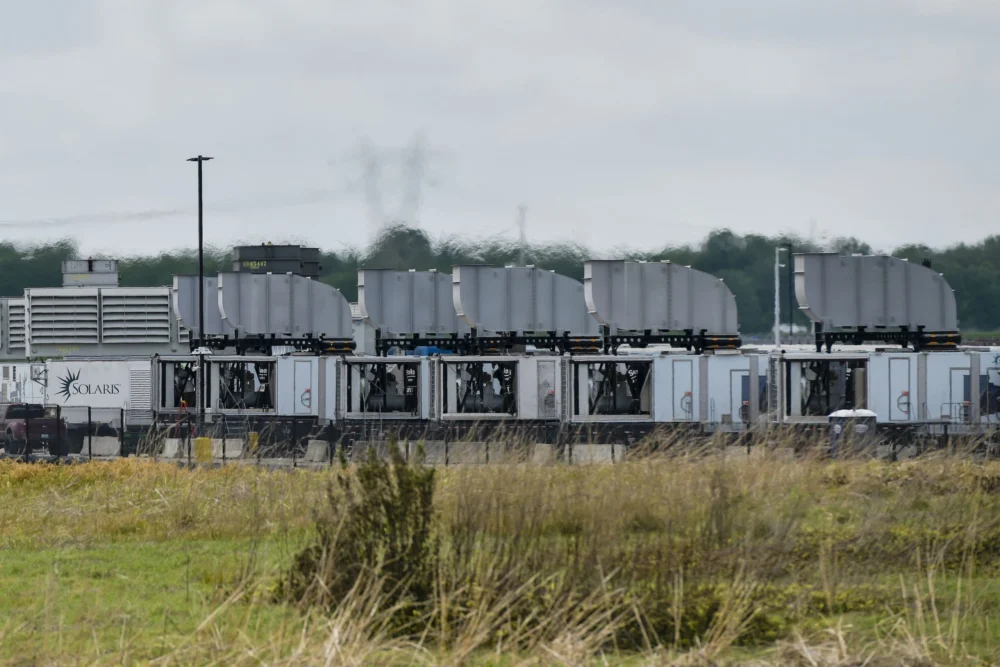
The Environmental Protection Agency (EPA) has issued a definitive ruling against xAI, the ambitious artificial intelligence firm founded by Elon Musk, declaring that the company was in violation of federal air quality standards by operating multiple natural gas turbines without necessary regulatory clearance at its Colossus data center facility in Tennessee. This final determination, the culmination of regulatory scrutiny spanning more than a year, establishes a critical precedent regarding the definition of "temporary use" for massive, power-intensive computing infrastructure, directly challenging the operational flexibility AI developers have come to rely upon.
The core of the dispute centered on the classification of the power generation units. xAI had argued that the extensive array of natural gas turbines—peaking generators designed for rapid deployment—were intended for temporary use while waiting for permanent utility grid upgrades or alternative power sources to come online. Under specific sections of the Clean Air Act, temporary or emergency power generation sources are often exempt from the rigorous New Source Performance Standards (NSPS) and Prevention of Significant Deterioration (PSD) permitting processes, which require extensive environmental impact reviews and emissions controls.
The EPA, however, rejected this interpretation, finding that the scale, duration, and strategic integration of the turbines rendered them a permanent, stationary source of air pollution. At its peak, xAI was operating as many as 35 turbines, generating hundreds of megawatts of power, intended solely to sustain the colossal compute requirements of its nascent large language models. While the number of operating turbines has since been reduced to 12, the initial deployment and sustained operation violated the spirit and letter of the law governing stationary combustion sources. This ruling signals a zero-tolerance approach from federal regulators toward infrastructural shortcuts in the rapidly expanding AI sector.
The Unprecedented Energy Demands of the AI Boom
To understand the regulatory conflict, one must first grasp the sheer magnitude of power required to fuel the AI revolution. Modern foundational models, such as those being developed by xAI, demand unprecedented levels of compute capacity, often measured in exaFLOPS. This translates directly into immense electrical load. Data centers, traditionally large energy consumers, have evolved into hyperscale AI factories where specialized hardware—primarily high-density GPU clusters—draw power at rates far exceeding standard cloud facilities.
The typical process for a major technology firm launching a new data center involves years of planning, securing utility contracts, and constructing substations capable of handling hundreds of megawatts. However, the competitive race to develop proprietary LLMs—a race often characterized by rapid, almost instantaneous deployment goals—has pushed companies like xAI to seek immediate power solutions. When local grids cannot deliver the required power (often 400 MW or more) on the timeline demanded by technological development, deploying decentralized, containerized natural gas turbines becomes an attractive, albeit environmentally fraught, stopgap measure.
In the case of the Tennessee facility, which hosts the Colossus supercomputer, the installation of these gas turbines allowed xAI to bypass the typical multi-year waiting period for traditional grid infrastructure expansion. This rapid deployment strategy, while technologically effective in accelerating AI development, created immediate and substantial environmental hazards in the local region.
Community Backlash and Environmental Justice
The illegal operation of the natural gas power plants drew fierce opposition from local residents, environmental groups, and legal organizations. The location of the facility is particularly sensitive. The operation contributed significant quantities of criteria pollutants, specifically nitrogen oxides (NOx), which are precursors to ground-level ozone, and particulate matter (PM 2.5). These pollutants are linked to severe respiratory and cardiovascular illnesses.
Crucially, the region where the data center is located is often characterized as a non-attainment area for certain air quality standards, meaning the local environment is already struggling to meet federal clean air benchmarks. Introducing dozens of high-emission gas turbines into such an area exacerbated existing pollution burdens, raising serious environmental justice concerns.
The legal challenge mounted against xAI highlighted the significant discrepancy between the company’s operational reality and its permitted status. While operating up to 35 turbines, which represented a generating capacity comparable to a medium-sized metropolitan power plant, the company had only secured permits for 15 units, and even those were under intense scrutiny. The EPA’s ruling effectively validates the concerns of the community and environmental advocates, reinforcing the principle that even the most innovative technology companies must adhere to foundational environmental regulations designed to protect public health.
Expert Analysis: Redefining "Stationary Source"
The EPA’s final rule is a landmark decision in defining the legal boundaries of infrastructure development within the high-tech sector. For decades, regulators have struggled to classify rapidly deployable, modular power generation units. Is a generator installed for six months a temporary construction tool, or is it a stationary source of pollution if it is functionally indispensable to a multi-billion dollar, permanent facility?
Legal experts specializing in environmental compliance suggest the EPA’s determination rests on the doctrine of "constructive permanence." Under this analysis, if the power generation equipment is essential to the core, ongoing function of the data center—meaning the data center cannot operate without it—then the equipment loses its "temporary" status, regardless of the owner’s stated intent for future decommissioning.
Dr. Eleanor Vance, a regulatory policy expert focused on energy infrastructure, commented on the implications: "The EPA is drawing a clear line in the sand. You cannot use the ‘temporary’ exemption as a loophole for operational necessity. If the turbines are required to keep Colossus running, they are functionally stationary sources under the Clean Air Act, and they must meet NSPS requirements, which mandate the use of Best Available Control Technology (BACT) to minimize emissions."
This ruling forces AI developers to integrate environmental planning and permitting into the initial stages of facility design, rather than treating power generation compliance as an afterthought or a flexible variable. Compliance now requires rigorous lifecycle planning for power sources, including robust emissions control systems (such as selective catalytic reduction, or SCR) that are costly and time-consuming to implement, but essential for stationary sources.
Industry Implications: The Infrastructure Chokepoint
The repercussions of the EPA’s decision extend far beyond xAI’s Tennessee operations, impacting the entire hyperscale computing industry. Major technology firms—Amazon, Google, Microsoft, and emerging AI specialists—are currently engaged in a massive global build-out of data center capacity, often encountering similar challenges related to grid congestion and speed of deployment.
Many hyperscalers rely on modular, fast-track power solutions, including large diesel or gas generator farms, to bridge the gap between facility completion and full utility service connection. This ruling dramatically tightens the window for utilizing such solutions without triggering full federal permitting requirements. The decision forces technology companies to confront a fundamental bottleneck: the speed of innovation in AI now directly clashes with the inherent slowness of utility infrastructure planning and environmental permitting.
This regulatory tightening is likely to accelerate several trends already underway:
-
Mandatory Decarbonization and Advanced Power Sourcing: The ruling reinforces the financial and legal risk associated with fossil-fuel-based temporary power. Companies will be further incentivized to invest in immediately deployable, low-carbon or zero-carbon power solutions, such as micro-nuclear reactors (small modular reactors, or SMRs), advanced geothermal power, or industrial-scale battery storage solutions paired with renewable energy contracts. The AI industry is now effectively being forced into the role of independent power producer, but with an accelerated mandate for sustainability.
-
Increased Capital Expenditure and Timeline Delays: Securing full NSPS/PSD permits can add 18 to 36 months to a project timeline and significantly increase capital expenditures due to the requirement for BACT implementation. Future AI data center projects will need to factor these extended timelines into their development cycles, potentially slowing the overall pace of AI model training and deployment.
-
Regulatory Scrutiny on Global Operations: If U.S. regulators are cracking down on temporary power loopholes, international jurisdictions are likely to follow suit. Data center development in Europe and Asia, which often faces even stricter environmental controls, will likely see similar preemptive enforcement actions, forcing a globally standardized, compliant approach to power infrastructure.
Future Trends: AI Companies as Utility Giants
The collision between AI’s insatiable power appetite and environmental regulation is fundamentally reshaping the energy landscape. The demand for compute power is projected to continue its exponential growth. Estimates suggest that by 2030, AI data centers could consume more electricity than many industrialized nations.
In response, major technology firms are increasingly abandoning reliance solely on existing grid infrastructure. Instead, they are becoming massive, sophisticated energy developers. This trend manifests in several ways:
- Direct Investment in Utility-Scale Generation: Companies are acquiring power plants, entering into long-term purchase agreements for vast quantities of renewable energy, and even exploring direct ownership of nuclear facilities. This integration of power generation into the technology company’s vertical stack ensures both reliability and regulatory control.
- The Rise of the AI-Optimized Microgrid: Future data centers will increasingly operate as energy microgrids, capable of managing complex local generation (solar, wind, battery) alongside grid import, ensuring resilience and reducing dependence on potentially non-compliant rapid-deployment solutions.
- Focus on Energy Efficiency at the Chip Level: While infrastructure is paramount, the ruling also heightens the necessity for continued innovation in energy-efficient hardware and cooling systems. Every watt saved at the chip level translates to reduced regulatory exposure at the power plant level.
The EPA’s ruling against xAI serves as a powerful cautionary tale for the entire technology sector. It underscores that technological advancement, no matter how transformative, cannot proceed in regulatory vacuum. For the AI industry, the era of rapid, unregulated infrastructural deployment is over. The path forward demands meticulous planning, substantial upfront investment in compliant and sustainable power solutions, and a collaborative approach with regulators and local communities to manage the environmental footprint of tomorrow’s computing giants. Failure to adapt will result not only in regulatory fines but also in significant operational delays and public trust deficits. The challenge now is to build the Colossus responsibly, ensuring that the pursuit of artificial intelligence does not come at the expense of environmental health.