

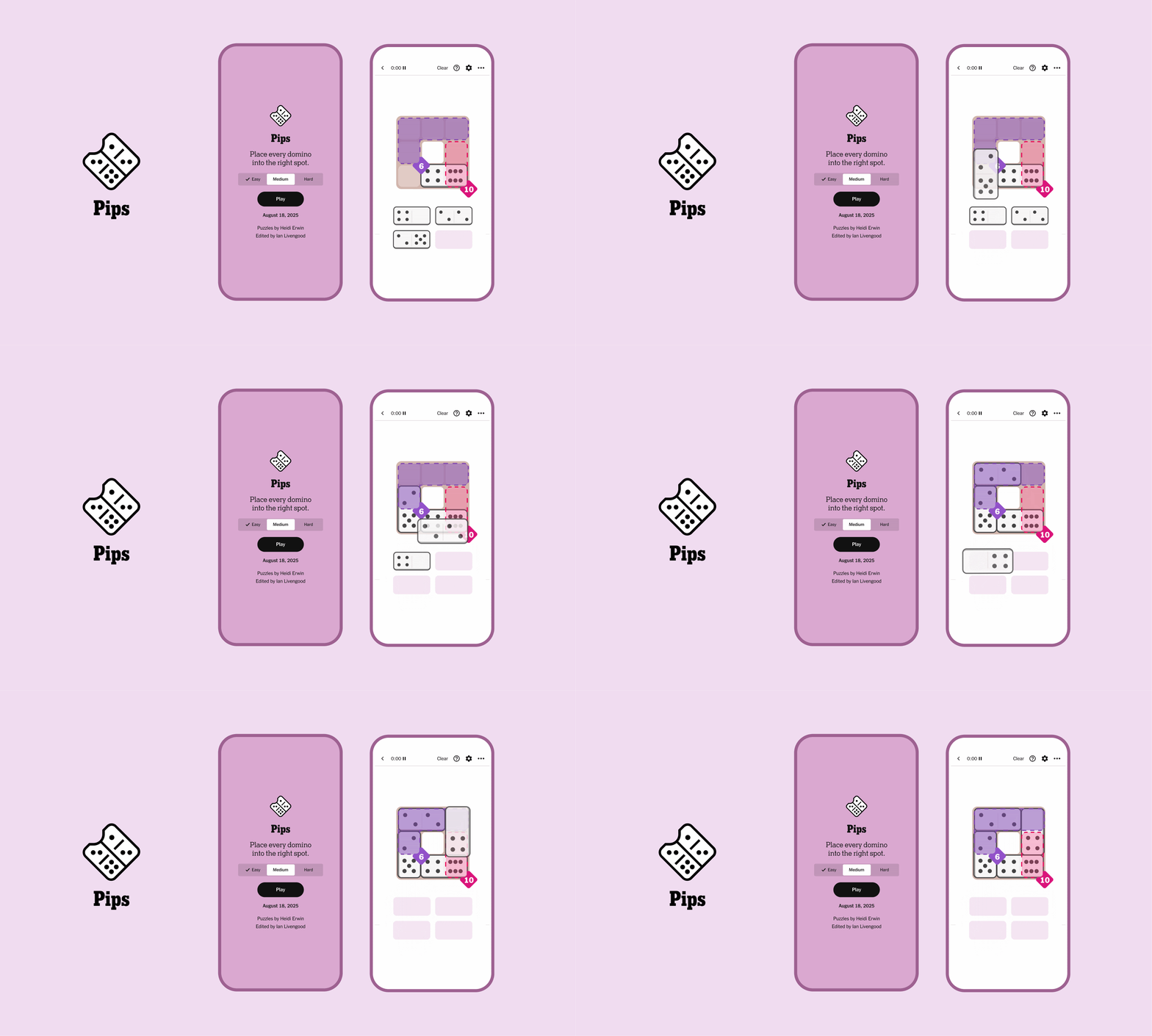
The digital puzzle landscape has undergone a seismic shift over the last several years, evolving from simple diversions into cornerstone engagement tools for major media organizations. Among these, the game Pips has emerged as a particularly compelling synthesis of traditional domino mechanics and modern logic-grid constraints. As we enter the first full weekend of February, the Saturday, February 7 slate of puzzles offers a rigorous test of spatial reasoning and mathematical deduction. Solving these grids requires more than just a passing familiarity with numerical values; it demands an understanding of how constraints interact across a multi-colored landscape.

The rise of Pips reflects a broader trend in the "gamification" of news and digital subscriptions. Historically, the crossword was the singular titan of the newspaper puzzle page. However, the modern era has seen the ascent of math-based and logic-based games that appeal to a different cognitive profile—those who favor pattern recognition and deductive reasoning over linguistic trivia. Pips, with its tiered difficulty system and elegant use of dominoes, fits perfectly into this niche, providing a daily mental "workout" that scales from accessible to formidable.
The Architectural Mechanics of Pips
Before diving into the specific solutions for February 7, it is essential to analyze the underlying architecture of a Pips grid. At its core, Pips is a constraint-satisfaction problem. Players are presented with a grid of multicolored cells, each associated with a specific logical or mathematical rule. These "conditions" are the heart of the game. For instance, a group of purple squares might be marked with a crossed-out equal sign, indicating that the numbers placed within them must be unique. A pink group might require a specific sum, such as zero or eleven.

The player is given a fixed set of dominoes—standard tiles with two halves, each containing a number of "pips" (the dots on the domino). The challenge lies in the fact that every domino must be used, and every condition must be met simultaneously. This creates a ripple effect: placing a domino to satisfy a condition in the upper-left corner might inadvertently break a sum-total condition in the center. Success requires a holistic view of the board, often identifying "anchor points"—cells where only one specific number can logically fit—and working outward from there.
Saturday Easy Tier: Establishing the Baseline
The Easy tier for Saturday, February 7, serves as an introductory exercise in basic sum-matching and orientation. In this grid, the constraints are relatively isolated, allowing the player to solve individual color blocks without fear of a massive cascade of errors. The primary focus here is on the "total" conditions.

When approaching the Easy puzzle, the most effective strategy is to identify the largest sum requirement first. By placing the higher-value dominoes in these slots, you narrow down the remaining pool of tiles for the more flexible, lower-sum areas. For February 7, the distribution of tiles is balanced, but the orientation of the dominoes—rotating them to bridge two different colored zones—is the key to a quick resolution. The Easy solution for today is straightforward once you realize that the vertical placements dictate the horizontal possibilities in the bottom row.
Saturday Medium Tier: Managing Interconnectivity
As we move to the Medium tier, the grid complexity increases through the introduction of shared boundaries. In the Medium puzzle for February 7, we see more instances where a single domino must satisfy conditions for two different color groups simultaneously. This is the "bridge" mechanic, where the orientation of the tile becomes as important as its numerical value.

In today’s Medium challenge, players must pay close attention to the central blue and orange blocks. These areas act as the "engine" of the puzzle. If the sum in the orange block is off by even a single pip, it will invalidate the equality constraint in the adjacent blue block. The solution involves a careful titration of the middle-value dominoes. By securing the perimeter first and working toward the center, the final three dominoes usually fall into place with only one viable orientation.
The Saturday Hard Tier: A "Sneaky" Masterclass in Deduction
The Hard Pips puzzle for February 7 is a fascinating example of psychological misdirection in game design. At first glance, the grid suggests a "staircase" logic, where the player might feel compelled to place dominoes in a continuous chain from one group to the next. This linear thinking is a trap.

The breakthrough for the Hard puzzle lies in the Green 2 group located on the far right of the grid. While the rest of the board seems to demand a complex sequence of dependencies, the Green 2 group can be satisfied by a single 1/1 domino. This "breaks the chain" and provides a fixed point from which the rest of the logic can be unfurled.
Step-by-Step Walkthrough:
- The Anchor: Start by isolating the Green 2 group. By placing the 1/1 domino here, you immediately remove it from the pool of available tiles, which simplifies the remaining sum-total calculations for the larger blocks.
- The High-Value Target: Next, focus on the Pink 11 group. In the February 7 Hard grid, achieving a sum of 11 is a restrictive constraint. Placing the 5/6 domino here is the only way to satisfy the requirement while leaving enough high-value pips for the Orange 10 block.
- The Cascade: Once the 5/6 is in Pink 11, the Orange 10 block’s requirements become clearer. From there, you can place the 5/4 domino bridging Orange 9 and Pink 11, followed by the 5/1 domino into Pink 3.
- The Closing Loop: The final phase of the puzzle involves a circular logic path. By moving the 5/2 domino into Blue 6, and the 4/3 into Purple 4, you set the stage for the 1/3 to land in Dark Blue 7. The puzzle concludes with the 4/4 and 4/1 dominoes filling the Blue 8 and Purple 5 areas, respectively, with the 4/2 domino finally completing the Pink 3 group.
This "full circle" resolution is a hallmark of high-level Pips design, where the final piece placed validates the very first assumptions made by the player.

Expert Analysis: Why This Puzzle Works
From a game design perspective, the February 7 Hard Pips is significant because it rewards "non-linear" thinking. Most players are conditioned to solve puzzles from top-to-bottom or left-to-right. By placing the "key" to the puzzle in a small, isolated Green 2 group on the right, the designers force the player to scan the entire environment rather than tunneling on the most complex-looking area.
This type of puzzle-solving engages the prefrontal cortex, specifically the areas responsible for executive function and working memory. To solve the Hard tier, a player must hold multiple "if-then" scenarios in their mind simultaneously. "If I put the 5/6 in Pink 11, what does that leave for the Orange 10?" This mental juggling is exactly what makes logic games like Pips so addictive and cognitively beneficial.

Industry Implications and the Future of Logic Gaming
The success of Pips and similar logic puzzles has significant implications for the digital media industry. As traditional advertising revenue becomes more volatile, media companies are leaning into "lifestyle" content—cooking, games, and shopping—to build "sticky" habits among their readers. A daily puzzle like Pips is not just a game; it is a retention mechanism. A user who visits every morning to solve the Pips grid is a user who is significantly more likely to maintain a long-term subscription.
Furthermore, we are seeing the beginning of a trend where AI and procedural generation are used to create these puzzles. While the Saturday, February 7 puzzle feels handcrafted due to its "sneaky" logic, the future will likely involve algorithms capable of generating thousands of unique grids that maintain this level of human-like cleverness. This would allow for "infinite" play modes, further increasing user engagement time.

Another trend to watch is the social integration of these games. We are already seeing "puzzle streaks" and shareable results grids (similar to the black-and-yellow squares of Wordle) becoming a form of social currency. This turns a solitary mental exercise into a communal event, where friends and colleagues compare their "Pips time" or discuss the specific "trick" of the day, such as today’s Green 2 realization.
Conclusion
The Pips challenges for Saturday, February 7, represent the current gold standard in digital logic puzzles. By balancing accessible entry points with a Hard tier that demands genuine insight, the game continues to solidify its place in the daily routines of millions. Whether you are a casual "Pipsqueak" or a hardcore logic enthusiast, today’s grid offers a satisfying reminder that sometimes, the most complex problems have a surprisingly simple anchor point. As we look forward to the rest of February, the evolution of these puzzles will undoubtedly continue to mirror our own growing appetite for structured, rewarding mental challenges in an increasingly chaotic digital world.