

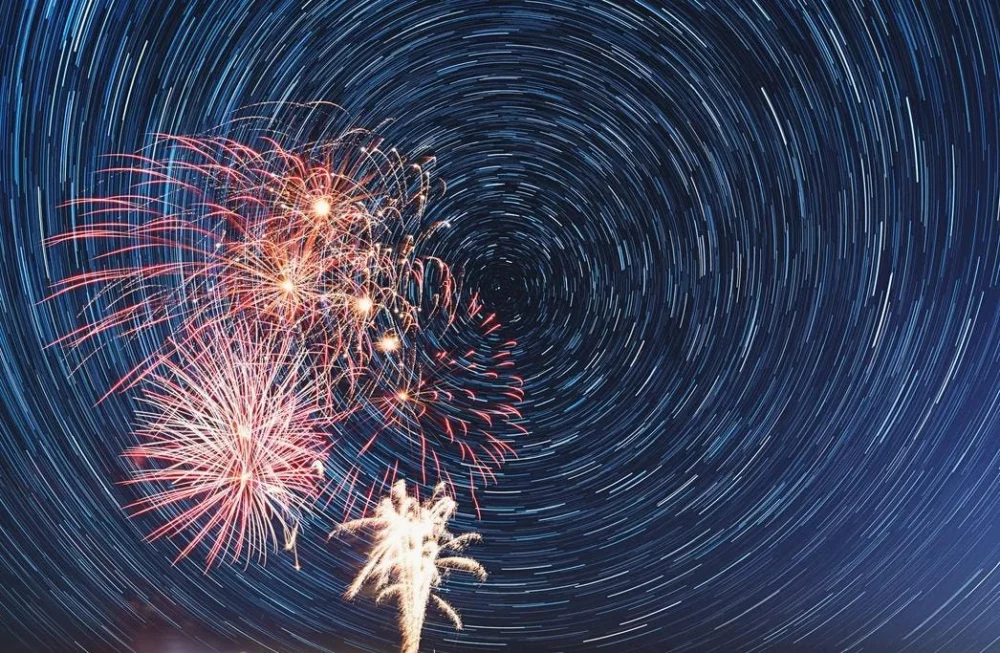
As the global population prepares to transition from 2025 into 2026, the traditional displays of pyrotechnics and synchronized drone swarms will face stiff competition from the heavens themselves. While urban centers from Sydney to New York compete for the most dazzling man-made light show, a series of significant astronomical events will be unfolding in the night sky, offering a natural spectacle that requires no electricity, only a clear horizon. The final night of 2025 serves as a bridge between years, marked by a nearly full "Wolf Moon," the peak brilliance of the solar system’s largest planet, and the shimmering dominance of the brightest star in the known sky. For amateur astronomers and casual observers alike, this New Year’s Eve provides a unique opportunity to witness the clockwork of the cosmos in high definition.
The evening’s primary protagonist is a 90%-illuminated waxing gibbous moon, which will be positioned in close proximity to the Pleiades star cluster. This celestial pairing is particularly noteworthy for its visual contrast. The moon, dominating the eastern sky about an hour after sunset, will provide a brilliant, silver anchor point for observers. However, its proximity to the Pleiades—often referred to as the "Seven Sisters" or Messier 45—presents a fascinating study in stellar evolution and historical mythology. While the naked eye typically identifies six or seven prominent stars in this cluster, modern astrophysics has radically redefined our understanding of this region. Recent research indicates that the Pleiades is not merely a small family of stars but a massive stellar nursery, with at least 3,000 confirmed stars originating from the same molecular cloud. These stars are relatively young in cosmic terms, aged at approximately 100 million years, and their blue-white glow represents the intense heat of stellar youth.
To locate this cluster on New Year’s Eve, one need only look slightly above and to the side of the moon’s bright disc. While the moon’s glare may drown out the fainter members of the cluster, the core "sisters" will remain visible, serving as a reminder of the vast distances and deep time inherent in our galaxy. The Pleiades have served as a navigational and agricultural marker for cultures ranging from the ancient Greeks to the Maori of New Zealand, and their prominence on the final night of the year adds a layer of historical continuity to the modern revelry.
As the night progresses and the sky rotates toward the south, the iconic constellation of Orion the Hunter will take center stage. Orion is perhaps the most recognizable constellation in the Northern Hemisphere’s winter sky, and its "Belt"—composed of the stars Alnitak, Alnilam, and Mintaka—serves as a celestial signpost. By following the diagonal line formed by these three stars downward toward the horizon, observers will encounter Sirius, the "Dog Star."

Sirius holds the title of the brightest star in the night sky, boasting an apparent magnitude of -1.46. Located a mere 8.6 light-years from Earth, it is a neighbor in galactic terms. On New Year’s Eve, Sirius is expected to put on a particularly vivid display of "scintillation." This phenomenon, commonly known as twinkling, is the result of atmospheric turbulence. Because Sirius is so bright and positioned relatively low on the horizon for many observers, its light must pass through a thicker, more turbulent layer of Earth’s atmosphere. This air acts as a series of moving prisms, refracting the starlight into its constituent colors—flashes of red, blue, and green—creating a diamond-like flickering that often leads to it being mistaken for a man-made object or even a drone.
The industrial and scientific implications of observing stars like Sirius and clusters like the Pleiades cannot be overstated. In the modern era, the rise of "Dark Sky" advocacy has become a significant movement within the environmental and tourism industries. As light pollution continues to grow at a rate of nearly 10% annually in some regions, the ability to see Sirius or the Pleiades has become a luxury. This has birthed a burgeoning "astrotourism" sector, where remote locations—from the Atacama Desert in Chile to the International Dark Sky Places in the American Southwest—market their lack of artificial light as a premium product. For technology journalists, this trend highlights a tension between the expansion of global infrastructure (such as satellite megaconstellations) and the preservation of the natural night sky.
Dominating the space between Sirius and the moon on New Year’s Eve will be the planet Jupiter. The gas giant is currently approaching its "opposition," which will occur on January 10, 2026. Opposition is a critical window for planetary observation, as it occurs when Earth passes directly between the sun and an outer planet. This geometry ensures that the planet is fully illuminated by the sun from our perspective and is at its closest point to Earth for the year. Currently shining at a formidable magnitude of -2.7, Jupiter is significantly brighter than any star.
For those equipped with even modest technology, Jupiter offers a wealth of detail. A standard pair of 10×50 binoculars is sufficient to reveal the four Galilean moons—Io, Europa, Ganymede, and Callisto. These moons, first documented by Galileo Galilei in 1610, are worlds in their own right, with Europa being a primary target for upcoming space missions like NASA’s Europa Clipper and the ESA’s JUICE (JUpiter ICy moons Explorer). On the night of December 31, these moons will appear as tiny, pin-point "stars" arranged in a nearly straight line flanking the planet’s disc. Observing them provides a tangible sense of the solar system’s three-dimensional nature, a stark contrast to the flat backdrop of the more distant stars.
The timing of these events is also a precursor to the first major astronomical milestones of 2026. Just three days after the New Year’s Eve celebrations, on January 3, the first full moon of the year—the Wolf Moon—will rise. This full moon will be positioned near the star Pollux in the constellation Gemini. While a full moon is a beautiful sight, it presents a challenge for meteor observers. The annual Quadrantid meteor shower, one of the year’s most prolific displays of "shooting stars," is scheduled to peak on the night of January 3 and the morning of January 4. Under ideal conditions, the Quadrantids can produce over 100 meteors per hour. However, the intense light of the Wolf Moon will likely wash out all but the brightest fireballs, reducing the visible count to approximately 10 per hour.

From an expert analysis perspective, the convergence of these events highlights the importance of celestial mechanics in our daily lives. The Gregorian calendar, which we use to mark the transition to 2026, is an approximation of Earth’s orbital period around the sun. However, the visibility of Jupiter at opposition or the specific phase of the moon reminds us that we live in a dynamic, multi-body system. The "twinkling" of Sirius provides a lesson in atmospheric physics, while the 3,000 stars of the Pleiades offer a window into the deep history of our galaxy.
Looking further into 2026, the tech and science industries are bracing for a landmark year in astronomy. The August 2026 total solar eclipse, which will sweep across Greenland, Iceland, and Spain, is already being dubbed the "Eclipse of the Century" for European observers. This event is expected to drive massive demand for high-end optical equipment and solar-filtered photography gear, further fueling the "prosumer" astronomy market. Companies specializing in "smart telescopes"—autonomous devices that use AI and GPS to locate and track celestial objects—are seeing record pre-orders as the public becomes increasingly interested in capturing these events for social media.
Furthermore, the impact of satellite constellations like SpaceX’s Starlink remains a polarizing topic in the astronomical community. While these satellites provide essential global connectivity, their reflective surfaces can create streaks in long-exposure astrophotography. As we move into 2026, the industry is seeing a shift toward "software-defined astronomy," where advanced algorithms are used to digitally scrub satellite interference from images of the night sky, ensuring that the view of Jupiter or the Pleiades remains pristine for scientific study.
As the clock strikes midnight and the fireworks fade, the moon, Jupiter, and Sirius will continue their silent transit across the sky. They serve as a permanent, universal backdrop to the temporary celebrations of humanity. Whether viewed through a multi-thousand-dollar telescope or with the naked eye from a suburban backyard, the sky on the night of December 31, 2025, offers a profound moment of reflection. It is a reminder that while our calendars are human constructs, the celestial bodies they track operate on a scale of majesty and precision that transcends the turn of a year. For those looking upward as 2026 begins, the message is clear: the most impressive light show isn’t on the ground; it’s overhead, waiting to be rediscovered.