

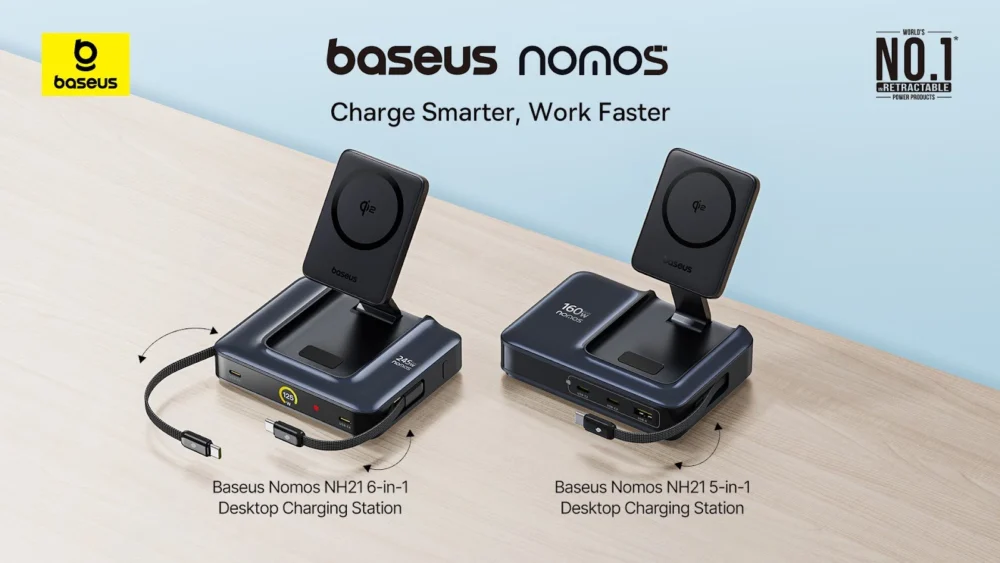
The modern workspace, whether a dedicated office or a hybrid home setup, is increasingly defined by the density of connected technology. For the dedicated professional, the creator, or the software engineer whose workflow relies on multiple high-demand devices—laptops, tablets, smartphones, and peripherals—the proliferation of charging bricks and cables represents not just an aesthetic issue, but a significant point of friction. This perpetual battle against cable spaghetti is what drives demand for sophisticated, high-power consolidation tools. Into this environment steps the Baseus Nomos NH21 series, specifically the 6-in-1 Desktop Charging Station, which aims to serve as the central power nexus for the entire digital ecosystem, boasting an impressive 245W total output capability.
This device is positioned not merely as a multi-port charger, but as a foundational piece of desk architecture. Understanding its utility requires looking beyond simple wattage numbers and examining its implications for power management, ergonomic efficiency, and the broader industry trend toward high-density, Gallium Nitride (GaN) powered solutions.
The Necessity of High-Density Power Consolidation
The contemporary professional landscape demands significant power. Modern flagship laptops, especially those optimized for creative workloads or development (think 14-inch MacBook Pros or high-end Dell XPS models), often require chargers capable of delivering 100W or more to maintain peak performance while simultaneously charging the battery. Simultaneously, demanding smartphones and tablets require 30W to 45W fast charging protocols. When these devices, alongside accessories like noise-canceling headphones or smartwatches, must all remain operational, the traditional setup quickly devolves into a chaotic mess of proprietary chargers, each drawing power inefficiently and occupying valuable desk real estate.
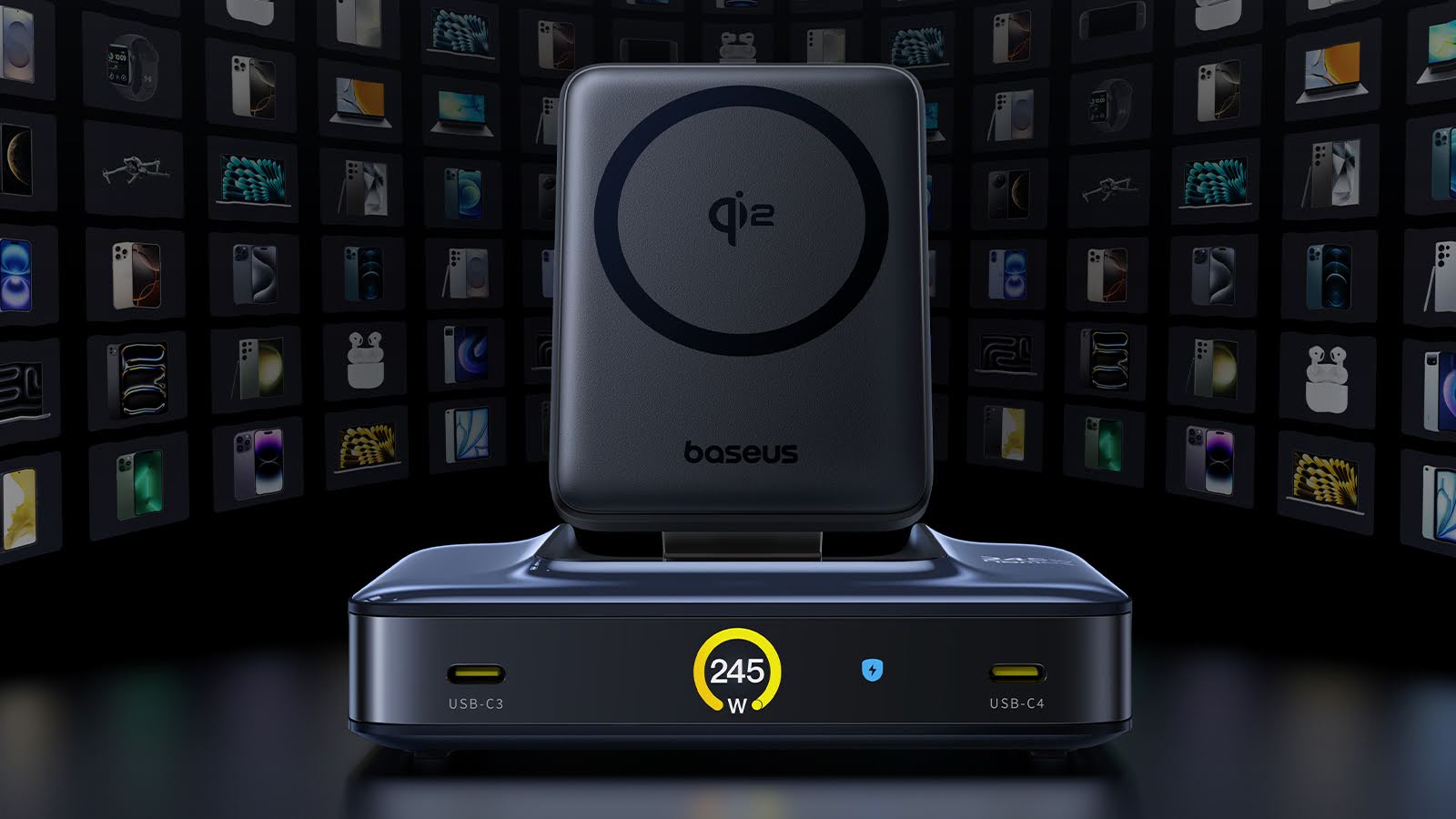
The Baseus Nomos NH21 6-in-1 model directly addresses this pain point. Its headline feature is the 245W maximum aggregate output, a figure that signifies its capability to handle simultaneous, high-demand charging across multiple platforms. This level of power availability is a significant differentiator from older, lower-wattage hubs.
Anatomizing the Connectivity Suite
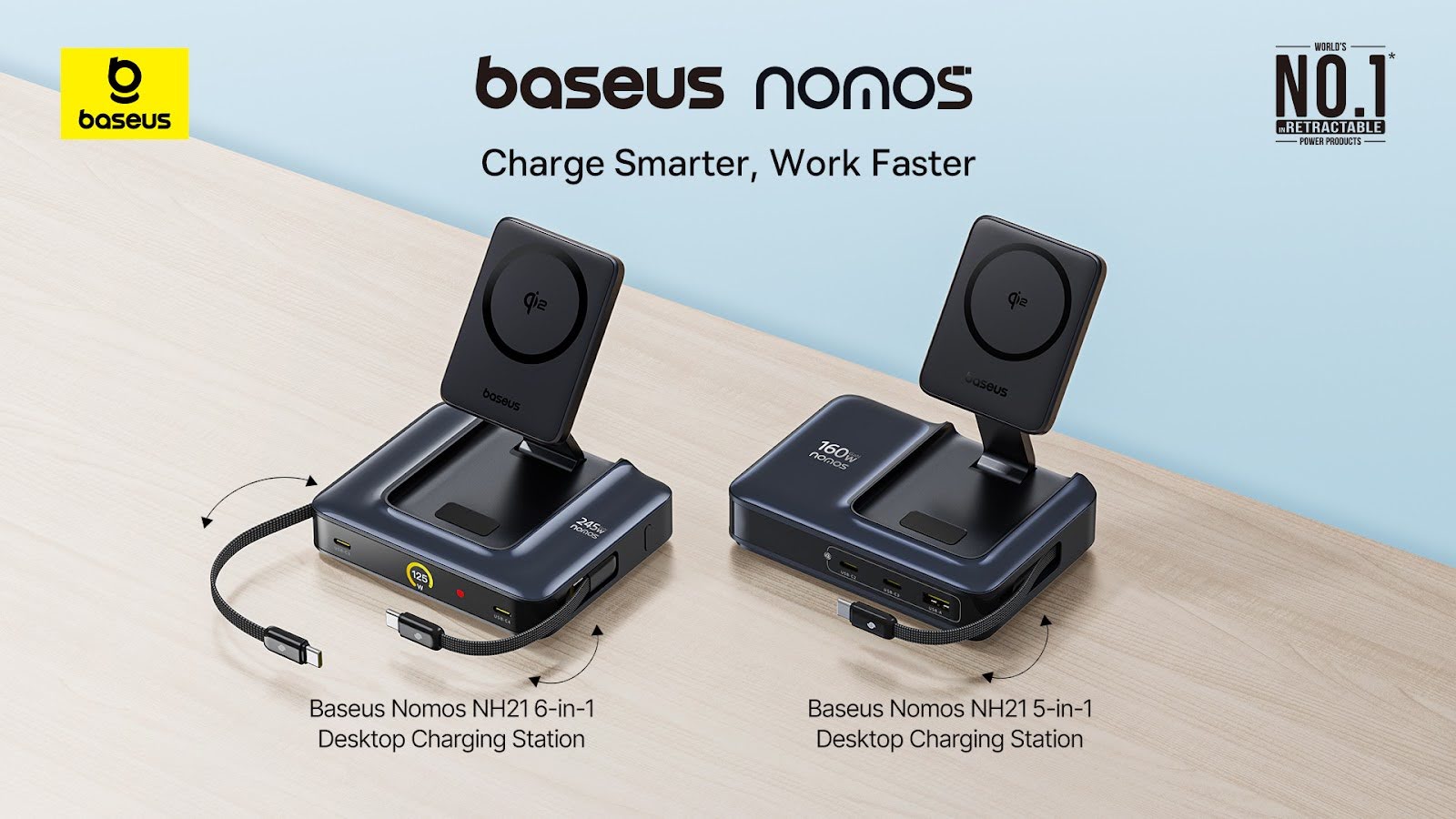
The design philosophy of the Nomos NH21 centers on maximizing port diversity while aggressively minimizing cable waste through integrated solutions. The six available charging pathways are strategically distributed:
- Dual Front-Facing USB-C Ports: These are the power workhorses, each capable of delivering up to 140W independently. This configuration is critical for users running two high-performance devices simultaneously, such as a primary laptop and a secondary workstation monitor or a powerful docking station that requires high throughput. The 140W capability aligns perfectly with the latest USB Power Delivery (PD) standards, ensuring compatibility with the most power-hungry portable computers on the market.
- Side-Mounted USB-A Port: Providing up to 22.5W, this port caters to legacy devices, low-power accessories, or quick top-ups for older gadgets that may not support USB-C PD protocols.
- Dual Integrated, Retractable USB-C Cables: This is arguably the most significant ergonomic innovation. By embedding two 0.8-meter retractable USB-C cables directly into the chassis, Baseus removes the necessity of keeping two extra cables lying loose on the desk. The longevity claim—rated for 35,000 retraction cycles—is statistically robust, suggesting operational lifespan measured in decades under typical use (three pulls per day). This feature directly translates to a visually cleaner workspace, a key metric for productivity enthusiasts.
- Magnetic Qi2 Wireless Charging Pad: Positioned on the top surface, this dedicated wireless spot supports the latest Qi2 standard at 15W. Crucially, the pad is designed to function as an adjustable stand. This transforms the charging station into a secondary display surface, ideal for monitoring notifications, managing video calls, or viewing reference material without occupying vertical screen space or requiring a separate phone stand.
Technological Underpinnings: The GaN Advantage
The ability of the Nomos NH21 to pack 245W of output into a relatively compact form factor is fundamentally enabled by Gallium Nitride (GaN) semiconductor technology. Traditional silicon-based chargers suffer from higher energy loss as heat, necessitating larger casings and bulky heat sinks. GaN transistors operate at higher efficiencies and higher switching frequencies, allowing for dramatic miniaturization without compromising thermal management or power delivery integrity.
For the end-user, this means the device is not only smaller and easier to integrate into a clean setup but also operates cooler under heavy load—a vital safety and performance consideration when dealing with near-quarter-kilowatt power delivery in an enclosed space.
Furthermore, the device supports a broad spectrum of fast-charging protocols, including PD (Power Delivery), QC (Quick Charge), SCP (SuperCharge), FCP (Fast Charging Protocol), AFC (Adaptive Fast Charging), and the highly flexible PPS (Programmable Power Supply). PPS support is particularly important for modern Android devices, as it allows for dynamic voltage and current adjustments, optimizing charging speed while minimizing battery degradation. This comprehensive protocol adoption solidifies the NH21’s role as a universally compatible charging solution across the disparate standards employed by major tech manufacturers.
Expert Analysis: Power Distribution and Scalability
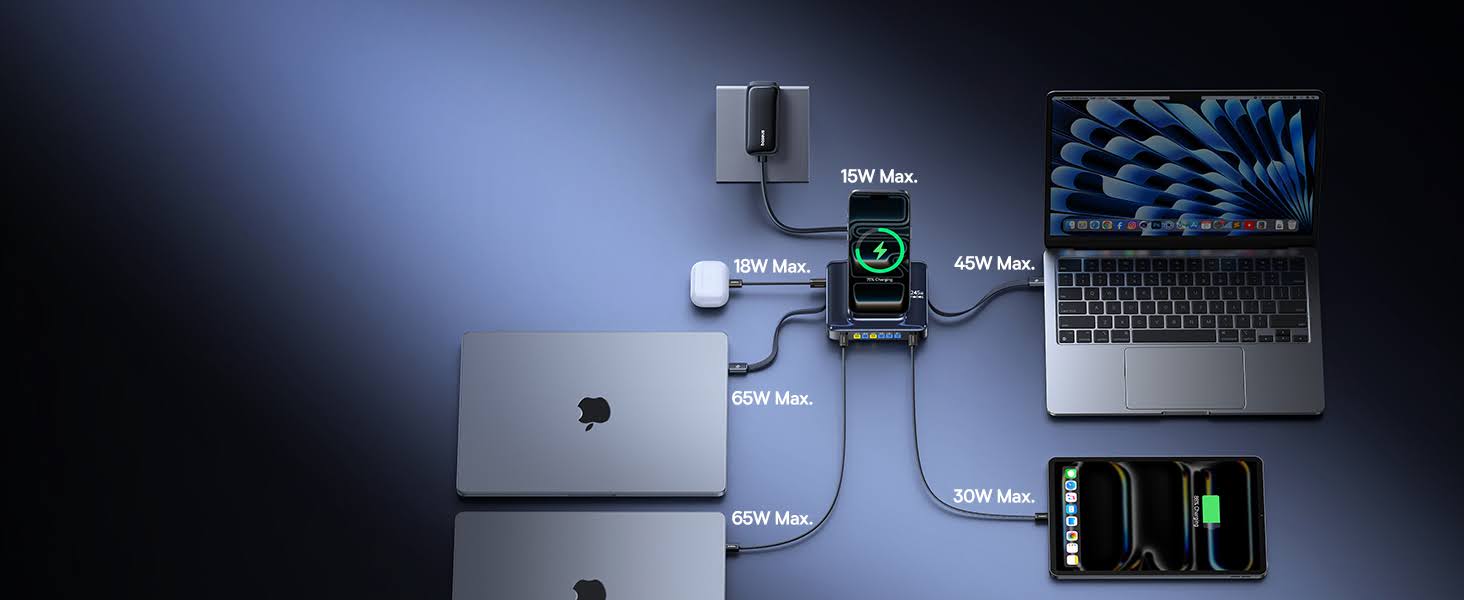
While 245W is the headline number, expert analysis requires understanding the power allocation matrix. When all six ports are active, the total output is dynamically managed to stay under the 245W ceiling. The distribution logic (e.g., how 140W is shared between the two main USB-C ports when a laptop and a tablet are plugged in) dictates the true utility for power-hungry users.
For instance, a user running a 140W-capable laptop and a 100W-capable secondary device might find that the system intelligently prioritizes or shares power, potentially delivering 140W to the laptop and throttling the secondary device to 100W (if available) or lower, depending on the device’s negotiated requirements. The sophistication of the internal power management circuitry is what separates a true desktop hub from a collection of simple ports. The Nomos system suggests an advanced level of load balancing necessary to maintain stable voltage delivery across all connections, a key factor in protecting sensitive electronics.
This centralization capability has significant industry implications. It signals a maturing market where consumers are actively seeking to replace multiple dedicated power supplies with single, intelligent units. This trend reduces electronic waste associated with obsolete or bundled chargers and simplifies power infrastructure management, especially in shared workspaces or co-working environments where mobility and quick setup are paramount.
Beyond the 6-in-1: Evaluating the 5-in-1 Variant
Baseus often provides tiered options to meet varying budget and requirement profiles. The introduction of the Baseus Nomos NH21 5-in-1 Desktop Charging Station serves users whose primary needs lean towards high-speed charging for fewer devices or who do not require the redundant cable solution.
The 5-in-1 model operates with a slightly reduced 160W maximum aggregate output. While lower, 160W is still sufficient to fast-charge a flagship laptop and several smaller devices concurrently. The trade-off involves:
- Reduced Output: 160W vs. 245W total.
- Fewer Integrated Cables: Only one retractable USB-C cable instead of two.
- USB-A Output: Slightly lower ceiling at 18W compared to the 6-in-1’s 22.5W.
The core high-power ports (two 140W USB-C ports) and the 15W Qi2 stand remain consistent. This version appeals to the minimalist who values the retractable cable convenience but can operate comfortably within the 160W envelope, likely foregoing the charging of a third high-power device simultaneously. The existence of both SKUs demonstrates a nuanced understanding of the target demographic—the power user versus the streamlined professional.
Future Impact and The Evolution of Desk Infrastructure
The Baseus Nomos NH21 series represents a leading edge in consumer power delivery technology, pointing toward several critical future trends in personal computing infrastructure:
1. The Dominance of USB-C Power Delivery: With 140W ports being standard, the industry is rapidly moving toward a future where nearly every peripheral, monitor, and portable computer uses a single, universal USB-C connection for power and data. Devices requiring proprietary barrel jacks or older connectors will increasingly become outliers. Hubs like the Nomos NH21 are essentially future-proofing the workspace against the legacy power sprawl.
2. Integration of Wireless Charging into Functionality: The magnetic Qi2 pad doubling as an adjustable stand is more than a convenience; it’s an evolution of form meeting function. As AR/VR devices and smart glasses become more commonplace, charging stands that incorporate display capabilities or positional support will become standard requirements, not premium add-ons.
3. Energy Efficiency as a Selling Point: The reliance on GaN technology underscores the growing consumer awareness regarding energy efficiency. While the primary goal is size reduction, the secondary benefit of lower operational heat and reduced standby power consumption will become increasingly emphasized in regulatory standards and consumer preference surveys.
4. Standardization of Charging Metrics: The robust support for major protocols (PD, QC, PPS) highlights the industry’s move toward interoperability, even amidst competing branding. A device that can seamlessly negotiate power with products from Apple, Samsung, and major PC manufacturers is a superior long-term investment.
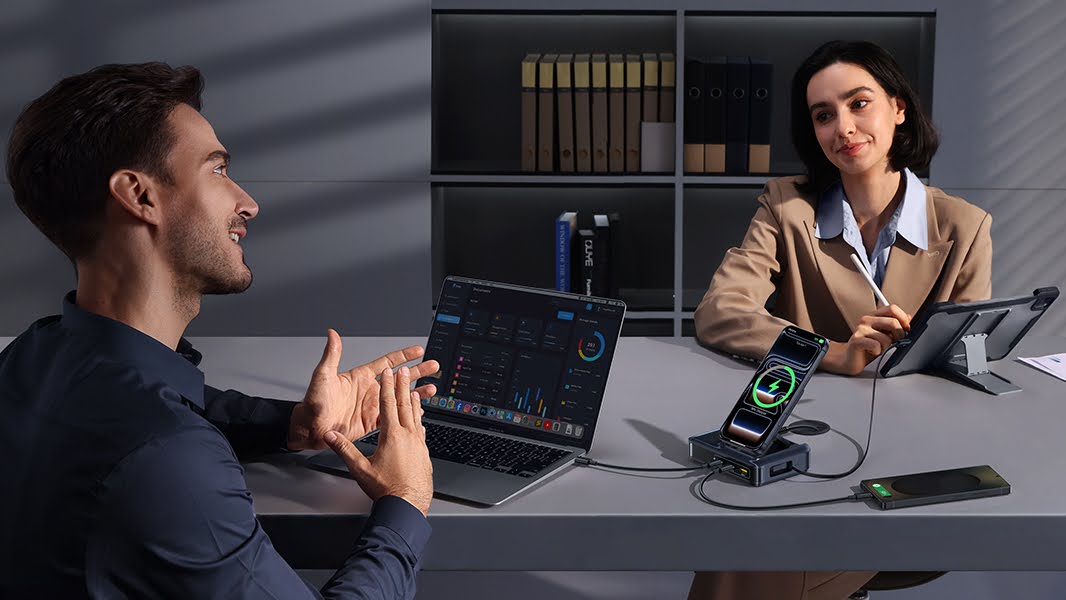
In conclusion, the Baseus Nomos NH21 6-in-1 Charging Station is a potent statement in desktop organization and power delivery architecture. It tackles the clutter epidemic by integrating essential charging capabilities, including the innovative use of durable, retractable cables and a multi-functional wireless stand. For any professional whose productivity is directly tied to the uptime and accessibility of their diverse tech stack, this device transcends the category of mere accessory; it becomes the silent, powerful backbone of the modern digital workstation. Its high aggregate wattage, advanced GaN construction, and comprehensive port selection position it as a benchmark for integrated power solutions in the evolving landscape of personal and professional technology deployment.