

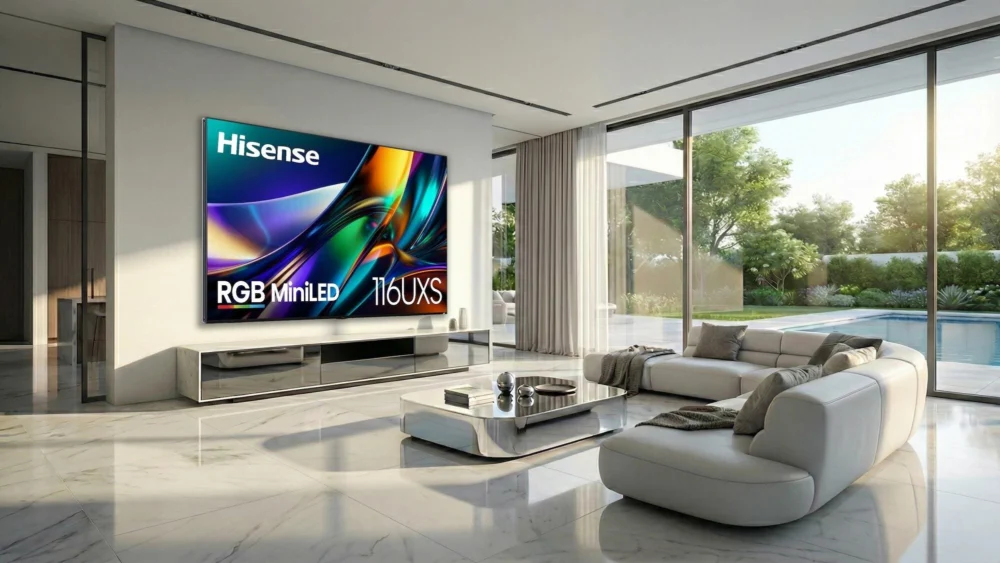
The landscape of premium home entertainment has long been defined by a relentless pursuit of three specific metrics: resolution, peak luminance, and contrast ratio. However, as the industry enters the mid-2020s, a new front has opened in the battle for visual dominance—the pursuit of absolute color fidelity and spectral coverage. At the most recent gathering of global technology leaders, Hisense signaled a definitive shift in its engineering philosophy, moving beyond the industry-standard RGB (Red, Green, Blue) sub-pixel structure to introduce a ground-breaking fourth color element to its flagship displays. By integrating cyan into its MiniLED lineup and yellow into its MicroLED arrays, the manufacturer is not merely incrementalizing performance but fundamentally rewriting the physics of how a television reproduces the visible spectrum.
For decades, the television industry has operated under the constraints of the "Primary Triad." Since the dawn of color broadcasting, every image we consume has been a composite of red, green, and blue light. While this system effectively mimics the way the human eye perceives color through its three types of cone cells, it has always struggled to reproduce the "interstitial" hues found in nature—the specific frequencies of light that fall between the primary peaks. Hisense’s announcement of the RGB MiniLED Evo technology, featuring a "Sky Blue" or cyan sub-pixel, represents the first significant challenge to this status quo in the mass-market premium segment.

The technical justification for adding cyan is rooted in human biology. The human visual system is remarkably sensitive to the transitions between blue and green. This spectral region is where we perceive the subtle gradients of a clear afternoon sky or the crystalline depths of tropical water. In a traditional RGB system, cyan is created by mixing blue and green LEDs or filtering white light through a combined matrix. This additive process often results in a "spectral gap" where the purity of the color is diluted, or the transition between shades appears stepped rather than smooth. By introducing a dedicated cyan sub-pixel in the new 116UXS flagship, Hisense is effectively filling this gap. The result is a display capable of rendering subtler tones and transitions that provide a heightened sense of three-dimensional depth, achieving what the company calls a "reference-grade" experience.
The specifications of the 116UXS are, by any contemporary standard, staggering. The 116-inch behemoth is designed to be the ultimate expression of the "Evo" philosophy. While the addition of a fourth sub-pixel is the headline, the supporting architecture is equally impressive. The panel is driven by the Hi-View AI Engine RGB, a proprietary chipset designed to manage the complex math required to map traditional RGB content onto a quad-pixel (RGBC) structure. This engine must decide, in real-time, how to distribute luminance across four sub-pixels instead of three without distorting the creator’s original intent.
According to internal metrics, this technology allows the 116UXS to cover 110% of the BT.2020 color gamut. To put this in perspective, most high-end OLED and MiniLED televisions currently struggle to exceed 80% of the BT.2020 space, which is the widest color standard used in professional mastering. By pushing beyond 100%, Hisense is creating a display that doesn’t just meet current cinematic standards but anticipates the next decade of high-dynamic-range (HDR) content. Furthermore, the company claims a color precision of 134 bits, a figure that suggests an almost infinite level of gradation, virtually eliminating the "contouring" or "banding" often seen in dark scenes or complex sky gradients.

The implications for energy efficiency and eye health are also significant. Traditionally, pushing for wider color gamuts required driving LEDs at higher voltages, which increased heat and power consumption. However, Hisense asserts that the RGB MiniLED Evo design is 30% more energy-efficient than current QD-OLED (Quantum Dot Organic Light Emitting Diode) panels. This is likely due to the fact that having a dedicated sub-pixel for intermediate colors reduces the "workload" on the other three, allowing for more efficient light distribution. Additionally, by fine-tuning the spectral output of the blue and cyan sub-pixels, the display significantly reduces high-energy blue light emissions, which are frequently cited as a primary cause of digital eye strain and circadian rhythm disruption.
While the 116UXS serves as the "halo" product for MiniLED, the brand is also applying this multi-sub-pixel logic to the even more complex realm of MicroLED. MicroLED has long been hailed as the "holy grail" of display technology because it offers the self-emissive benefits of OLED (where each pixel can turn off completely for perfect blacks) with the extreme brightness and longevity of traditional LEDs. However, manufacturing MicroLEDs is notoriously difficult; millions of microscopic LEDs must be placed onto a backplane with sub-micron precision.
In a move that caught industry analysts by surprise, Hisense unveiled the 163MXS, a 163-inch MicroLED display that incorporates a fourth yellow sub-pixel (RGBY). The engineering required to add a fourth element to an already cramped MicroLED matrix is monumental. The "yellow gap" in the 500-600nm range of the light spectrum is a known weakness in standard RGB MicroLEDs, often leading to skin tones that look slightly desaturated or "digital." By adding a physical yellow light source at the pixel level, Hisense ensures that the mid-spectrum frequencies are reproduced with 100% accuracy. This 163-inch display, housed in a chassis only 32mm deep, represents the pinnacle of luxury home cinema, intended for environments where compromise is not an option.

However, technology of this caliber is only relevant to the broader market if it can be scaled. Hisense addressed this by announcing the UR9 and UR8 series, which will bring second-generation RGB MiniLED technology to more accessible price points and practical sizes, ranging from 55 to 100 inches. While these models may not feature the "Sky Blue" fourth sub-pixel of the flagship UXS, they benefit from the "trickle-down" effects of the research and development. These sets aim to deliver superior color purity and tone separation compared to the standard blue-LED-plus-phosphor-filter designs that dominate the current mid-range market.
The emphasis on visual fidelity is complemented by a strategic partnership with the French acoustics firm Devialet. Historically, as televisions have become thinner, sound quality has suffered, forced into the narrow confines of slim bezels. Hisense is countering this trend by integrating the Devialet Opera de Paris 6.2.2-channel audio system into the 116UXS and the UR series. By combining high-end French audio engineering with Chinese display innovation, the brand is positioning itself not just as a hardware manufacturer, but as a curator of premium sensory experiences.
From an industry perspective, Hisense’s move toward quad-sub-pixel architectures is a direct challenge to the dominance of Samsung and LG. For the past several years, the "TV Wars" have been fought between LG’s WOLED (White OLED) and Samsung’s QD-OLED. Both technologies rely on various methods of color conversion or filtering. Hisense’s RGB and RGBC MiniLED approach is different—it focuses on direct light emission without the "middleman" of a color filter. By adding a fourth sub-pixel, Hisense is betting that the next generation of consumers will value spectral accuracy and "naturalism" over raw brightness alone.

Looking toward the future, the success of these technologies will likely depend on content availability. Currently, most movies and games are mastered for the DCI-P3 color space. To truly see what a 110% BT.2020 display can do, we need a new wave of content mastered on the very reference monitors that Hisense is now attempting to emulate. By releasing the 116UXS as a "reference" panel, Hisense is essentially inviting the film industry to use its hardware as a canvas for the next generation of cinematography.
As we move toward the latter half of the decade, the introduction of the fourth sub-pixel may be remembered as the moment the "RGB era" began its transition into something more complex and capable. Whether it is the cyan-enhanced MiniLED for the enthusiast or the yellow-boosted MicroLED for the ultra-luxury tier, the message is clear: the future of television is no longer just about more pixels, but about better, purer, and more complete light. Hisense has thrown down a gauntlet at CES 2026, challenging the industry to stop looking at color as a mixture of three parts and start seeing it as a full, unbroken spectrum.