

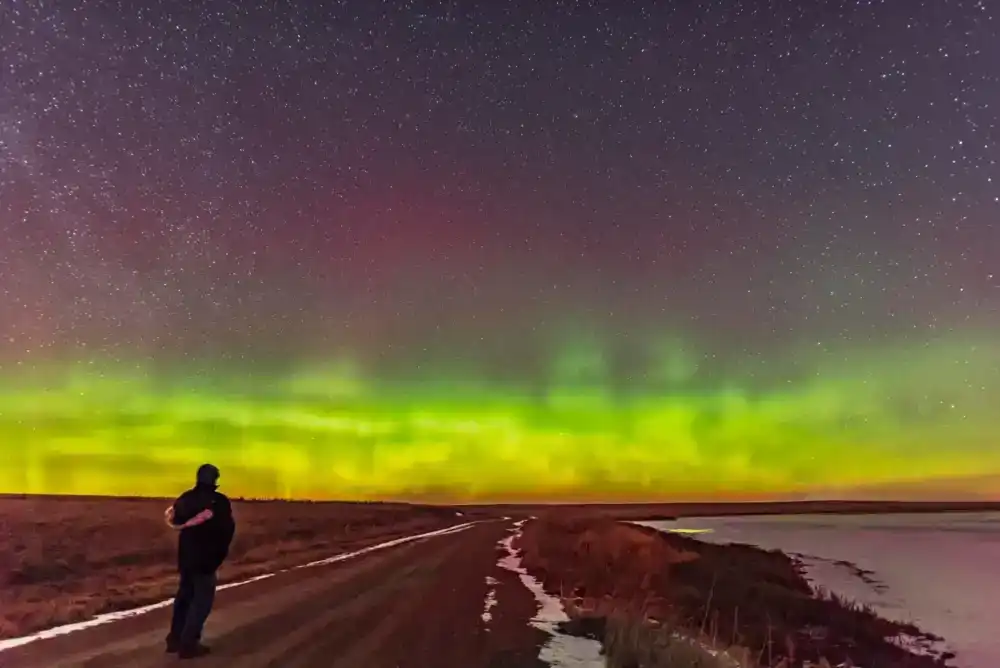
As the celestial calendar pivots from the harsh clarity of winter toward the burgeoning life of spring, the night sky undergoes a profound "changing of the guard." This week marks a pivotal moment for amateur astronomers and casual observers alike. Following the dramatic appearance of a "Blood Moon" earlier in the month, the lunar cycle is now receding toward its new phase, providing the dark-sky conditions necessary for deep-space observation. Coupled with the arrival of Daylight Saving Time and the nearing spring equinox, the atmosphere is primed for a rare convergence of astronomical phenomena, most notably a significant surge in the visibility of the Aurora Borealis.
The shift in the night sky is not merely a change in scenery but a physical transition dictated by Earth’s orbital mechanics. As we approach the equinox on March 20, the tilt of Earth’s axis begins to align in a specific orientation relative to the sun. This period is historically one of the most productive times for aurora hunters. While solar activity remains the primary driver of the Northern Lights, the geometry of the equinox acts as a catalyst, opening "cracks" in the Earth’s magnetic defense system. This phenomenon, known to scientists as the Russell-McPherron effect, makes the planet significantly more susceptible to the solar wind, effectively doubling the chances of seeing shimmering curtains of green and red light compared to the solstices.
The Science of the Equinox Aurora Surge
To understand why this week is critical for aurora monitoring, one must look at the interaction between the solar wind and Earth’s magnetosphere. The Russell-McPherron effect occurs because the Earth’s magnetic poles are tilted. Around the equinoxes, the interplanetary magnetic field (IMF) and Earth’s magnetic field are more likely to align in a way that allows for "magnetic reconnection." During these windows, the solar wind—a stream of charged particles from the sun—can penetrate the magnetosphere more easily.

Once these particles enter our upper atmosphere, they collide with gas molecules, such as oxygen and nitrogen. These collisions excite the atoms, which then release energy in the form of light. Oxygen typically produces the iconic green and rare high-altitude red hues, while nitrogen contributes to purple or blue fringes. Because we are currently in a period of high solar activity within Solar Cycle 25, the potential for "Equinox Cracks" to facilitate major geomagnetic storms is heightened. For residents in northern U.S. states, Canada, and Northern Europe, this week represents a premier viewing window, especially as the moon’s fading light reduces natural light pollution.
A Masterclass in Lunar Observation: From Conjunctions to Earthshine
The lunar cycle this week offers a textbook progression for those interested in the mechanics of our natural satellite. On Tuesday, March 10, early risers will be treated to a stunning conjunction between the waning gibbous moon and Antares. Antares, the "Heart of the Scorpion," is a red supergiant star located approximately 550 light-years away. It is one of the largest stars visible to the naked eye; if placed at the center of our solar system, its outer layers would reach beyond the orbit of Mars. Seeing the 60%-illuminated moon pass within one degree of this fiery colossus provides a rare sense of scale and depth in the southeastern sky.
By Wednesday, March 11, the moon reaches its last quarter phase. This is a critical turning point for stargazers. Rising around midnight and appearing half-lit, the last quarter moon signals the beginning of a week dominated by dark evening skies. For the next ten days, the absence of bright moonlight after sunset will allow the faint structures of the Milky Way and distant nebulae to become visible to the unaided eye.
As we move toward the weekend, the moon transforms into a delicate sliver. On Saturday, March 14, and Sunday, March 15, a thin crescent moon—ranging from 22% down to 14% illumination—will hang low in the southeast before dawn. This is the optimal time to observe "Earthshine," also known as the "Da Vinci Glow." This phenomenon occurs when sunlight reflects off Earth’s clouds and oceans, bouncing back to illuminate the dark portion of the lunar disk. It creates a ghostly, three-dimensional appearance of the moon, where the unlit side is visible in a faint, ashen light.

The Seasonal Shift: Winter’s Exit and Spring’s Ascent
The transition of constellations this week serves as a visual clock for the changing seasons. In the western sky, the "Winter Hexagon"—a massive asterism composed of the brightest stars in the winter sky—is beginning its descent. Sirius (the brightest star in the night sky), Rigel (the blue supergiant in Orion), and the planet Jupiter are losing their dominance as they sink toward the horizon shortly after dusk.
Conversely, the heralds of spring are rising in the east. The "Sickle of Leo," which forms the head of the lion, is now prominent, anchored by the star Regulus. In the northeast, the Big Dipper is climbing higher, standing on its handle as it reaches "Ursa Major High." This shift is not just aesthetic; it marks a change in the types of objects available for telescopic observation. As the winter Milky Way fades, we move away from the "Galactic Plane" and begin looking out of the "Galactic Chimney" into deep intergalactic space. This makes the coming weeks the "Season of Galaxies," where observers can peer far beyond our own Milky Way toward the Virgo Cluster and other distant star cities.
Industry Implications: The Growth of Astrotourism and Technology
The surge in interest regarding events like the equinox aurora and the transition of the night sky has fueled a significant expansion in the "astrotourism" sector. Communities with "Dark Sky" certifications are seeing record numbers of visitors, particularly during equinox windows when the probability of auroral displays is highest. This economic trend has prompted the development of specialized technology aimed at amateur astronomers.
In the tech sector, the rise of "smart telescopes" like those from Unistellar and Vaonis has democratized deep-sky photography. These devices use light-pollution reduction algorithms and automated star-tracking to allow users in urban environments to see objects that were previously reserved for those in remote observatories. Furthermore, the proliferation of real-time space weather apps has transformed aurora chasing from a game of luck into a data-driven pursuit. Users can now receive push notifications based on satellite data from the Deep Space Climate Observatory (DSCOVR), which measures solar wind speed and magnetic orientation in real-time.

Environmental Challenges: The Fight Against Light Pollution
Despite the technological advancements helping us see the stars, the global community faces an escalating challenge: light pollution. The "dark window" created by the new moon this week is increasingly compromised by the "skyglare" of expanding urban centers. Professional astronomers and ecological advocates are raising alarms about the impact of artificial light at night (ALAN) on both scientific research and migratory wildlife.
The spring equinox is a particularly sensitive time for birds, many of whom navigate using the stars. Excessive light pollution can disorient these species, leading to fatal collisions with buildings. As we observe the "guest star" Jupiter and the fading winter Milky Way this week, there is a growing movement to implement "dark sky" lighting ordinances. These efforts aim to preserve the heritage of the night sky, ensuring that future generations can still experience the Russell-McPherron effect and the delicate beauty of Earthshine without the interference of unshielded LED streetlights.
Looking Ahead: A Season of Discovery
As the clocks "spring forward" and the nights grow shorter, the window for stargazing becomes more precious. This week’s celestial lineup—the Antares conjunction, the peak of Earthshine, and the high probability of auroras—serves as a reminder of the dynamic nature of our solar system. Beyond the immediate events, the astronomical community is looking toward the potential arrival of a daylight comet later this season, an event that could further highlight the unpredictability of our cosmic neighborhood.
Whether you are a seasoned astrophotographer tracking the Kp-index for an aurora alert or a casual observer looking for the Big Dipper in the northeast, this week offers a rare opportunity to witness the mechanics of the universe in motion. The transition from the "Blood Moon" of the past to the equinox of the future is a bridge between the seasons, offering a moment of reflection on our place within the vast, shimmering expanse of the cosmos. As the winter Milky Way takes its final bow, the stage is set for a spring filled with galactic discovery and the haunting, neon dance of the Northern Lights.