

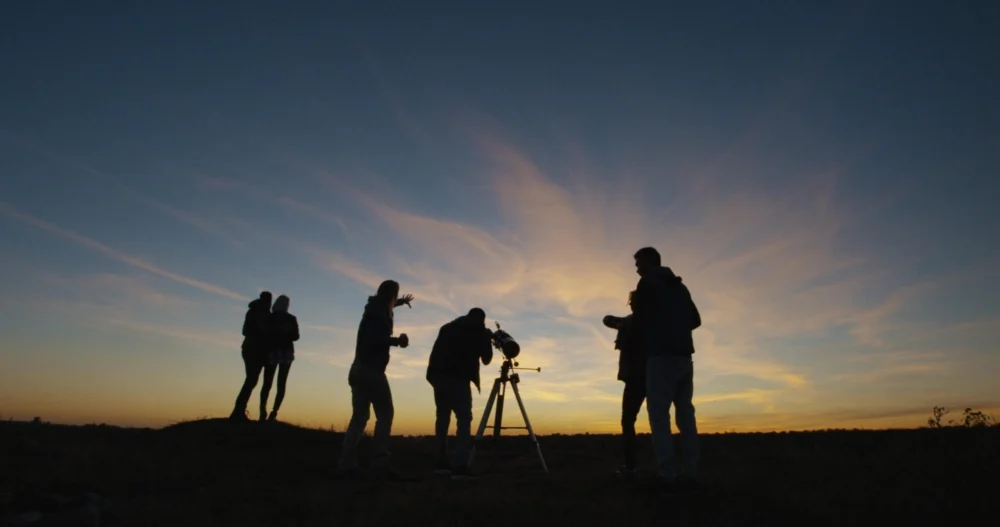
The final weekend of February 2026 presents a fleeting window of opportunity for skywatchers to witness the conclusion of a rare celestial event. For several weeks, the evening sky has been graced by a "planet parade," a visual grouping of six planets that has captured the imagination of the public and the lenses of astrophotographers worldwide. However, as the month draws to a close, the orbital mechanics of our solar system are pulling this arrangement apart. This coming Saturday and Sunday represent the final opportunity to observe this specific collective before several of its members vanish into the sun’s overwhelming glare or sink below the horizon for the foreseeable future.
While the term "planetary alignment" has been used frequently in social media and news cycles, astronomers are quick to clarify that the current phenomenon is more of a visual procession than a literal straight-line alignment. From our perspective on Earth, Mercury, Venus, Saturn, Neptune, Uranus, and Jupiter have all occupied the same general region of the sky after sunset. Yet, this "parade" is now in a state of rapid dissolution. To see it at all, observers must act with precision, as the visibility windows for several of these worlds are now measured in minutes rather than hours.
The Saturday Night Visibility Report: What Remains
As we approach the evening of Saturday, February 28, the challenge of seeing all six planets has increased significantly. The most accessible targets remain Venus and Jupiter, which serve as the brilliant "bookends" of the formation. Venus, currently shining at a magnitude of -3.9, is the undisputed queen of the western twilight. It is the first "star" to appear after sunset, but its proximity to the horizon means it sets roughly an hour after the sun. For those hoping to catch it, the prime viewing window is a narrow 20-to-30-minute slice of time beginning roughly half an hour after sundown.
In stark contrast, Jupiter dominates the high sky. Located in the constellation Gemini, the gas giant is visible for nearly the entire night. It remains the most rewarding target for casual observers, appearing as a steady, creamy-white light that does not twinkle like the nearby stars Castor and Pollux. Between these two luminaries, however, the rest of the parade is fading.
Mercury has already begun its descent into the bright twilight, making it nearly impossible to spot without professional-grade optics and a perfectly clear horizon. Saturn, once a staple of the early evening, is sinking fast and setting less than two hours after the sun. Its dimming glow is increasingly lost in the atmospheric haze of the horizon. Neptune, the outermost ice giant, has effectively exited the stage; for all intents and purposes, it is now too close to the sun’s position to be viewed. Uranus remains technically visible through binoculars near the Pleiades star cluster in Taurus, but even its visibility is being hampered by a secondary celestial factor: the moon.
The Lunar Influence and the Impending Eclipse
Adding to the complexity of this weekend’s observation is a 92%-lit waxing gibbous moon. While the moon provides a beautiful companion to Jupiter in the constellation Gemini, its intense luminosity creates significant light pollution. This "natural" light pollution washes out the fainter members of the planet parade, specifically Uranus and the retreating Saturn.
However, the moon’s presence is more than just a distraction; it is a herald of the next major astronomical event. The moon is currently racing toward a dramatic total lunar eclipse scheduled for the night of March 2-3. This "Blood Moon" will see the Earth’s shadow completely envelop the lunar disk, turning it a deep, copper red. For many skywatchers, the fading planet parade serves as the opening act for this eclipse, which will be the last total lunar eclipse visible from North America until 2029. The transition from a multi-planet display to a deep-red lunar eclipse marks a high point in the 2026 astronomical calendar, emphasizing a period of intense celestial activity.
The Science of the "Parade" vs. the "Alignment"
To understand why this event is ending, one must understand the geometry of the solar system. The planets of our solar system orbit the sun on a relatively flat plane known as the ecliptic. Because of this, they always appear to travel along a similar arc across our sky. A "planet parade" occurs when several planets happen to be on the same side of the sun as viewed from Earth, causing them to cluster within a 90-degree or 180-degree sector of the sky.
It is a common misconception that these planets are "lined up" in space. In reality, they are separated by billions of miles. For example, while Venus and Mercury may look close together in the western sky this weekend, Venus is roughly 100 million miles from Earth, while Mercury is on the far side of its orbit. Jupiter, meanwhile, is hundreds of millions of miles further out. The "alignment" is purely a matter of perspective—a line-of-sight phenomenon that occurs because we are observing these distant bodies from a moving platform (Earth) as we all circle the sun at different speeds.
The reason the parade is "breaking up" is that the inner planets, Mercury and Venus, move much faster in their orbits than the outer giants. Mercury, the swiftest of all, completes an orbit in just 88 days. Its rapid movement is what has caused it to "dive" back toward the sun’s glare this week. Saturn, which takes 29 years to orbit the sun, is being "left behind" by Earth’s own orbital motion, causing it to disappear behind the sun from our point of view—a configuration astronomers call solar conjunction.
Industry Implications: The Rise of Consumer Astrophotography
The hype surrounding the February 2026 planet parade highlights a significant shift in the technology and hobbyist industries. In decades past, seeing six planets in one evening would have required a deep knowledge of star charts and expensive, manually operated telescopes. Today, the "democratization of the stars" has changed the landscape.
The surge in interest has been a boon for the optics industry. Manufacturers of "smart telescopes"—fully automated systems that use GPS and image recognition to find celestial objects—have reported record sales leading up to this event. These devices allow even novice users to locate faint targets like Uranus or Neptune with a single tap on a smartphone app. Furthermore, the advancement of smartphone camera sensors, particularly those with dedicated "Night Mode" and long-exposure capabilities, has allowed casual observers to capture images of the planetary lineup that would have required professional equipment just ten years ago.
This trend has also fueled the "astro-tourism" sector. National parks and "Dark Sky" preserves have seen a marked increase in bookings during these planetary windows. As urban light pollution continues to worsen, the value of pristine night skies has become a tangible economic driver for rural areas that can offer unobstructed views of the ecliptic.
Future Outlook and Trends in Observation
As the six-planet parade fades this weekend, the focus of the astronomical community will shift toward the individual trajectories of these worlds. While the collective display is ending, the "evening star" era of Venus is just beginning. Over the coming months, Venus will climb higher and higher into the sky, becoming a brilliant fixture of the summer nights. It will eventually reach its greatest elongation, standing far from the sun and providing spectacular views through the end of the year.
Jupiter, too, will remain a dominant feature, though it will slowly migrate toward the western sky as Earth continues its trek around the sun. For those who miss this weekend’s finale, the next "large" planetary parade (featuring five or more planets) is not expected to occur with this level of visibility for several years.
The legacy of the February 2026 parade, however, will likely be its impact on science communication. In an era of digital distraction, events that encourage the general public to "look up" serve as vital entry points for STEM (Science, Technology, Engineering, and Mathematics) engagement. Educational institutions and planetariums have used the parade to explain complex concepts like orbital resonance, light-travel time, and the scale of the solar system.
Conclusion: A Final Call to the Horizon
For those planning to head out this weekend, the instructions are simple but the timing is critical. Find a location with a completely unobstructed view of the western horizon—a beach, a hilltop, or a high-rise balcony is ideal. Begin your observations approximately 30 minutes after sunset.
Look first for the brilliant spark of Venus low in the west. If you have binoculars, scan the area just below and to the right of Venus to catch a final, fleeting glimpse of Mercury. Higher up and slightly to the south, look for the pale yellow dot of Saturn before it follows the sun into the depths. Once the sky fully darkens, turn your attention to the east-southeast to find the king of planets, Jupiter, shining brightly near the moon.
The 2026 planet parade was a reminder of the clockwork precision of our solar system. It was a temporary meeting of worlds, each following its own ancient path, briefly converging for our benefit. By Monday, the geometry will have shifted, the curtains will have drawn, and the parade will be a matter of historical record. This weekend is the final chance to see the show.