

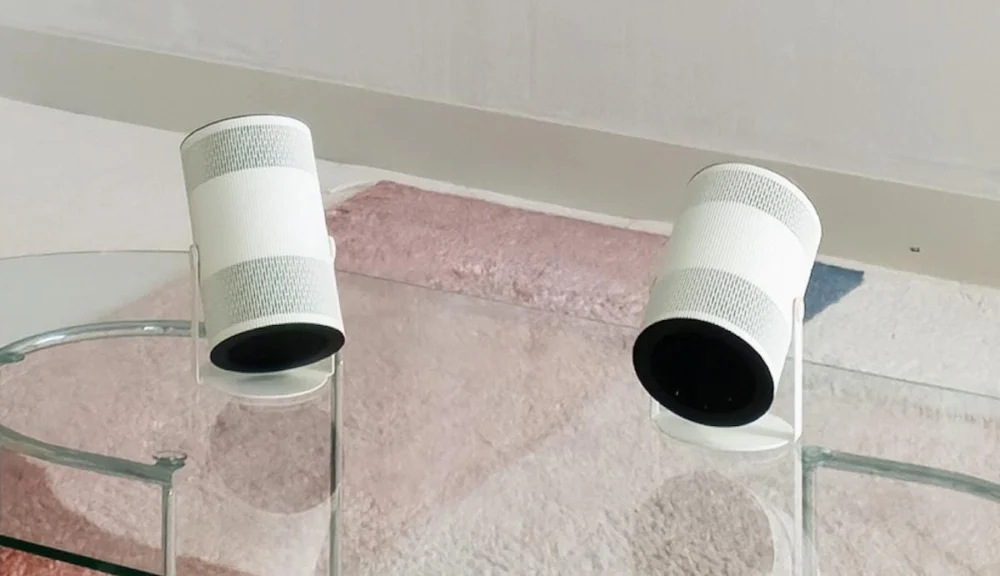
The landscape of home entertainment has undergone a radical transformation over the last decade, shifting from the rigid, stationary monolith of the living room television to a more fluid, "screen-everywhere" philosophy. Leading this charge in the lifestyle segment has been Samsung, whose foray into ultra-portable projection began as a bold experiment in 2022. As the industry prepares for the technological showcases of 2026, Samsung has signaled its next major move with the unveiling of The Freestyle+. While the device retains the iconic aesthetic of its predecessors, it represents a profound leap forward in optical performance and, more significantly, the integration of generative and vision-based artificial intelligence to solve the age-old frustrations of mobile projection.
The Evolution of the Lifestyle Projector
To understand the significance of The Freestyle+, one must first look at the trajectory of the portable projector market. For years, "pico" projectors were relegated to the status of novelties—dim, difficult to focus, and plagued by poor color accuracy. Samsung’s original Freestyle disrupted this category by prioritizing ease of use and design, offering a cylindrical chassis that could rotate 180 degrees. However, even with its success, power users noted that the brightness and the manual nature of complex setups remained hurdles for true cinematic immersion.
The Freestyle+ addresses these legacy concerns head-on. By maintaining the hardware’s physical footprint—a compact, barrel-shaped unit mounted on a versatile cradle—Samsung honors a design language that has resonated with "digital nomads" and Gen Z consumers alike. The stability of the external design belies the radical overhaul occurring within the optics and the processing engine.
A New Standard in Luminance: The 430 ISO Lumen Threshold
The most immediate hardware upgrade in The Freestyle+ is its light output. Rated at 430 ISO Lumens, the new model offers nearly double the brightness of the previous generation. In the world of projection, brightness is the primary currency of quality. A higher lumen count does not merely mean a "brighter" picture; it translates to better contrast ratios, more vibrant color saturation, and, crucially, the ability to maintain image integrity in environments with ambient light.

For the user, this means The Freestyle+ is no longer restricted to pitch-black bedrooms. It can now reasonably compete with the soft glow of a sunset during an outdoor movie night or the overhead lighting of a studio apartment. Furthermore, the increased light output allows for a larger "throw" without the image becoming washed out. While previous iterations were comfortably viewed at 60 to 80 inches, the Freestyle+ can push toward a 100-inch canvas while maintaining the punchiness required for high-definition content.
AI OptiScreen: Eliminating the Friction of Setup
The centerpiece of Samsung’s 2026 announcement is undoubtedly AI OptiScreen. While "auto-keystone" has been a marketing buzzword for several years, it has often been a hit-or-miss feature that required significant manual fine-tuning. Samsung’s new suite of AI-driven tools aims to make the setup process entirely invisible to the user.
1. 3D Auto Keystone and Geometric Mastery
Traditional keystone correction handles the vertical and horizontal tilt of a projector. However, real-world surfaces are rarely perfect. The Freestyle+ introduces 3D Auto Keystone, which uses computer vision to map the topology of the projection surface. Samsung claims the device can now project into the corner of a room—where the image spans two different walls and a ceiling—and still render a perfectly rectangular, flat-looking image. By calculating the depth and angles of the environment in three dimensions, the AI reshapes the output pixels to compensate for extreme geometric distortions that would have rendered earlier projectors useless.
2. The Challenge of Non-Flat Surfaces
Perhaps the most impressive claim regarding the AI OptiScreen system is its ability to handle "soft" surfaces. In portable scenarios, users often project onto bedsheets, curtains, or makeshift screens that may have folds, ruffles, or wrinkles. The 3D Auto Keystone system analyzes these micro-fluctuations in the surface texture and applies real-time digital compensation. This ensures that a movie playing on a draped curtain appears as stable and linear as if it were on a rigid glass panel.
3. Real-Time Focus and Screen Fit
Focus drift is a common issue with portable projectors as they heat up or are slightly nudged. The Real-Time Focus tool in The Freestyle+ utilizes a continuous feedback loop to ensure the image remains razor-sharp, regardless of whether the unit is being rotated during operation. Complementing this is the Screen Fit feature, which recognizes the black borders of professional projection screens and automatically snaps the image to fill the exact dimensions of the "business area," eliminating the distracting light bleed often seen in manual setups.

4. Intelligent Wall Calibration
One of the persistent "killers" of projection quality is the color of the wall. Most consumers do not have dedicated white screens; they have beige, grey, or even patterned wallpaper. The AI OptiScreen’s Wall Calibration feature uses the projector’s sensors to "read" the color and pattern of the background. It then dynamically adjusts the white balance and color gamut of the video output to neutralize the wall’s tint. The result is an image that looks color-accurate regardless of the substrate it is projected upon.
The Vision AI Companion: A New Era of Interaction
Beyond the optical improvements, Samsung is leveraging its broader ecosystem through the Vision AI Companion. This platform represents the next stage of Bixby’s evolution, moving away from simple voice commands toward a more sophisticated, conversational interface. By integrating with global AI service partners, the Freestyle+ can act as a personalized content curator.
Instead of scrolling through endless tiles on Netflix or Disney+, a user can engage in a natural dialogue: "Find me a sci-fi movie from the 90s that feels like a summer vacation." The AI doesn’t just search metadata; it understands context and sentiment. This integration is vital in an era of "choice paralysis," where the time spent looking for content often exceeds the time spent watching it.
Gaming and Ecosystem Synergy
The Freestyle+ remains a formidable hub for the modern gamer. By including the Samsung Gaming Hub, the projector provides native access to cloud gaming services like Xbox Cloud Gaming and NVIDIA GeForce NOW. When paired with the increased brightness and AI-optimized focus, the Freestyle+ becomes a portable 100-inch gaming monitor that requires no console—only a Bluetooth controller and a stable internet connection.
Audio, often the Achilles’ heel of small projectors, is addressed via the integrated 360-degree speaker system. While the internal hardware provides an immersive soundstage for its size, the inclusion of Q-Symphony technology allows the projector to sync with Samsung soundbars. In this configuration, the projector’s speakers and the soundbar work in unison rather than the soundbar simply replacing the projector’s audio. This creates a more vertical and expansive sound field, which is particularly effective when the projector is tilted upward to display content on a ceiling.

Market Implications and Future Trends
The launch of The Freestyle+ comes at a time when the "traditional" TV market is reaching a saturation point. Consumers, particularly those in urban environments with limited space, are increasingly looking for hardware that can be tucked away when not in use. Samsung’s investment in AI setup features is a direct response to the "friction" that prevents projectors from becoming mainstream TV replacements.
By removing the need for technical knowledge—the "set it and forget it" promise—Samsung is positioning The Freestyle+ as a lifestyle appliance rather than a piece of AV equipment. We are seeing a trend where the intelligence of the device is becoming more important than the raw resolution. While 4K is standard in the living room, in the portable space, the ability of a 1080p image to look perfect on a wrinkled curtain is a far more valuable feature for the average user.
Conclusion: The Road to CES 2026
As Samsung prepares for a phased global rollout in the first half of 2026, the industry will be watching closely to see how competitors like LG, Anker, and XGIMI respond to this AI-heavy approach. The Freestyle+ is more than just a brighter light source; it is a manifesto on the future of displays. It suggests a world where our digital content is no longer trapped behind a glass rectangle but can be draped over our physical environment with the help of sophisticated machine learning.
While the final retail pricing remains under wraps, the value proposition is clear: Samsung is selling the freedom to turn any surface into a high-quality theater with zero effort. In the high-stakes world of consumer electronics, the brand that makes technology invisible usually wins. With its 3D mapping and real-time environmental compensation, The Freestyle+ may be the closest we have come to that ideal.