

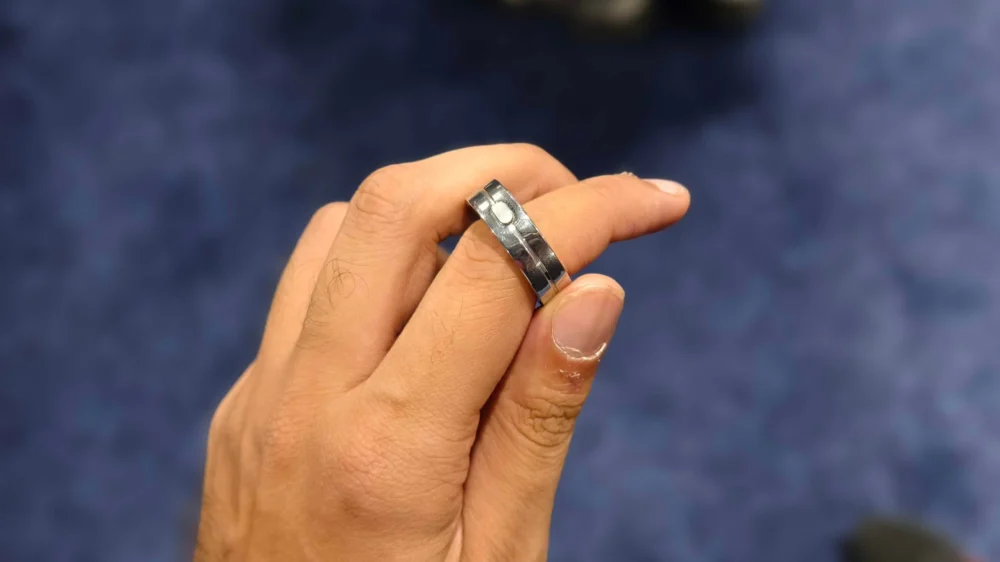
The smart ring market, long dominated by a singular focus on the quantification of the human body, is witnessing a radical philosophical shift. Since the inception of the category, manufacturers have engaged in an escalating arms race of biometric sensors, packing photoplethysmography (PPG) arrays, skin temperature sensors, and accelerometers into ever-slimmer bands of titanium and ceramic. However, as the novelty of sleep scores and heart-rate variability begins to plateau for the average consumer, a new contender has emerged at CES 2026 to challenge the status quo. The Vocci AI Ring represents a departure from the "wellness-first" wearable paradigm, opting instead to utilize the finger-worn form factor as a gateway for ambient intelligence and professional productivity.
By intentionally omitting the health-tracking suite that defines competitors like the Oura Ring or the Samsung Galaxy Ring, Vocci is betting on a future where wearables are judged not by how much they tell us about our bodies, but by how much they assist us in our intellectual and professional lives. This is a device designed for the "information worker"—a tool that prioritizes the capture of ideas and the synthesis of conversations over the counting of steps or the monitoring of REM cycles.
The Architecture of Minimalist Utility
At first glance, the Vocci AI Ring adheres to the sleek, understated aesthetic expected of modern high-end wearables. Yet, its internal architecture is fundamentally different. Weighing between a featherlight 3 to 5 grams depending on the size—with a comprehensive range spanning sizes 6 through 15—the ring is designed for 24/7 comfort. Its 2.8mm thickness makes it one of the most unobtrusive smart rings on the market, rivaling traditional wedding bands in its profile.
Constructed from a high-grade metal alloy, the device carries an IPX4 water-resistance rating. While this means it is not suitable for deep-sea diving or prolonged submersion in a swimming pool, it is more than capable of surviving the rigors of daily life, including hand washing and the occasional rainstorm. The design philosophy here is clear: the ring should be a permanent fixture on the hand, invisible until it is needed.
The interface is refreshingly tactile in an era of finicky touch surfaces. A single, discrete button serves as the primary point of interaction. This physical trigger is a deliberate choice, allowing users to activate the device’s core functions without the "attention tax" of looking at a smartphone screen or navigating a complex app menu. A double-press initiates a high-fidelity voice recording, while a single press during a session acts as a digital "highlighter," marking specific moments for the AI to prioritize during its post-processing phase.
The Engine of Insights: LLMs and ASR
The true power of the Vocci AI Ring lies not in its hardware, but in the sophisticated software stack that processes the captured audio. The device leverages a combination of Automated Speech Recognition (ASR) and Large Language Models (LLM) to transform raw audio into actionable data. This is what Vocci refers to as its "in-context AI insights engine."

Unlike traditional voice recorders that merely store files, the Vocci system is designed to understand the nuance of human interaction. It supports over 112 languages, making it a truly global tool for international business, academia, and journalism. The AI-enhanced audio algorithm is optimized for a 5-meter effective pickup range, a feat of engineering considering the diminutive size of the microphones that can fit within a 2.8mm chassis.
In practice, this allows the ring to capture clear audio in varied environments, from intimate one-on-one coffee shop interviews to larger boardroom presentations. Perhaps most impressively, the system features automatic speaker detection, allowing the resulting transcripts to be neatly categorized by participant—a feature traditionally reserved for high-end desktop transcription software.
Privacy and the Ethics of Ambient Capture
In 2026, the conversation around AI is inextricably linked to data privacy. A device that is essentially a "hot mic" on a finger could easily raise ethical eyebrows. Vocci has addressed these concerns by implementing a local encryption protocol. The company claims that all conversations are encrypted at the source, ensuring that the raw audio remains secure.
Furthermore, the device’s operational logic is built around user-initiated recording rather than "always-on" listening. By requiring a physical double-press to begin a session, Vocci provides a clear boundary for consent and intentionality. This distinction is vital for professionals in legal, medical, or journalistic fields who must adhere to strict confidentiality and ethical standards regarding the recording of private conversations.
Workflow Integration for the Modern Professional
For the journalist, the researcher, or the executive, the Vocci AI Ring addresses a specific pain point: the friction of documentation. While smartphones have long had recording apps, the act of pulling out a phone, unlocking it, and finding an app creates a psychological barrier and a social interruption. The ring allows for a more natural, "heads-up" interaction.
The "single-press highlight" feature is particularly transformative. During an hour-long interview or a complex lecture, the user can mark key quotes or critical insights in real-time. When the recording is later synced to the companion app, the AI engine uses these markers to generate summaries that focus specifically on those highlighted sections, drastically reducing the time required for manual review.
The device offers up to 8 hours of continuous recording on a single charge—more than enough for a full day of meetings or a conference. The accompanying portable charging case, which mirrors the design language of high-end earbud cases, provides three additional full recharges. For those in a rush, a quick-charge feature brings the ring back to life in just 30 minutes, ensuring that the tool is rarely out of commission.

Industry Implications: The End of the "Swiss Army Knife" Wearable?
The debut of the Vocci AI Ring signals a potential bifurcation in the wearable market. For years, the trend has been toward the "everything device"—watches and rings that attempt to be a doctor, a personal trainer, a notification hub, and a payment terminal all at once. Vocci is making a compelling case for the "specialized wearable."
By stripping away the heart rate sensors and the vibrating motors for notifications, Vocci is attempting to reduce the "mental load" associated with modern technology. There are no buzzing alerts to distract the wearer, no "stand up" reminders, and no gamified step goals. It is a tool that exists solely to serve the user’s cognitive output.
This pivot reflects a broader movement toward digital minimalism. As consumers become increasingly wary of "notification fatigue," there is a growing appetite for devices that do one thing exceptionally well. In this context, the Vocci ring isn’t just a voice recorder; it is a statement against the attention economy.
Future Impact and the Path to Ambient Intelligence
Looking ahead, the success of the Vocci AI Ring could pave the way for a new category of "input-only" wearables. As AI models become more adept at understanding context and intent, the need for screens on our bodies may diminish. We are moving toward an era of ambient computing, where the environment—and the objects we wear—respond to our voice and gestures in a seamless, invisible flow.
The Vocci AI Ring is a precursor to this future. It envisions a world where our thoughts and conversations are captured and organized by a silent partner on our finger, allowing us to remain present in the moment rather than tethered to a screen. Whether this specific device becomes a mass-market hit or remains a niche tool for professionals, it has successfully shifted the conversation. It has proven that a smart ring doesn’t need to know your pulse to be the most valuable piece of technology you own; it just needs to listen to what you have to say.
In the final analysis, the Vocci AI Ring is a bold experiment in functional design. It challenges the assumption that more sensors equal more value. By focusing on the high-value problem of information capture and synthesis, Vocci has created a wearable that feels less like a gadget and more like an extension of the mind. In the crowded halls of CES 2026, it stands out not for what it adds to the wearable experience, but for what it has the courage to leave out.