

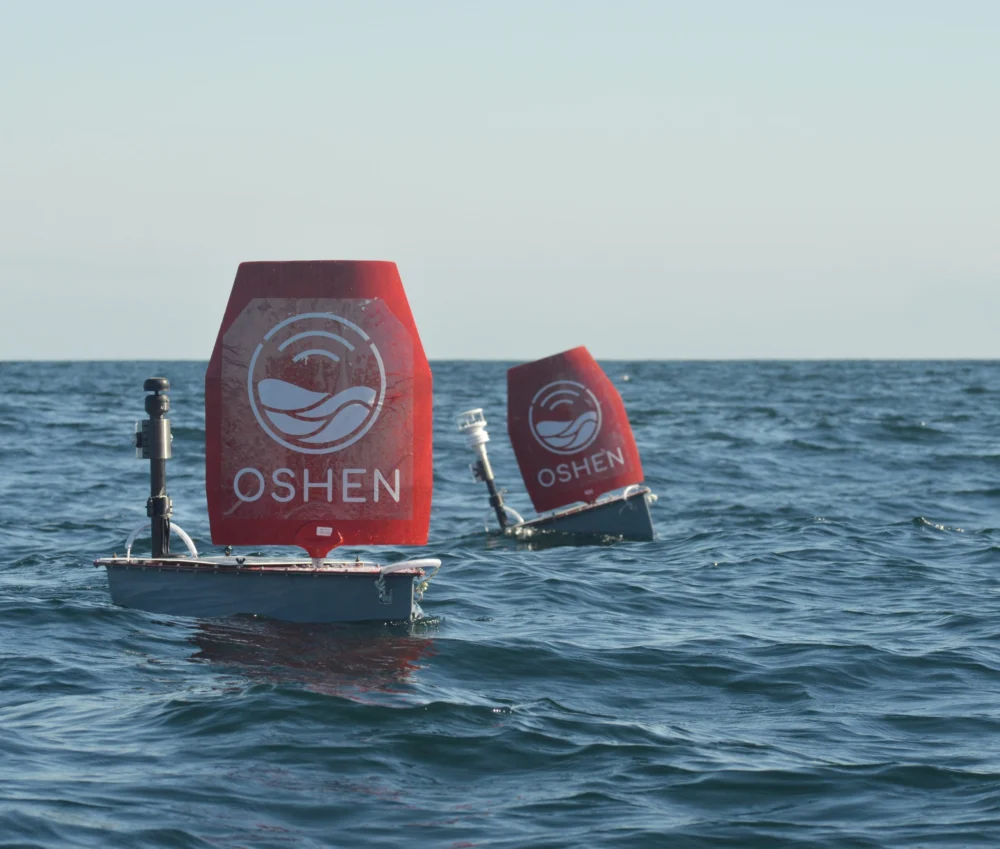
The successful collection of real-time meteorological and oceanographic data from within the eyewall of a Category 5 hurricane represents a monumental validation for the nascent field of miniaturized autonomous marine robotics. This unprecedented achievement was spearheaded by Oshen, a UK-based marine technology startup whose innovative fleet of micro-robots, known as C-Stars, proved capable of enduring the most violent forces nature can unleash. The mission, undertaken in collaboration with the National Oceanic and Atmospheric Administration (NOAA) during the 2025 Atlantic season, confirmed that these low-cost, disposable platforms can operate reliably in conditions where human-crewed vessels and traditional monitoring equipment cannot survive or are too expensive to risk.
Oshen’s genesis is rooted not in traditional marine science, but in a frustrated attempt at transatlantic autonomy. Founder Anahita Laverack, initially focused on an aerospace engineering trajectory, shifted focus following her participation in the notoriously difficult Microtransat Challenge in 2021. This competition mandates the creation of autonomous, sail-powered micro-robots capable of crossing the Atlantic Ocean unassisted. Like every previous participant, Laverack’s attempt ended in failure, but it yielded a profound insight that catalyzed her entrepreneurial pivot. She observed that the high failure rate wasn’t solely due to the mechanical difficulty of building small vessels that could withstand continuous abuse from the open sea; critically, these micro-robots lacked the fundamental environmental intelligence required for self-preservation. They were operating blind, unable to accurately predict or navigate around localized severe weather events because the necessary, high-resolution ocean data simply did not exist.
The realization illuminated a critical gap in global oceanographic capabilities. While satellite imagery provides broad surface data, and large research vessels offer detailed but spatially limited subsurface profiles, the vast majority of the world’s oceans—especially dynamic, high-energy zones—remain severely under-sampled. Laverack’s subsequent investigations at global marine technology forums, such as Oceanology International, confirmed this suspicion. She found not a wealth of existing solutions, but a chorus of urgent requests from researchers and government bodies willing to finance any viable method of filling this data void. This market signal was the foundation upon which Oshen was built, co-founded in April 2022 with electrical engineer Ciaran Dowds.
Oshen was founded on the principle of distributed, persistent sensing. Their flagship product, the C-Star micro-robot, is designed for mass deployment, capable of operating autonomously for periods exceeding 100 days. These systems are typically deployed in coordinated swarms, providing simultaneous, spatially diverse data sets that far surpass the capacity of single, high-value assets. The engineering philosophy centered on solving a trifecta of design challenges that had historically plagued marine robotics: affordability, scalability, and long-term durability. Laverack noted that previous industry efforts often achieved two of these three metrics—they could build durable, expensive robots, or cheap, fragile ones. Oshen’s breakthrough lay in marrying affordability and mass production with a level of resilience previously reserved for highly specialized, costly platforms.
The company’s early bootstrapping phase underscores the commitment to practical, real-world validation. Eschewing immediate venture capital, Laverack and Dowds pooled personal savings, purchased a modest 25-foot sailboat, and established a testing base at one of the most economical marinas in the United Kingdom. This vessel served as their constant laboratory. For two years, the development cycle was brutally efficient: design iterations were immediately followed by deployment in the volatile, unforgiving coastal waters of the UK. This meant continuous testing not just in calm summer seas, but critically, throughout the brutal North Atlantic winter storms.
This rigorous, high-stakes testing environment was instrumental in hardening the C-Star design. As Laverack recounted, the winter months exposed the robots to conditions that often exceeded the safety limits of their 25-foot test platform. The ability of the C-Stars to survive and function under continuous gale-force winds and high seas—even if occasionally recovered with "a few missing parts"—provided the empirical proof of concept needed for high-stakes governmental contracts. It was this demonstrable resilience in punishing UK winter weather that ultimately convinced NOAA, which had initially expressed interest two years prior but deemed the technology insufficiently proven, to greenlight a critical operational deployment.
The Categorical Shift in Ocean Monitoring
The true test arrived just two months before the 2025 hurricane season, when NOAA, recognizing Oshen’s validated robustness, commissioned the deployment of 15 C-Stars into the Atlantic. The mission was focused on Hurricane Humberto, a storm rapidly intensifying toward the U.S. Virgin Islands. Five C-Stars were strategically deployed in the predicted path of the storm. While the initial expectation was merely to gather crucial pre-storm and early-stage intensification data, three of the micro-robots defied all conventional engineering expectations. They successfully navigated and collected continuous data streams throughout the entire passage of the system as it developed into a Category 5 hurricane.
This event was a technological watershed. A Category 5 hurricane generates sustained winds exceeding 157 miles per hour, capable of producing wave heights often surpassing 50 feet. Traditional research buoys (often large, moored systems) are frequently ripped from their moorings or simply destroyed by the shear forces in such extreme environments. Uncrewed Surface Vessels (USVs) currently deployed for research are generally larger, higher-value assets that are strategically pulled out of harm’s way before reaching Cat 3 intensity. The C-Stars, by contrast, are small enough, and their design robust enough, to operate effectively in the chaotic, energy-dense environment of the storm’s core.
The data collected by these three surviving robots is invaluable. Within the context of numerical weather prediction (NWP), the accuracy of long-range forecasts is critically dependent on the quality of initial conditions fed into the computational models. Hurricanes are notoriously difficult to predict because the rapid intensification phase—often driven by complex air-sea interactions, including the exchange of heat and moisture at the ocean surface—occurs in zones where monitoring is minimal. Data on sea surface temperature (SST), subsurface heat content, barometric pressure gradients, and wave kinematics, captured directly within the storm’s environment, provides meteorologists with unprecedented clarity. This granular input dramatically improves the initialization parameters for complex atmospheric models, potentially enhancing lead times for evacuation orders and refining landfall projections.
Industry Implications and the Data Deficit
The success of Oshen’s distributed sensing architecture signals a major paradigm shift in oceanographic data collection, moving away from expensive, singular assets toward affordable, resilient swarms. Historically, ocean monitoring has been dominated by multi-million-dollar research vessels, static deep-sea moorings, and the Argo float program (profiling floats that drift globally). While effective, these systems are constrained by operational costs, logistical complexities, and geographic limitations.
The C-Star model fundamentally disrupts this cost structure. By making each unit disposable or highly recoverable, and utilizing small form factors for ease of deployment (often via aircraft or vessels of opportunity), Oshen dramatically reduces the marginal cost of acquiring high-fidelity data in hazardous or remote areas.
This disruption has profound implications across multiple sectors.
1. Climate Modeling and Ocean Health: The ocean absorbs over 90% of the excess heat trapped by greenhouse gases. Understanding how this heat is distributed vertically and horizontally is crucial for predicting long-term climate change trajectories. Swarms of C-Stars can provide the spatial density of measurements needed to map ocean currents, heat transport, and deep-water formation processes with resolution previously unattainable outside of dedicated, short-term research cruises.
2. Naval and Defense Operations: Government entities, including the UK government (which is already contracting with Oshen), require real-time, accurate environmental intelligence for maritime domain awareness (MDA). Ocean conditions—including water column temperature and salinity profiles—are critical factors for sonar performance, acoustic prediction, and naval strategy. Deployable swarms offer a covert, flexible, and persistent method for environmental reconnaissance in contested or critical zones.
3. Commercial Maritime Efficiency: Accurate, real-time weather and current data minimizes transit times and optimizes fuel consumption for global shipping fleets. By providing superior forecasting, autonomous data collection directly translates into economic savings and reduced carbon emissions for the multi-trillion-dollar logistics industry.
Expert Analysis: The Engineering of Survival
The ability of a micro-robot to survive a Category 5 hurricane is not merely luck; it is a triumph of advanced marine resilience engineering. Dr. Helena Karras, a leading expert in Autonomous Marine Systems (AMS) architecture, notes that the success hinges on strategic design choices:
"The key is the balance between energy harvesting and hydrodynamic stability," Karras explains. "Larger platforms are designed to ride the waves; they are energy-intensive and have large surface areas susceptible to immense wind loading and capsizing forces. Micro-robots like the C-Stars are designed to be minimally buoyant, often semi-submersible, allowing them to ride under the most violent chop while retaining a surface connection for communication. Their small physical footprint minimizes the sheer force applied by high-velocity winds and breaking waves. Furthermore, the longevity (100+ days) implies exceptional efficiency in power management, likely utilizing advanced materials that resist corrosion and biofouling without requiring complex active cleaning systems."
The challenge of miniaturization also extends to sensor integration. Oshen had to integrate highly accurate, research-grade meteorological and oceanographic sensors into a ruggedized package while maintaining low cost—a technological hurdle known as ‘sensor-to-size-to-cost ratio.’ Their successful deployment suggests they have achieved breakthroughs in solid-state sensing technology and data compression for satellite transmission.
Future Trajectories and Scaling Demand
Following this pivotal validation, Oshen is transitioning rapidly from a nimble, bootstrapped startup to a major player in the marine technology sector. The company has strategically relocated to Plymouth, England, a globally recognized center for marine robotics and hydrography. This move positions them within a robust ecosystem of specialized suppliers, research institutions, and governmental partners.
The demand curve for their technology is steep, driven by both defense and climate monitoring requirements. The company’s immediate future involves a strategic move to secure external venture capital, a necessary step to scale production and deployment capacity to meet escalating contract volumes. Scaling is not simply about manufacturing more C-Stars; it involves developing the necessary infrastructure for managing vast, continuous data streams from potentially hundreds or thousands of active robots simultaneously deployed across different oceanic basins.
The long-term impact of Oshen’s technology will likely be seen in the democratization of ocean data. By providing cheaper, faster, and more geographically diverse data, C-Stars enable smaller nations, academic consortia, and even environmental non-profits to participate actively in ocean monitoring, breaking the traditional reliance on the highly capitalized research fleets of major world powers.
Looking forward, the trend is toward even greater integration and intelligence within these swarms. Future generations of C-Stars will likely incorporate advanced machine learning capabilities for on-board data processing, enabling the robots to make autonomous decisions—such as adjusting sampling density or moving to avoid specific hazards—based on the data they are collecting, minimizing transmission bandwidth and maximizing operational efficiency.
The journey from a failed transatlantic crossing attempt to successfully weathering a Category 5 hurricane encapsulates the relentless innovation driving the autonomous maritime sector. Oshen has not just built a resilient robot; it has laid the groundwork for a truly global, continuous, and high-resolution picture of the world’s oceans, fundamentally improving our ability to predict, prepare for, and ultimately understand the most powerful phenomena on Earth. This miniaturized fleet represents a critical technological leap in securing vital environmental intelligence for the 21st century.