

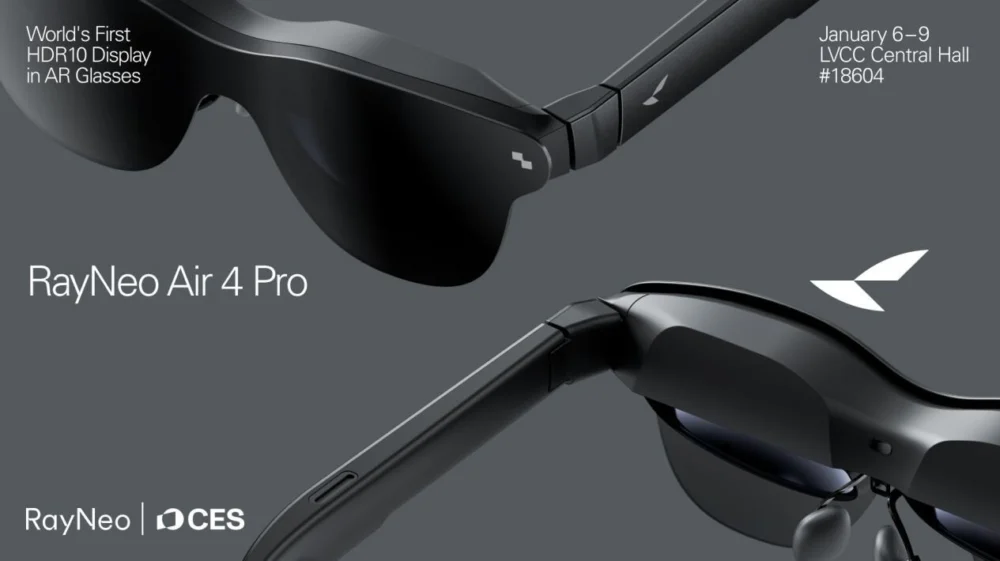
The landscape of consumer augmented reality (AR) wearables is undergoing a significant maturation, moving beyond mere notifications and basic overlay functions toward delivering genuinely immersive visual experiences. This evolution was sharply underscored by the global unveiling of the RayNeo Air 4 Pro smart glasses at CES 2026. While RayNeo has established a consistent presence in the AR eyewear sector, this latest iteration signals a critical pivot toward premium visual performance, highlighted by the introduction of what the company claims is the world’s inaugural High Dynamic Range 10 (HDR10) compatible display integrated into AR glasses. This development is not merely iterative; it represents a foundational shift in how digital content is rendered within a spatial computing context.
The journey of AR wearables has historically been hampered by compromises, primarily relating to display quality, brightness, form factor, and computational power. Early models often struggled with insufficient luminosity for outdoor use or displayed washed-out colors due to the limitations of the waveguide or projection technology employed. RayNeo’s strategy with the Air 4 Pro appears to directly confront these long-standing challenges by prioritizing cinematic-grade color science and contrast, a domain where traditional AR has lagged significantly behind modern mobile and television displays.
At the core of this visual upgrade is the implementation of dual-layer micro-OLED panels, each measuring a compact 0.6 inches. These displays are engineered to achieve an impressive 1,200 nits of peak brightness, a figure crucial for maintaining visual integrity under varying ambient light conditions. Furthermore, the inclusion of a high 120Hz refresh rate ensures fluid motion rendering, essential for reducing perceived latency and combating motion sickness during dynamic viewing or interaction. Perhaps more critically for image quality, the specification sheet notes a 3,840Hz Pulse Width Modulation (PWM) dimming frequency. This high-frequency dimming is vital for maintaining color accuracy and reducing flicker at lower brightness levels, a common pitfall in OLED technology that can strain the user’s eyes over extended periods.
The perceived scale of the visuals generated by these near-eye displays is staggering: RayNeo advertises an immersive experience equivalent to viewing a 201-inch screen positioned six meters away. This metric, while subjective in its direct translation to real-world comfort, underscores the ambition to replace traditional, larger screens with a highly portable, head-mounted solution for media consumption and productivity.
The defining technological leap, however, rests on the HDR10 compliance. HDR10, a non-proprietary standard, allows for greater luminance variation and a broader color gamut than standard dynamic range (SDR) content. For the user, this translates into perceptibly brighter highlights—such as sunlight glinting off water or vibrant on-screen light sources—and substantially deeper, more nuanced shadows, leading to superior perceived contrast and visual depth. This is particularly transformative for video playback, where faithful reproduction of the creator’s intended dynamic range is paramount.
To drive this advanced visual pipeline, RayNeo has incorporated a dedicated processing unit: the Pixelworks-customized Vision 4000 chip. This specialized silicon is the engine room for real-time image manipulation. Its capabilities extend beyond merely displaying native HDR content; the chip performs dynamic upscaling of standard dynamic range (SDR) video streams to approximate HDR characteristics, effectively enhancing legacy content. More interestingly, it features 2D-to-3D conversion capabilities, suggesting a sophisticated approach to spatializing standard media for the stereoscopic nature of AR viewing. The presence of a dedicated image processing unit indicates a commitment to visual fidelity that offloads intensive rendering tasks from the connected host device, a crucial architectural consideration for maintaining battery life and performance on tethered smartphones or laptops.
The integration of high-fidelity audio further solidifies the Air 4 Pro’s positioning as a personal entertainment device. The collaboration with Bang & Olufsen on the acoustic design points to an effort to create a truly holistic sensory experience. The inclusion of four precision-tuned speakers aims to deliver spatialized audio that complements the visual field while maintaining a degree of auditory privacy—a balance difficult to strike in open-ear audio solutions. The sound needs to feel integrated into the virtual environment without excessively disturbing nearby individuals, a persistent requirement for public wearable technology.
In terms of physical design, the Air 4 Pro adheres to the established trend toward lightweight, aesthetically palatable smart glasses, weighing in at a mere 76 grams. This is essential for mitigating neck strain and encouraging prolonged use, which is the ultimate litmus test for any head-mounted display (HMD). Connectivity remains robustly tethered via USB-C, offering broad compatibility across modern smartphones, tablets, laptops, and gaming consoles, ensuring the glasses function effectively as an external, portable monitor for virtually any device supporting display output protocols.
While initial market buzz surrounds the global launch, the pricing structure provides a crucial indicator of RayNeo’s market penetration strategy. Reports suggest a retail price point of $299, with availability slated for late January. If these figures hold true, the RayNeo Air 4 Pro positions itself aggressively in the consumer electronics space. At this price, it undercuts many early-generation AR glasses and positions itself as an affordable alternative to premium virtual reality (VR) headsets, targeting consumers interested in high-quality mobile media viewing without the full immersion penalty of traditional VR.
The decision to launch globally after an initial release in China reflects a measured expansion strategy, allowing the company to refine hardware and software based on initial user feedback before tackling broader international markets.
Beyond the consumer focus of the Air 4 Pro, RayNeo utilized CES 2026 to signal future technological trajectories with the demonstration of a prototype RayNeo X3 Pro variant equipped with integrated eSIM technology. This conceptual device moves beyond the limitations of tethering, suggesting a future where AR glasses operate as fully independent computing platforms capable of streaming and processing data without reliance on a proximal smartphone. Such independence is a prerequisite for truly ubiquitous AR, removing the most significant physical constraint on user mobility and spontaneous use.
Industry Implications and Contextualizing the HDR Shift
The introduction of HDR10 into mainstream consumer AR wearables has significant implications for the entire augmented and mixed reality ecosystem. For years, the industry has focused on Field of View (FoV) and optical clarity. While these remain critical, visual fidelity—color depth, brightness, and contrast—is now becoming the next major battleground.
The consumer electronics market has already standardized HDR (HDR10, HDR10+, Dolby Vision) across televisions, smartphones, and streaming services. Users are now conditioned to expect this level of visual performance. When they shift their viewing habits to a head-worn display, the visual disparity between their high-end phone screen and their AR glasses becomes jarring. RayNeo’s move forces competitors to accelerate their own timelines for adopting advanced color science standards. If AR glasses are to genuinely replace secondary screens—for media, gaming, or productivity—they must meet or exceed the visual quality benchmarks set by those screens.
This development also places pressure on content creators and platform providers. As display hardware improves, the demand for native HDR content optimized for spatial display will increase. Developers creating immersive applications or cinematic experiences for AR platforms will need to leverage the expanded dynamic range capabilities to justify the hardware investment.
Expert Analysis: The Role of the Vision 4000 Chip
The inclusion of the Pixelworks Vision 4000 chip warrants closer technical scrutiny. In AR systems, the processing pipeline is complex: input data (from a host device) must be rapidly translated, processed, and rendered onto the micro-OLED panels with minimal latency. By incorporating a dedicated video enhancement chip, RayNeo is strategically decoupling general operating system processing from display pipeline optimization.
Upscaling SDR content in real-time to leverage HDR capabilities is computationally intensive. The Vision 4000’s ability to perform this without observable lag suggests advanced, low-latency processing algorithms. Furthermore, the 2D-to-3D conversion is a sophisticated application of computational optics and depth estimation, aiming to create a pseudo-stereoscopic experience from standard flat media. While this conversion will never perfectly replicate native 3D content, its success relies heavily on the chip’s ability to accurately infer depth cues and present them consistently across the micro-OLEDs. This specialized silicon positions the Air 4 Pro not just as a passive display, but as an active media processor.
Future Trends: Form Factor and Computational Independence
The Air 4 Pro’s reliance on USB-C tethering positions it firmly in the current generation of consumer AR accessories, where the smartphone or laptop acts as the primary computational brain and battery pack. However, the parallel demonstration of the eSIM-enabled X3 Pro prototype strongly indicates where the industry, and RayNeo specifically, sees the technology heading.
True ubiquity for AR glasses requires computational independence. Devices must integrate miniaturized, powerful processors, long-lasting batteries, and robust wireless connectivity (5G/Wi-Fi 7) directly into the lightweight frame. The challenges here are immense: managing thermal dissipation within a small form factor worn directly against the head, and optimizing power consumption for all-day battery life while running complex spatial operating systems. The X3 Pro prototype serves as a proof of concept that RayNeo is actively investing in solving these architectural hurdles necessary for the next generation of standalone AR devices.
The development path suggests a near-future where high-fidelity displays, like the HDR10 panels in the Air 4 Pro, are seamlessly integrated into standalone hardware. This convergence will transition AR from a niche accessory for early adopters to a viable, daily-use computing platform capable of handling everything from professional collaboration overlays to high-quality entertainment consumption in any environment. The Air 4 Pro represents a significant step in refining the visual experience that will underpin that future platform.