

The trajectory of Apple’s entry into the dedicated smart home display market, a segment long dominated by rivals like Google’s Nest Hub and Amazon’s Echo Show, appears to be charting a more complex and protracted course than initially anticipated. Recent intelligence suggests that the Cupertino giant has once again postponed the commercial debut of its much-discussed device, internally designated as J490. This latest setback is reportedly not rooted in hardware maturation—which sources indicate has been finalized for months—but rather hinges critically on the ongoing development of a significantly upgraded, generative artificial intelligence core for its virtual assistant, Siri.
This continuous deferral underscores a pivotal strategic reality for Apple: in the modern ecosystem, hardware differentiation is increasingly insufficient without commensurate, cutting-edge software intelligence. The company appears unwilling to launch a flagship home interface without the foundational, next-generation conversational AI capabilities that are meant to define its entire future strategy in personalized computing and ambient intelligence. The expected launch window, which had been optimistically placed for the near future, is now reportedly being recalibrated toward the autumn cycle, aligning perhaps with the traditional cadence of major hardware introductions, such as the anticipated iPhone 18 Pro series.
The AI Dependency: Why Siri is the Bottleneck
For years, Siri has been perceived as the technological laggard in the voice assistant landscape, frequently outmaneuvered by the rapid advancements demonstrated by Google Assistant (now leveraging Gemini) and Amazon’s Alexa. Apple’s response to this competitive pressure involves a massive undertaking to rebuild Siri’s underlying architecture, moving it from a primarily command-and-response system to a truly proactive, context-aware, and generative AI partner. The smart display, J490, is not merely an ancillary product; it is positioned as a primary vehicle to showcase this monumental software overhaul.
The implications of delaying the hardware are profound. It signals that the software dependencies—specifically the integration of advanced Large Language Models (LLMs) capable of complex reasoning and deep personalization—are proving more challenging to perfect than anticipated. Apple has historically prioritized user privacy and on-device processing, constraints that inherently complicate the development of powerful, cloud-dependent generative AI features. Successfully navigating these engineering hurdles while maintaining the ecosystem’s signature security profile is proving to be a high-friction process, causing ripple effects across product timelines. Several promised features tied to the assistant have already faced previous postponements, suggesting systemic challenges in realizing their AI roadmap.
Deconstructing the J490 Hardware Vision
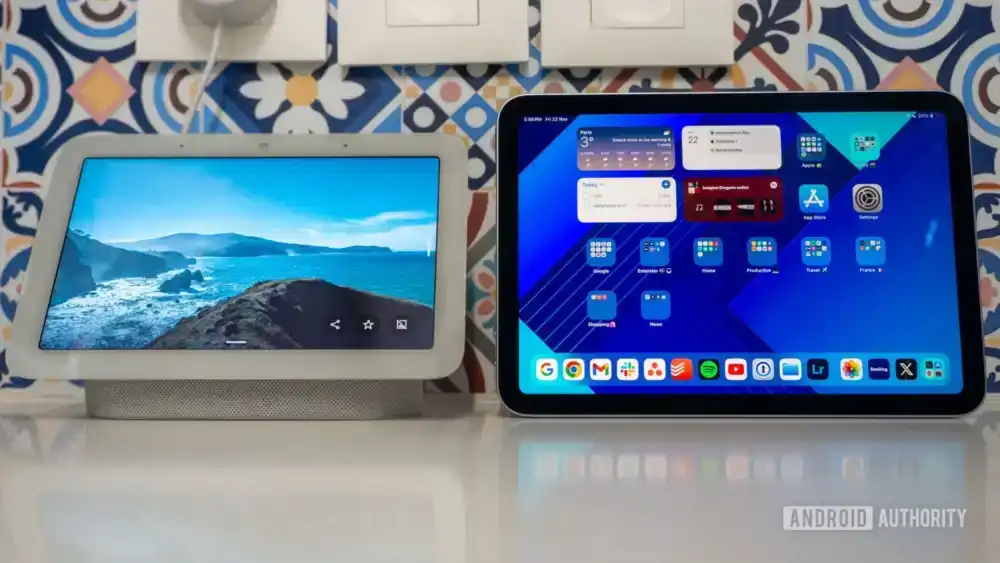
The design specifications leaked for the J490 paint a picture of a device clearly intended to bridge the gap between a dedicated smart display and a portable tablet experience. Described as an iPad-esque form factor, the device features a roughly 7-inch screen, suggesting a size profile competitive with mid-range smart displays but offering a significantly richer visual interface than many current offerings. Crucially, the design appears modular: it can function as a wall-mounted display or connect seamlessly to a half-dome speaker base, transforming it into a high-fidelity audio hub akin to a premium HomePod iteration.
The intelligence embedded within the hardware is equally significant. Reports suggest the inclusion of advanced facial recognition capabilities. This feature moves beyond simple user identification; it is intended to enable deep personalization. Imagine walking into a room and the display automatically surfaces your upcoming calendar entries, preferred music playlists, or relevant news feeds, without requiring explicit voice commands. This level of ambient, context-aware interaction is the holy grail of the modern smart home, moving the device from a passive information kiosk to an active household coordinator.
This hardware architecture suggests a dual mandate: dominating the stationary smart display space while simultaneously serving as a highly intelligent, portable control center for the Apple ecosystem—a blend of the functionality found in the iPad mini and the connectivity of the HomePod.
Industry Implications: The AI Arms Race in the Home
The delay in Apple’s launch has immediate ramifications for the established smart home market leaders. Google and Amazon have invested heavily in their respective ecosystems, treating their smart displays as the central nervous system for their smart home platforms. For Apple, entering this fray late necessitates a superior offering to justify the wait. If J490 launches with truly breakthrough AI functionality—especially regarding on-device processing—it could instantly reset user expectations for what a voice assistant should be capable of, potentially eroding the competitive lead Google and Amazon have built through sheer market presence.
However, the delay provides a temporary reprieve for competitors to refine their own offerings. Google, in particular, is integrating Gemini across its hardware stack. Any perceived gap in Apple’s AI capabilities right now can be exploited by emphasizing the robustness and speed of current-generation AI services available today.
Furthermore, this situation highlights a significant industry trend: the smartphone-centric development cycle is fracturing. Companies are realizing that specialized, ambient devices require specialized, powerful AI that cannot simply be ported from mobile operating systems. The smart home display is evolving from a simple screen attached to a speaker into a dedicated AI endpoint.
Expert Analysis: The Risk of Over-Engineering the Core
From an engineering and product strategy perspective, Apple’s decision to hold the hardware hostage to the software indicates a deeply ingrained corporate philosophy: never ship a product that doesn’t exemplify the best possible user experience, even if it means missing critical market windows. While admirable, this philosophy carries inherent risks in a fast-moving AI landscape.
The technical challenge lies in harmonizing the new generative models with the established HomeKit framework and the existing Siri infrastructure, all while adhering to stringent power consumption and thermal limits within a dedicated home device. The move toward advanced personalization, while compelling, requires significant investment in training and deployment pipelines that must function flawlessly from day one. A buggy or inconsistent AI experience on a high-profile, highly visible device like a smart display could be far more damaging to consumer trust than a similar flaw on a phone.
The tentative September target places the J490 launch squarely alongside the iPhone 18 Pro cycle. This timing is likely intentional, maximizing the marketing impact by debuting the next-generation Siri concurrently across the entire flagship lineup. This "big bang" approach suggests that the new Siri will not be a minor update but a systemic shift in interaction paradigms across all major Apple platforms.
Future Trajectories: Beyond the Display
The smart display is only the vanguard of Apple’s renewed focus on ambient computing and home automation, driven by AI. According to reports, the J490 initiative is intertwined with the development of several other sophisticated hardware concepts designed to leverage this enhanced intelligence.
Most intriguing is the mention of a variant of the display equipped with a robotic arm. This moves the concept firmly into the realm of domestic robotics—a high-risk, high-reward sector. If functional, this device could transition from controlling smart devices to physically interacting with the environment, perhaps handling small organizational tasks or serving as an advanced security monitor with physical reach. Such a product would represent a genuine leap beyond current offerings from Google and Amazon, positioning Apple as the leader in truly automated home assistance.
Additionally, the underlying platform driving the J490—expected to be a specialized iteration of tvOS—will likely cascade improvements into the existing Apple TV hardware, enhancing its own smart home control capabilities and potentially unlocking new avenues for media interaction powered by advanced voice commands. The HomePod line is also slated for updates, suggesting that the entire audio and home hub strategy is being unified under this new AI umbrella.
The significance of the Siri overhaul, therefore, cannot be overstated. It is the keystone for Apple’s entire next-generation hardware strategy outside of its core mobile devices. Until that software foundation is deemed stable and feature-complete, the physical hardware, regardless of its readiness, remains tethered, highlighting a clear strategic hierarchy where software intelligence dictates hardware release cadence. For consumers, the wait for a truly intelligent Apple home interface continues, but the potential payoff, if these ambitious AI goals are met, could redefine the competitive landscape of the smart home for years to come. The September target, if achieved, will be the moment of reckoning for Apple’s AI investment strategy.